Browse · MathNet
PrintAUT_ABooklet_2020
Austria 2020 geometry
Problem
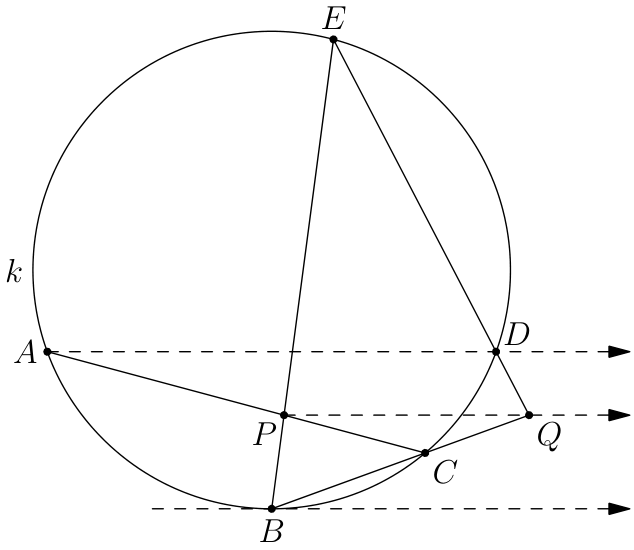
Let be a convex pentagon having a circumcircle and satisfying . The point is the intersection of the diagonals and . The lines and intersect in point . Show that the line is parallel to the diagonal .
Solution
Figure 2: Problem 6
Solution:
We denote the circumcircle of the pentagon by , see Figure 2. By assumption, the triangle is isosceles, which implies that the tangent to in is parallel to .
We apply Pascal's theorem to the inscribed hexagon : The intersection point of the opposite sides and is , the intersection point of the opposite sides and is , and the intersection point of the parallel opposite sides (i.e., ) and is the point at infinity corresponding to direction . Therefore, is parallel to .
Solution:
We denote the circumcircle of the pentagon by , see Figure 2. By assumption, the triangle is isosceles, which implies that the tangent to in is parallel to .
We apply Pascal's theorem to the inscribed hexagon : The intersection point of the opposite sides and is , the intersection point of the opposite sides and is , and the intersection point of the parallel opposite sides (i.e., ) and is the point at infinity corresponding to direction . Therefore, is parallel to .
Techniques
TangentsConcurrency and Collinearity