Browse · MathNet
PrintSelection Examinations for the IMO
Slovenia geometry
Problem
For what positive integers does there exist a convex -gon which can be divided into finitely many parallelograms?
Solution
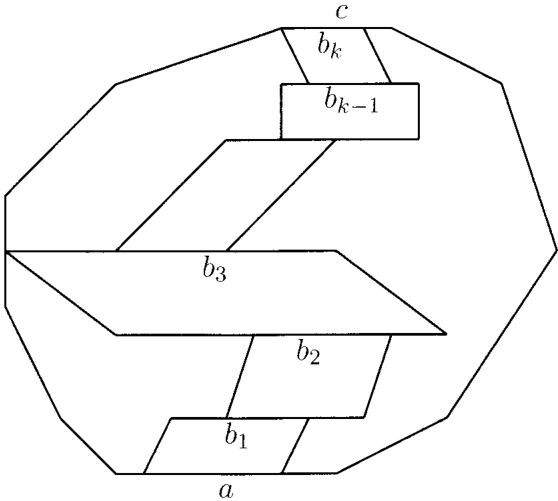
We will show that an -gon with this property exists for even, but not for odd. Assume that a convex -gon can be divided into finitely many parallelograms. Denote one of the sides by . There exists a parallelogram with one side lying on . Denote the opposite side of this parallelogram by . If does not lie on some side of the -gon, then there exists a parallelogram that shares a segment with . Denote the opposite side of this parallelogram by . Repeat. The parallelograms obtained in this way are all distinct. Since there are only finitely many parallelograms altogether, we eventually (after a finite number of steps) get to a side , which lies on some side of the -gon. Since the segments and are parallel for all , is parallel to and is parallel to , we conclude that and are also parallel. Obviously, . We have shown that for each side of our -gon we can find another side parallel to the first. Since the -gon is convex no three of its sides are parallel. Indeed, denote the vertices of the -gon by . Because of the convexity we have (the angles are measured in the positive direction from the first vector to the second). Hence, there is only one number such that . We conclude that the segment is parallel to . This -gon has pairs of parallel sides. In particular, the number of the sides is even, so is even. We have hereby shown that an -gon with the required property does not exist for odd.
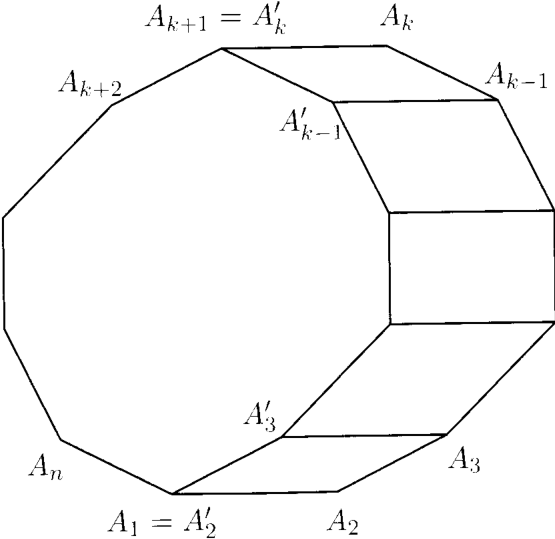
Now, let us prove by induction that for all even every convex -gon consisting of pairs of parallel segments of equal length can be divided into finitely many parallelograms. If , then this 4-gon is a parallelogram and such a splitting exists. Now, assume that we already have the division of an -gon into finitely many parallelograms for some even . Consider a -gon consisting of pairs of parallel segments of equal length. Denote its vertices by . Assume that and are parallel and of equal length. Let be the translation by . Denote for all . We have and . Since is a translation, the quadrilateral is a parallelogram for all . At the same time, is a convex -gon consisting only of pairs of parallel sides of equal length. By the induction hypothesis it can be divided into finitely many parallelograms. Hence, the -gon can also be divided into finitely many parallelograms.
Now, let us prove by induction that for all even every convex -gon consisting of pairs of parallel segments of equal length can be divided into finitely many parallelograms. If , then this 4-gon is a parallelogram and such a splitting exists. Now, assume that we already have the division of an -gon into finitely many parallelograms for some even . Consider a -gon consisting of pairs of parallel segments of equal length. Denote its vertices by . Assume that and are parallel and of equal length. Let be the translation by . Denote for all . We have and . Since is a translation, the quadrilateral is a parallelogram for all . At the same time, is a convex -gon consisting only of pairs of parallel sides of equal length. By the induction hypothesis it can be divided into finitely many parallelograms. Hence, the -gon can also be divided into finitely many parallelograms.
Final answer
n is even
Techniques
TranslationAngle chasing