Browse · MathNet
Print48th International Mathematical Olympiad Vietnam 2007 Shortlisted Problems with Solutions
2007 algebra
Problem
Given a sequence of real numbers. For each () define and let
a. Prove that for arbitrary real numbers ,
b. Show that there exists a sequence of real numbers such that we have equality in (1).
a. Prove that for arbitrary real numbers ,
b. Show that there exists a sequence of real numbers such that we have equality in (1).
Solution
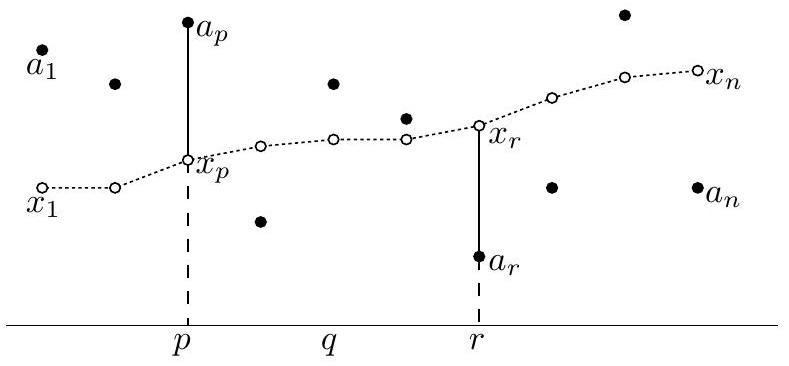
(a) Let be indices for which and thus . (These indices are not necessarily unique.) For arbitrary real numbers , consider just the two quantities and . Since we have either or . Hence,
(b) Define the sequence as We show that we have equality in (1) for this sequence. By the definition, sequence ( ) is non-decreasing and for all . Next we prove that Consider an arbitrary index . Let be the smallest index such that . We have either , or and . In both cases, Since equality (3) implies We obtained that for all , so We have equality because .
---
Alternative solution.
We present another construction of a sequence ( ) for part (b). For each , let For all , we have and Therefore sequences ( ) and ( ) are non-decreasing. Moreover, since is listed in both definitions, To achieve equality in (1), set Since sequences ( ) and ( ) are non-decreasing, this sequence is non-decreasing as well. From we obtain that Therefore Since the opposite inequality has been proved in part (a), we must have equality.
(b) Define the sequence as We show that we have equality in (1) for this sequence. By the definition, sequence ( ) is non-decreasing and for all . Next we prove that Consider an arbitrary index . Let be the smallest index such that . We have either , or and . In both cases, Since equality (3) implies We obtained that for all , so We have equality because .
---
Alternative solution.
We present another construction of a sequence ( ) for part (b). For each , let For all , we have and Therefore sequences ( ) and ( ) are non-decreasing. Moreover, since is listed in both definitions, To achieve equality in (1), set Since sequences ( ) and ( ) are non-decreasing, this sequence is non-decreasing as well. From we obtain that Therefore Since the opposite inequality has been proved in part (a), we must have equality.
Techniques
Combinatorial optimizationRecurrence relations