Browse · MathNet
Print19-th Macedonian Mathematical Olympiad
North Macedonia geometry
Problem
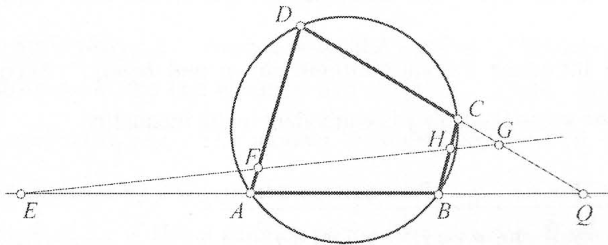
A fixed circle is given, together with three collinear points , and such that and lie outside the circle and lies inside the circle. Prove that if is an arbitrary quadrangle, inscribed in the circle such that the extensions of the sides , and pass through , and respectively, then its side passes through a fixed point, collinear with , and , which doesn't depend on the quadrangle .
Solution
Let be such a quadrangle. Notice that, according to the conditions of the exercise, the line intersects the side in a point inside of . Let us denote that point by . We will consider two cases:
Case 1: The lines and are not parallel.
Let them intersect at point . By Menelaus's theorem for the triangle and the line and we have If we multiply the last two equalities and use that , since that is the degree of point with respect to circle , we get or Notice that and are the degrees of points and with respect to circle respectively and that they do not depend on the choice of the quadrangle . It is clear that and do not depend on the choice of the quadrangle .
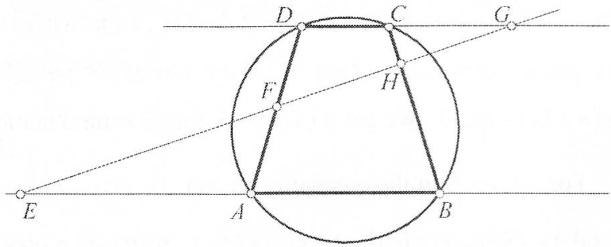
Case 2: The lines and are parallel. It is clear that and . From the similarity, we have If we multiply the last two equalities, we get or which is actually the same as in the first case. We conclude that the side intersects the line in a point for which (1) (which is the same as (2)) holds. Since and lie outside the circle and lies inside the circle and the extensions of sides , and pass through , and respectively, if is an arbitrary quadrangle which satisfies the condition of the exercise, the point which is obtained as the intersection of the line with the side must lie between and . From this and from (1) (analogously, (2)) follows that the point is unique, i.e., it doesn't depend on the choice of the quadrangle .
Case 1: The lines and are not parallel.
Let them intersect at point . By Menelaus's theorem for the triangle and the line and we have If we multiply the last two equalities and use that , since that is the degree of point with respect to circle , we get or Notice that and are the degrees of points and with respect to circle respectively and that they do not depend on the choice of the quadrangle . It is clear that and do not depend on the choice of the quadrangle .
Case 2: The lines and are parallel. It is clear that and . From the similarity, we have If we multiply the last two equalities, we get or which is actually the same as in the first case. We conclude that the side intersects the line in a point for which (1) (which is the same as (2)) holds. Since and lie outside the circle and lies inside the circle and the extensions of sides , and pass through , and respectively, if is an arbitrary quadrangle which satisfies the condition of the exercise, the point which is obtained as the intersection of the line with the side must lie between and . From this and from (1) (analogously, (2)) follows that the point is unique, i.e., it doesn't depend on the choice of the quadrangle .
Techniques
Cyclic quadrilateralsMenelaus' theoremRadical axis theorem