Browse · MathNet
PrintBMO 2017
2017 geometry
Problem
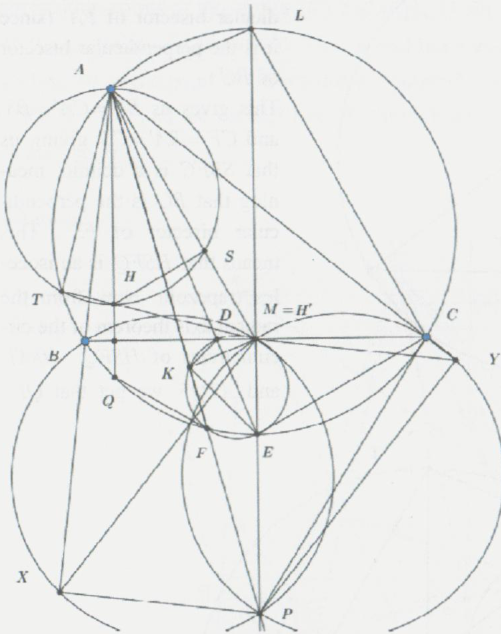
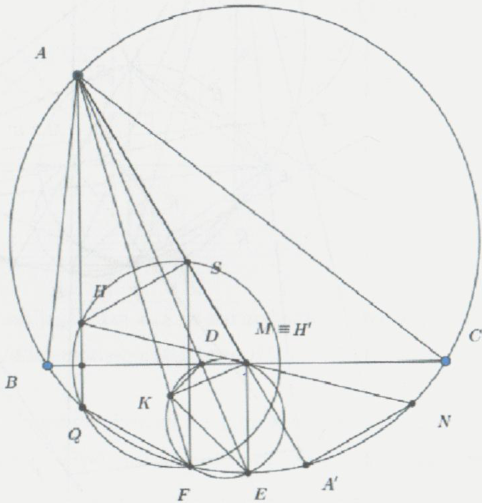
Let be an acute triangle with and circumcircle . The angle bisector of intersects and at and respectively. Circle with diameter intersects again at . Point is on such that and and are feet of perpendiculars from to and respectively. Let and be the ortocenters of and respectively. meets again at . If and intersect the circle with diameter again at points and , respectively, prove that the lines , and are concurrent.
Solution
WLOG, assume . Let be the midpoint of side and let the circumcircle of intersect again at . Since it follows that Because and we get from which it follows that is the perpendicular bisector of and here we get It is obvious that is the intersection of and . Let intersect again at . From the angle bisector theorem in triangle we get ( is the external angle bisector of since is the diameter of ). Now we prove that and are angle bisectors of . Let be the point on such that . From the angle bisector theorem we get Multiplying (1) and (2) we get adding 1 on both sides we get from which it follows that and thus and are the bisectors of . Now we have
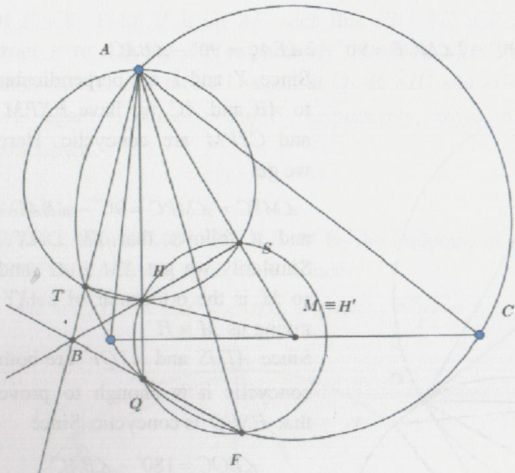
Since and are perpendicular to and we have and are concyclic. Here we get and it follows that . Similarly we get and so is the ortocenter of giving us . Since and are both concyclic it is enough to prove that is concyclic. Since and it follows that is the perpendicular bisector of . It is enough to prove that is the perpendicular bisector of . Let and meet again at points and respectively. Since passes through the midpoint of side and it follows that is a parallelogram. From here we get that giving us and similarly . This means is the diameter of , so and from here we have . Now since and is the midpoint of (because is a parallelogram) we get
that is a paralelogram. Since HS, AT are concurrent. we get that is an isosceles trapezoid which means that is the perpendicular bisector of (since it is the perpendicular bisector of ). This gives us and giving us that is a deltoid, meaning that is the perpendicular bisector of . This means that is an isosceles trapezoid. Now from the radical axis theorem of the circumcircles of , and we get that ,
Since and are perpendicular to and we have and are concyclic. Here we get and it follows that . Similarly we get and so is the ortocenter of giving us . Since and are both concyclic it is enough to prove that is concyclic. Since and it follows that is the perpendicular bisector of . It is enough to prove that is the perpendicular bisector of . Let and meet again at points and respectively. Since passes through the midpoint of side and it follows that is a parallelogram. From here we get that giving us and similarly . This means is the diameter of , so and from here we have . Now since and is the midpoint of (because is a parallelogram) we get
that is a paralelogram. Since HS, AT are concurrent. we get that is an isosceles trapezoid which means that is the perpendicular bisector of (since it is the perpendicular bisector of ). This gives us and giving us that is a deltoid, meaning that is the perpendicular bisector of . This means that is an isosceles trapezoid. Now from the radical axis theorem of the circumcircles of , and we get that ,
Techniques
Triangle centers: centroid, incenter, circumcenter, orthocenter, Euler line, nine-point circleRadical axis theoremCoaxal circlesCyclic quadrilateralsAngle chasing