Browse · MathNet
PrintIMO 2019 Shortlisted Problems
2019 geometry
Problem
Let be the set of all lines in the plane and let be a function that assigns to each line a point on . Suppose that for any point , and for any three lines passing through , the points and lie on a circle. Prove that there is a unique point such that for any line passing through .
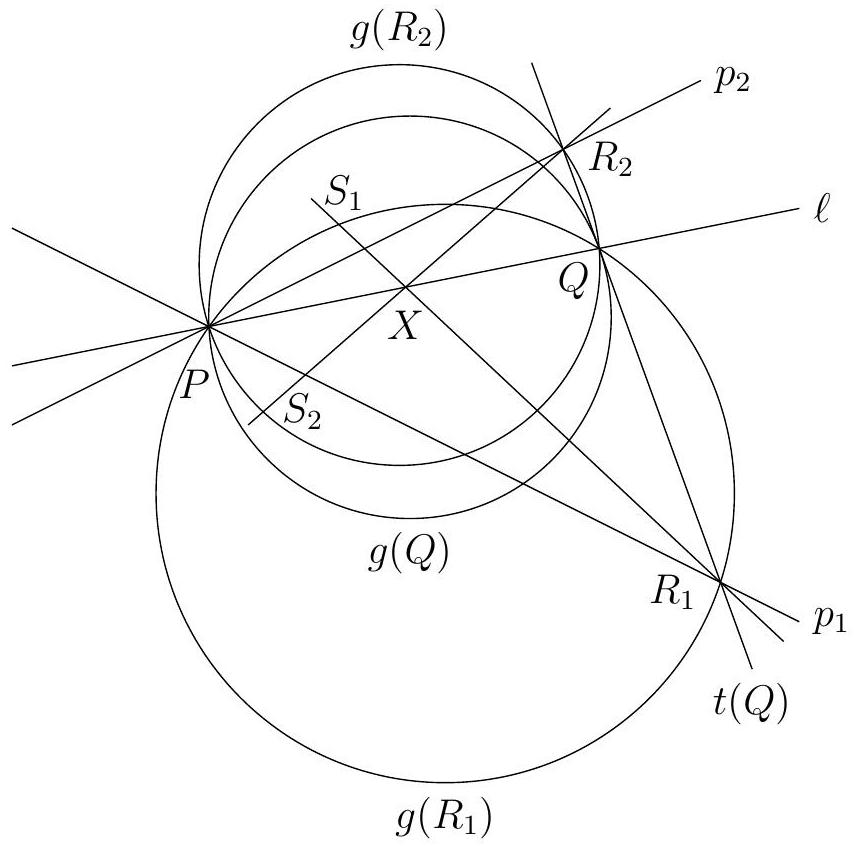
Solution
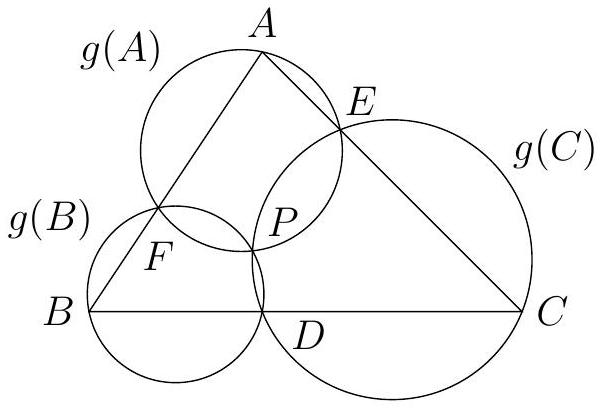
Write for the directed angle modulo between the lines and . Given a point and an angle , for each line , let be the line through satisfying , and let be the intersection point of and . We will prove that there is some pair ( ) such that and are the same function. Then is the unique point in the problem statement. Given an angle and a point , let a line be called -good if . Let a point be called ( )-good if the circle passes through and some point on satisfies . It follows from this definition that if is good then every point of satisfies this angle condition, so for every . Equivalently, for each line passing through . This shows the following lemma. Lemma 1. If is -good and is a line passing through then either or is -good. Lemma 2. If and are different ( )-good points, then line is -good. Proof. If is not -good then by the previous Lemma, and similarly , but clearly this is impossible as . Lemma 3. If and are different ( )-good lines which intersect at , then either or or is -good. Proof. If , then is the circumcircle of and . Since and are -good lines, the angles so lies on . Hence, is -good. Lemma 4. If and are different -good lines which intersect at , then is -good. Proof. This follows from the previous Lemma since at most one of the three lines can satisfy as the three lines are all -good. Lemma 5. If is a triangle such that and are all different points, then there is some point and some angle such that and are -good points and and are ( )-good lines. Proof. Let denote the points , respectively. Then , and are the circumcircles of and , respectively. Let be the second intersection of circles and (or, if these circles are tangent at , then ). By Miquel's theorem (or an easy angle chase), also passes through . Then by the cyclic quadrilaterals, the directed angles for some angle . Hence, lines and are all ( )-good, so by Lemma 3, and are -good. (In the case where , the line in the equation above denotes the line which is tangent to at . Similar definitions are used for and in the cases where or .) Consider the set of all points with integer coordinates , and consider the set of all horizontal, vertical and diagonal lines passing through at least one point in . A simple counting argument shows that there are 5998 lines in . For each line in we colour the point red. Then there are at most 5998 red points. Now we partition the points in into 10000 ten by ten squares. Since there are at most 5998 red points, at least one of these squares contains no red points. Let be the bottom left point in . Then the triangle with vertices and satisfies the condition of Lemma 5, so these three vertices are all ( )-good for some point and angle , as are the lines joining them. From this point on, we will simply call a point or line good if it is -good for this particular pair . Now by Lemma 1, the line is good, as is the line . Then Lemma 3 implies that ( ) is good. By applying these two lemmas repeatedly, we can prove that the line is good, then the points ( ) and ( ) then the lines and , then the points and and so on until we have prove that all points in are good. Now we will use this to prove that every point is good. Since is a circle, it passes through at most two points of on any vertical line, so at most 20 points in total. Moreover, any line through intersects at most 10 points in . Hence, there are at least eight lines through which contain a point in which is not on . Since is not on , the point . Hence, by Lemma 1, the line is good. Hence, at least eight good lines pass through , so by Lemma 4, the point is good. Hence, every point is good, so by Lemma 2, every line is good. In particular, every line passing through is good, and therefore satisfies , as required.
---
Alternative solution.
Note that for any distinct points , the circles and meet on at the point . We write for the second intersection point of circles and . Lemma 1. Suppose that and are not collinear, and that and similarly for and . Then . Proof. The circles and through the vertices of triangle meet pairwise on the corresponding edges (produced). By Miquel's theorem, the second points of intersection of any two of the circles coincide. (See the diagram for Lemma 5 of Solution 1.) Now pick any line and any six different points on . Pick a point not on or any of the circles . Reordering the indices if necessary, we may suppose that do not lie on , so that for . By applying the above lemma to triangles for , we find that the points and are all equal, to point say. Note that either does not lie on , or , since . Now consider an arbitrary point not on or any of the circles for . As above, we see that there are two indices such that and do not lie on . By applying the above lemma to triangle we see that , and in particular passes through . We will now show that for all lines through . By the above note, we may assume that . Consider a variable point not on or any of the circles for . We know that . Since was suitably arbitrary, we have as desired.
---
Alternative solution.
Notice that, for any two different points and , the point lies on both and , so any two such circles meet in at least one point. We refer to two circles as cutting only in the case where they cross, and so meet at exactly two points, thus excluding the cases where they are tangent or are the same circle. Lemma 1. Suppose there is a point such that all circles pass through . Then has the given property. Proof. Consider some line passing through , and suppose that . Consider some with and . Then passes through all of and , but those three points are collinear, a contradiction. Lemma 2. Suppose that, for all , there is a point with of radius at most . Then there is a point with the given property. Proof. Consider a sequence and corresponding points . Because the two circles and meet, the distance between and is at most . As converges, these points converge to some point . For all , the point has distance at most from , and all circles pass through a point with distance at most from , so distance at most from . A circle that passes distance at most from for all must pass through , so by Lemma 1 the point has the given property. Lemma 3. Suppose no two of the circles cut. Then there is a point with the given property. Proof. Consider a circle with centre . The circle must meet without cutting it, so has half the radius of . Repeating this argument, there are circles with arbitrarily small radius and the result follows by Lemma 2. Lemma 4. Suppose there are six different points such that no three are collinear, no four are concyclic, and all the circles cut pairwise at . Then there is a point with the given property. Proof. Consider some line through that does not pass through any of the and is not tangent to any of the . Fix some direction along that line, and let be the point on that has distance from in that direction. In what follows we consider only those for which does not lie on any (this restriction excludes only finitely many possible values of ). Consider the circle . Because no four of the are concyclic, at most three of them lie on this circle, so at least two of them do not. There must be some sequence of such that it is the same two of the for all in that sequence, so now restrict attention to that sequence, and suppose without loss of generality that and do not lie on for any in that sequence. Then is not , so must be the other point of intersection of with , and the same applies with . Now consider the three points and . As , the angle at tends to or , which is not 0 or because no three of the points were collinear. All three distances between those points are bounded above by constant multiples of (in fact, if the triangle is scaled by a factor of , it tends to a fixed triangle). Thus the circumradius of those three points, which is the radius of , is also bounded above by a constant multiple of , and so the result follows by Lemma 2. Lemma 5. Suppose there are two points and such that and cut. Then there is a point with the given property. Proof. Suppose that and cut at and . One of those points, without loss of generality , must be , and so lie on the line . We now consider two cases, according to whether also lies on that line. Case 1: does not lie on that line. In this case, consider a sequence of at distance from , tending to along some line that is not a tangent to either circle, but perturbed slightly (by at most ) to ensure that no three of the points and are collinear and no four are concyclic. Consider the points and , and the circles on which they lie. The point might be either or the other intersection of with the circle , and the same applies for . If, for some sequence of , both those points are the other point of intersection, the same argument as in the proof of Lemma 4 applies to find arbitrarily small circles. Otherwise, we have either infinitely many of those circles passing through , or infinitely many passing through ; without loss of generality, suppose infinitely many through . We now show we can find five points satisfying the conditions of Lemma 4 (together with ). Let be any of the for which passes through . Then repeat the following four times, for . Consider some line (different from those considered for previous ) that is not tangent to any of the for , and is such that , so passes through for all on that line. If there are arbitrarily small circles we are done by Lemma 2, so the radii of such circles must be bounded below. But as , along any line not tangent to , the radius of a circle through and tangent to at tends to 0 . So there must be some such that cuts at rather than being tangent to it there, for all of the previous , and we may also pick it such that no three of the and are collinear and no four are concyclic. Let be this . Now the result follows by Lemma 4. Case 2: does lie on that line. In this case, we follow a similar argument, but the sequence of needs to be slightly different. and both lie on the line , so one must be and the other must be . Consider a sequence of tending to . Rather than tending to along a straight line (with small perturbations), let the sequence be such that all the points are inside the two circles, with the angle between and the tangent to at tending to 0 . Again consider the points and . If, for some sequence of , both those points are the other point of intersection with the respective circles, we see that the angle at tends to the angle between and the tangent to at , which is not 0 or , while the distances tend to 0 (although possibly slower than any multiple of ), so we have arbitrarily small circumradii and the result follows by Lemma 2. Otherwise, we have either infinitely many of the circles passing through , or infinitely many passing through , and the same argument as in the previous case enables us to reduce to Lemma 4.
---
Alternative solution.
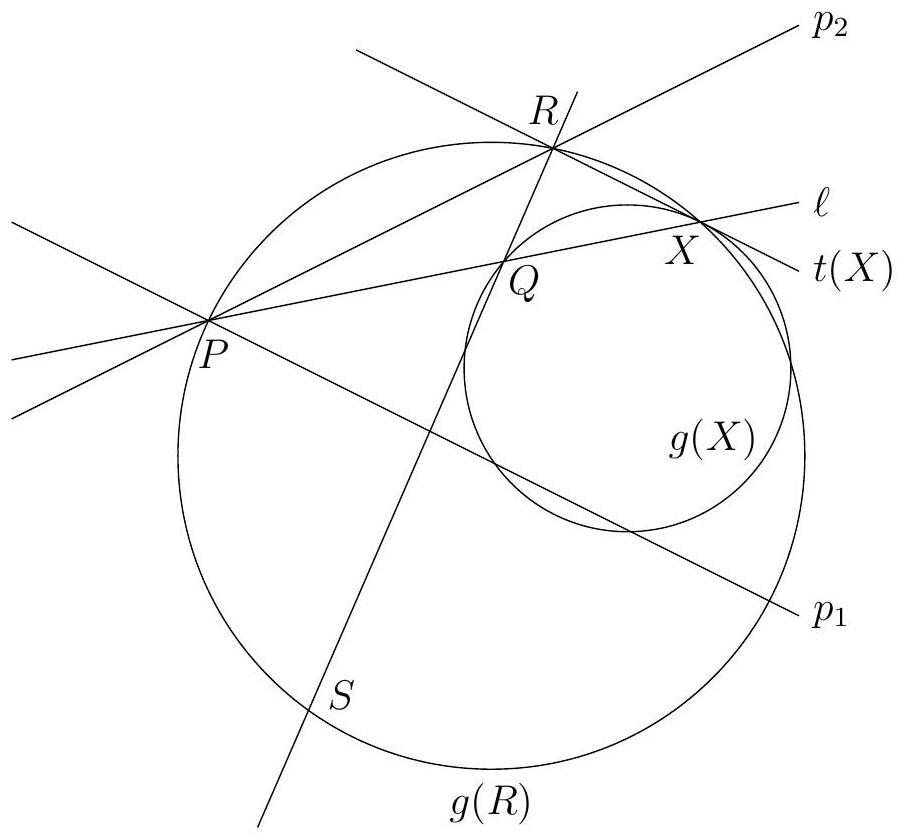
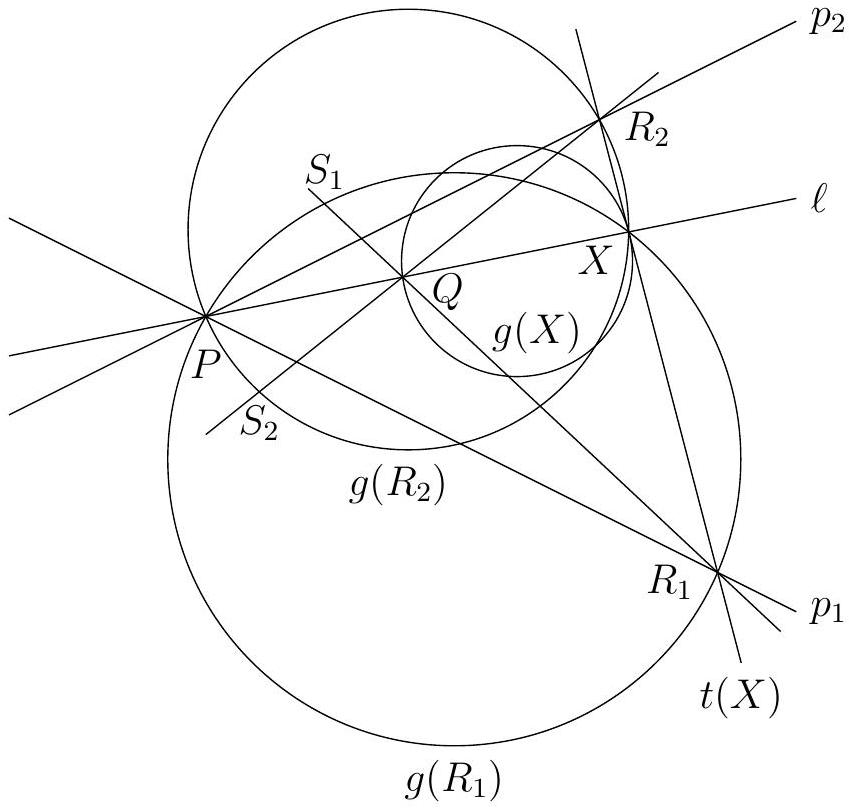
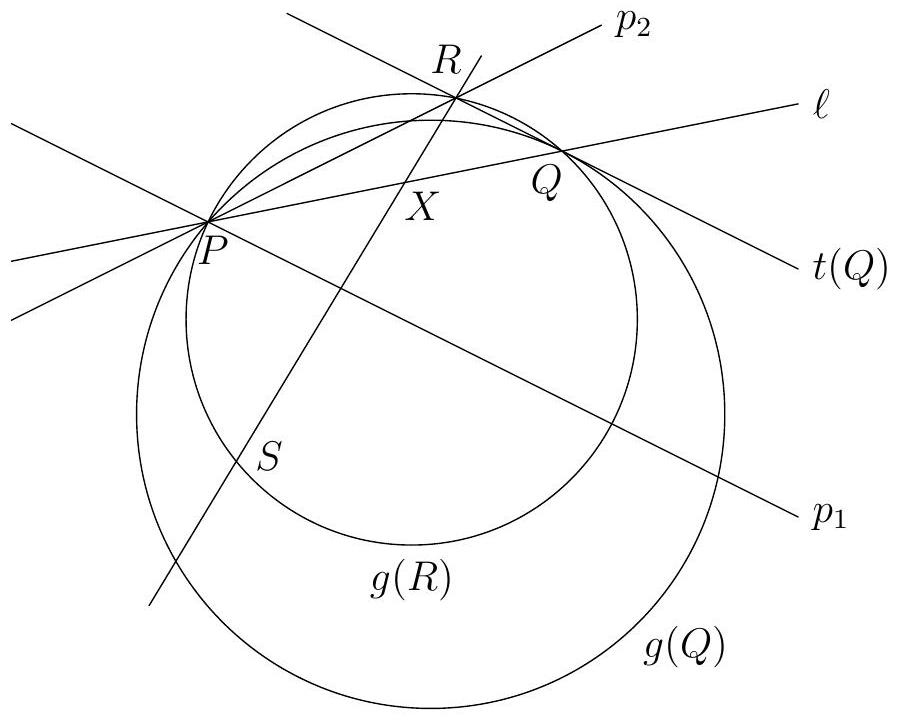
For any point , denote by the line tangent to at ; notice that , so is surjective. Step 1: We find a point for which there are at least two different lines and such that . Choose any point . If does not have this property, take any ; then . If does not have the property, , and the circles and meet again at some point . Then , so has the required property. We will show that is the desired point. From now on, we fix two different lines and with . Assume for contradiction that for some line through . We fix , and note that . Step 2: We prove that . Take an arbitrary point . Two cases are possible for the position of in relation to the ; we will show that each case (and subcase) occurs for only finitely many positions of , yielding a contradiction. Case 2.1: is parallel to one of the ; say, to . Let cross at . Then is the circle ( ), as and . Let cross again at . Then , so contains one of the points and . If , then is one of finitely many points in the intersection , and each of them corresponds to a unique position of , since is parallel to . If , then , so is constant for all such points , and all points obtained in such a way lie on one circle passing through and . Since does not contain , it is different from , so there are only finitely many points . Each of them uniquely determines and thus . So, Case 2.1 can occur for only finitely many points . Case 2.2: crosses and at and , respectively. Clearly, , as is the tangent to at , and meets only at and . Notice that is the circle ( ). Let meet again at ; then , as meets only at and . Then , and we distinguish several subcases. Subcase 2.2.1: ; so . In this case we have , which shows . Subcase 2.2.2: ; so . This can happen for at most four positions of - namely, at the intersections of with a line of the form , where . Subcase 2.2.3: (the case is similar). In this case, there are at most two possible positions for - namely, the meeting points of with . Consider one of them. Let vary on . Then is the projection of to via is the projection of to via . Finally, , so is obtained by a fixed projective transform from . So, if there were three points satisfying the conditions of this subcase, the composition of the three projective transforms would be the identity. But, if we apply it to , we successively get some point , then , and then some point different from , a contradiction. Thus Case 2.2 also occurs for only finitely many points , as desired. Step 3: We show that , as desired. The argument is similar to that in Step 2, with the roles of and swapped. Again, we show that there are only finitely many possible positions for a point , which is absurd. Case 3.1: is parallel to one of the ; say, to . Let cross at ; then is the circle ( ). Let cross again at . Then , so contains one of the points and . Subcase 3.1.1: . We have . Hence . Now we recall Case 2.1: we let cross at , so , and let meet again at ; notice that . Excluding one position of , we may assume that , so . Therefore, . But then, as in Case 2.1, we get . This means that is parallel to , which is impossible. Subcase 3.1.2: . In this case, we have . Again, let ; this point exists for all but at most one position of . Then ; let meet again at . Due to determines in at most two ways, so for all but finitely many positions of we have . Therefore, for those positions we have . But then is fixed, so this case can hold only for one specific position of as well. Thus, in Case 3.1, there are only finitely many possible positions of , yielding a contradiction. Case 3.2: crosses and at and , respectively. By Step 2, . Notice that is the circle . Let meet at ; then . Then , and we distinguish several subcases. Subcase 3.2.1: and , so . As in Subcase 2.2.1, we have , which shows . But as well, so meets at three distinct points, which is absurd. Subcase 3.2.2: , so . Now three distinct collinear points , and belong to , which is impossible. Subcase 3.2.3: (the case is similar). We have , so this case can occur for a unique position of . Thus, in Case 3.2, there is only a unique position of , again yielding the required contradiction.
---
Alternative solution.
Note that for any distinct points , the circles and meet on at the point . We write for the second intersection point of circles and . Lemma 1. Suppose that and are not collinear, and that and similarly for and . Then . Proof. The circles and through the vertices of triangle meet pairwise on the corresponding edges (produced). By Miquel's theorem, the second points of intersection of any two of the circles coincide. (See the diagram for Lemma 5 of Solution 1.) Now pick any line and any six different points on . Pick a point not on or any of the circles . Reordering the indices if necessary, we may suppose that do not lie on , so that for . By applying the above lemma to triangles for , we find that the points and are all equal, to point say. Note that either does not lie on , or , since . Now consider an arbitrary point not on or any of the circles for . As above, we see that there are two indices such that and do not lie on . By applying the above lemma to triangle we see that , and in particular passes through . We will now show that for all lines through . By the above note, we may assume that . Consider a variable point not on or any of the circles for . We know that . Since was suitably arbitrary, we have as desired.
---
Alternative solution.
Notice that, for any two different points and , the point lies on both and , so any two such circles meet in at least one point. We refer to two circles as cutting only in the case where they cross, and so meet at exactly two points, thus excluding the cases where they are tangent or are the same circle. Lemma 1. Suppose there is a point such that all circles pass through . Then has the given property. Proof. Consider some line passing through , and suppose that . Consider some with and . Then passes through all of and , but those three points are collinear, a contradiction. Lemma 2. Suppose that, for all , there is a point with of radius at most . Then there is a point with the given property. Proof. Consider a sequence and corresponding points . Because the two circles and meet, the distance between and is at most . As converges, these points converge to some point . For all , the point has distance at most from , and all circles pass through a point with distance at most from , so distance at most from . A circle that passes distance at most from for all must pass through , so by Lemma 1 the point has the given property. Lemma 3. Suppose no two of the circles cut. Then there is a point with the given property. Proof. Consider a circle with centre . The circle must meet without cutting it, so has half the radius of . Repeating this argument, there are circles with arbitrarily small radius and the result follows by Lemma 2. Lemma 4. Suppose there are six different points such that no three are collinear, no four are concyclic, and all the circles cut pairwise at . Then there is a point with the given property. Proof. Consider some line through that does not pass through any of the and is not tangent to any of the . Fix some direction along that line, and let be the point on that has distance from in that direction. In what follows we consider only those for which does not lie on any (this restriction excludes only finitely many possible values of ). Consider the circle . Because no four of the are concyclic, at most three of them lie on this circle, so at least two of them do not. There must be some sequence of such that it is the same two of the for all in that sequence, so now restrict attention to that sequence, and suppose without loss of generality that and do not lie on for any in that sequence. Then is not , so must be the other point of intersection of with , and the same applies with . Now consider the three points and . As , the angle at tends to or , which is not 0 or because no three of the points were collinear. All three distances between those points are bounded above by constant multiples of (in fact, if the triangle is scaled by a factor of , it tends to a fixed triangle). Thus the circumradius of those three points, which is the radius of , is also bounded above by a constant multiple of , and so the result follows by Lemma 2. Lemma 5. Suppose there are two points and such that and cut. Then there is a point with the given property. Proof. Suppose that and cut at and . One of those points, without loss of generality , must be , and so lie on the line . We now consider two cases, according to whether also lies on that line. Case 1: does not lie on that line. In this case, consider a sequence of at distance from , tending to along some line that is not a tangent to either circle, but perturbed slightly (by at most ) to ensure that no three of the points and are collinear and no four are concyclic. Consider the points and , and the circles on which they lie. The point might be either or the other intersection of with the circle , and the same applies for . If, for some sequence of , both those points are the other point of intersection, the same argument as in the proof of Lemma 4 applies to find arbitrarily small circles. Otherwise, we have either infinitely many of those circles passing through , or infinitely many passing through ; without loss of generality, suppose infinitely many through . We now show we can find five points satisfying the conditions of Lemma 4 (together with ). Let be any of the for which passes through . Then repeat the following four times, for . Consider some line (different from those considered for previous ) that is not tangent to any of the for , and is such that , so passes through for all on that line. If there are arbitrarily small circles we are done by Lemma 2, so the radii of such circles must be bounded below. But as , along any line not tangent to , the radius of a circle through and tangent to at tends to 0 . So there must be some such that cuts at rather than being tangent to it there, for all of the previous , and we may also pick it such that no three of the and are collinear and no four are concyclic. Let be this . Now the result follows by Lemma 4. Case 2: does lie on that line. In this case, we follow a similar argument, but the sequence of needs to be slightly different. and both lie on the line , so one must be and the other must be . Consider a sequence of tending to . Rather than tending to along a straight line (with small perturbations), let the sequence be such that all the points are inside the two circles, with the angle between and the tangent to at tending to 0 . Again consider the points and . If, for some sequence of , both those points are the other point of intersection with the respective circles, we see that the angle at tends to the angle between and the tangent to at , which is not 0 or , while the distances tend to 0 (although possibly slower than any multiple of ), so we have arbitrarily small circumradii and the result follows by Lemma 2. Otherwise, we have either infinitely many of the circles passing through , or infinitely many passing through , and the same argument as in the previous case enables us to reduce to Lemma 4.
---
Alternative solution.
For any point , denote by the line tangent to at ; notice that , so is surjective. Step 1: We find a point for which there are at least two different lines and such that . Choose any point . If does not have this property, take any ; then . If does not have the property, , and the circles and meet again at some point . Then , so has the required property. We will show that is the desired point. From now on, we fix two different lines and with . Assume for contradiction that for some line through . We fix , and note that . Step 2: We prove that . Take an arbitrary point . Two cases are possible for the position of in relation to the ; we will show that each case (and subcase) occurs for only finitely many positions of , yielding a contradiction. Case 2.1: is parallel to one of the ; say, to . Let cross at . Then is the circle ( ), as and . Let cross again at . Then , so contains one of the points and . If , then is one of finitely many points in the intersection , and each of them corresponds to a unique position of , since is parallel to . If , then , so is constant for all such points , and all points obtained in such a way lie on one circle passing through and . Since does not contain , it is different from , so there are only finitely many points . Each of them uniquely determines and thus . So, Case 2.1 can occur for only finitely many points . Case 2.2: crosses and at and , respectively. Clearly, , as is the tangent to at , and meets only at and . Notice that is the circle ( ). Let meet again at ; then , as meets only at and . Then , and we distinguish several subcases. Subcase 2.2.1: ; so . In this case we have , which shows . Subcase 2.2.2: ; so . This can happen for at most four positions of - namely, at the intersections of with a line of the form , where . Subcase 2.2.3: (the case is similar). In this case, there are at most two possible positions for - namely, the meeting points of with . Consider one of them. Let vary on . Then is the projection of to via is the projection of to via . Finally, , so is obtained by a fixed projective transform from . So, if there were three points satisfying the conditions of this subcase, the composition of the three projective transforms would be the identity. But, if we apply it to , we successively get some point , then , and then some point different from , a contradiction. Thus Case 2.2 also occurs for only finitely many points , as desired. Step 3: We show that , as desired. The argument is similar to that in Step 2, with the roles of and swapped. Again, we show that there are only finitely many possible positions for a point , which is absurd. Case 3.1: is parallel to one of the ; say, to . Let cross at ; then is the circle ( ). Let cross again at . Then , so contains one of the points and . Subcase 3.1.1: . We have . Hence . Now we recall Case 2.1: we let cross at , so , and let meet again at ; notice that . Excluding one position of , we may assume that , so . Therefore, . But then, as in Case 2.1, we get . This means that is parallel to , which is impossible. Subcase 3.1.2: . In this case, we have . Again, let ; this point exists for all but at most one position of . Then ; let meet again at . Due to determines in at most two ways, so for all but finitely many positions of we have . Therefore, for those positions we have . But then is fixed, so this case can hold only for one specific position of as well. Thus, in Case 3.1, there are only finitely many possible positions of , yielding a contradiction. Case 3.2: crosses and at and , respectively. By Step 2, . Notice that is the circle . Let meet at ; then . Then , and we distinguish several subcases. Subcase 3.2.1: and , so . As in Subcase 2.2.1, we have , which shows . But as well, so meets at three distinct points, which is absurd. Subcase 3.2.2: , so . Now three distinct collinear points , and belong to , which is impossible. Subcase 3.2.3: (the case is similar). We have , so this case can occur for a unique position of . Thus, in Case 3.2, there is only a unique position of , again yielding the required contradiction.
Techniques
Miquel pointTangentsAngle chasingPigeonhole principle