Browse · MathNet
PrintThe DANUBE Mathematical Competition
Romania geometry
Problem
Consider a cyclic quadrilateral and let and be the midpoints of the diagonals and , respectively. If , prove that .
Solution
(Cristian Mangra)
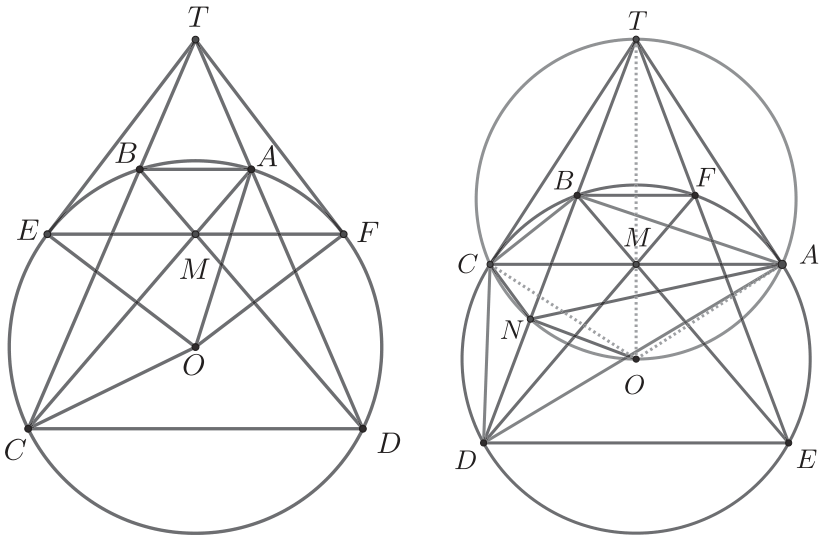
Lemma: Let be an isosceles trapezoid () inscribed in a circle of center , is the intersection point of the diagonals and , and is the intersection point of lines and . If the line through parallel to meets the circle at and , then and are tangent to the circle.
Proof of the Lemma: Assume . It is clear that points , and are collinear. Also, , which means that the quadrilateral is cyclic. From the power of point with respect to the circumcircle of triangle we get . But from the power of with respect to , so . This means that is cyclic, so . But , hence , i.e., is tangent to .
Let us now return to the problem. Denote by and the second intersection points with the circle of lines , and , respectively. Because is the midpoint of the diagonal , and angles and are equal, it follows that is an isosceles trapezoid (it is symmetric with respect to the perpendicular bisector of ). Moreover, . If lines and meet at , from the lemma it follows that and are tangent to the circumcircle of . If is the center of this circle, it follows that and . As is the
midpoint of , we have . Thus, points , and all lie on the circle of diameter . Assume (if , simply swap and ; the case is easy). In this case, , and . But means .
---
Alternative solution.
Alternative Solution. (Given in the contest by David-Andrei Anghel.)
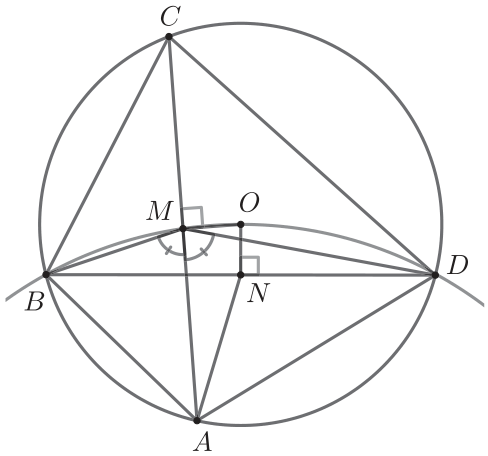
We only treat the case in the figure below; the other cases are similar.
Let be the circumcenter of triangle . is on the perpendicular bisector of but also on the external bisector of angle (it is perpendicular to , the internal bisector of that angle). It is known that these two lines meet on the circumcircle of triangle (in the midpoint of the arc ), therefore is cyclic.
We obtain that angles and are equal. It follows that As , triangles and are similar. It follows that , which leads to . But according to Ptolemy's Theorem, therefore , i.e., the quadrilateral is harmonic.
This leads to the similarity of triangles and . Also, triangles and are similar. The two similarities imply
Lemma: Let be an isosceles trapezoid () inscribed in a circle of center , is the intersection point of the diagonals and , and is the intersection point of lines and . If the line through parallel to meets the circle at and , then and are tangent to the circle.
Proof of the Lemma: Assume . It is clear that points , and are collinear. Also, , which means that the quadrilateral is cyclic. From the power of point with respect to the circumcircle of triangle we get . But from the power of with respect to , so . This means that is cyclic, so . But , hence , i.e., is tangent to .
Let us now return to the problem. Denote by and the second intersection points with the circle of lines , and , respectively. Because is the midpoint of the diagonal , and angles and are equal, it follows that is an isosceles trapezoid (it is symmetric with respect to the perpendicular bisector of ). Moreover, . If lines and meet at , from the lemma it follows that and are tangent to the circumcircle of . If is the center of this circle, it follows that and . As is the
midpoint of , we have . Thus, points , and all lie on the circle of diameter . Assume (if , simply swap and ; the case is easy). In this case, , and . But means .
---
Alternative solution.
Alternative Solution. (Given in the contest by David-Andrei Anghel.)
We only treat the case in the figure below; the other cases are similar.
Let be the circumcenter of triangle . is on the perpendicular bisector of but also on the external bisector of angle (it is perpendicular to , the internal bisector of that angle). It is known that these two lines meet on the circumcircle of triangle (in the midpoint of the arc ), therefore is cyclic.
We obtain that angles and are equal. It follows that As , triangles and are similar. It follows that , which leads to . But according to Ptolemy's Theorem, therefore , i.e., the quadrilateral is harmonic.
This leads to the similarity of triangles and . Also, triangles and are similar. The two similarities imply
Techniques
Cyclic quadrilateralsTangentsPolar triangles, harmonic conjugatesAngle chasingTriangle centers: centroid, incenter, circumcenter, orthocenter, Euler line, nine-point circle