Browse · MathNet
PrintBMO 2022 shortlist
2022 geometry
Problem
Let be a triangle with circumcircle , circumcenter , and orthocenter . Let be the midpoint of . The perpendicular to at intersects and at and , respectively. The lines and intersect again at and , respectively. Prove that the second intersection of the circumcircles of triangles and lies on .
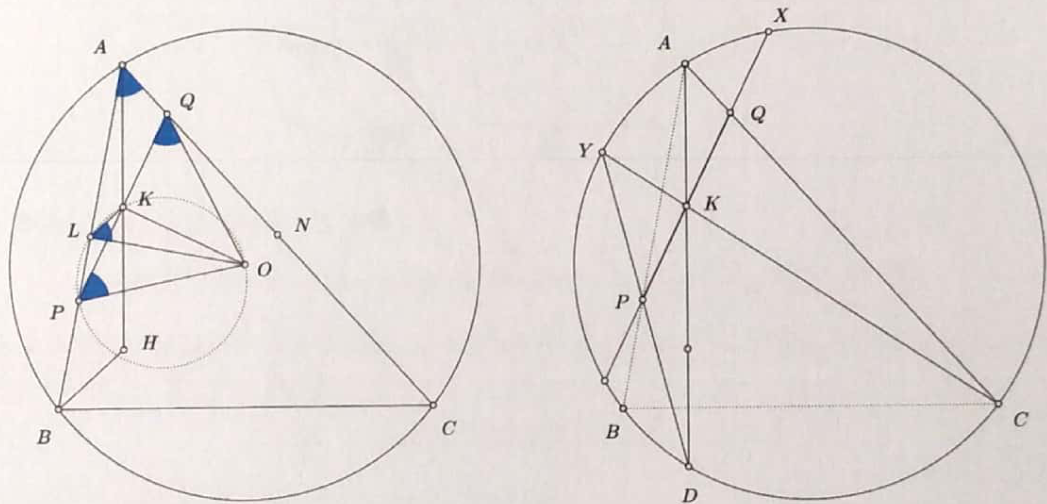
Solution
Claim 1. . Proof of Claim 1. Let and be the midpoints of and , respectively. Since and are midpoints of and , then and so . Since also , then . Also, , so the quadrilateral is cyclic and therefore . Similarly, . Therefore, the triangle is isosceles, and since then is the midpoint of .
Claim 2. The intersection of and lies on . Proof of Claim 2. Let be the other point of intersection of with . Since , then is the midpoint of the chord of through . Since and intersect at , by the Butterfly theorem the points and are equidistant from . Thus and .
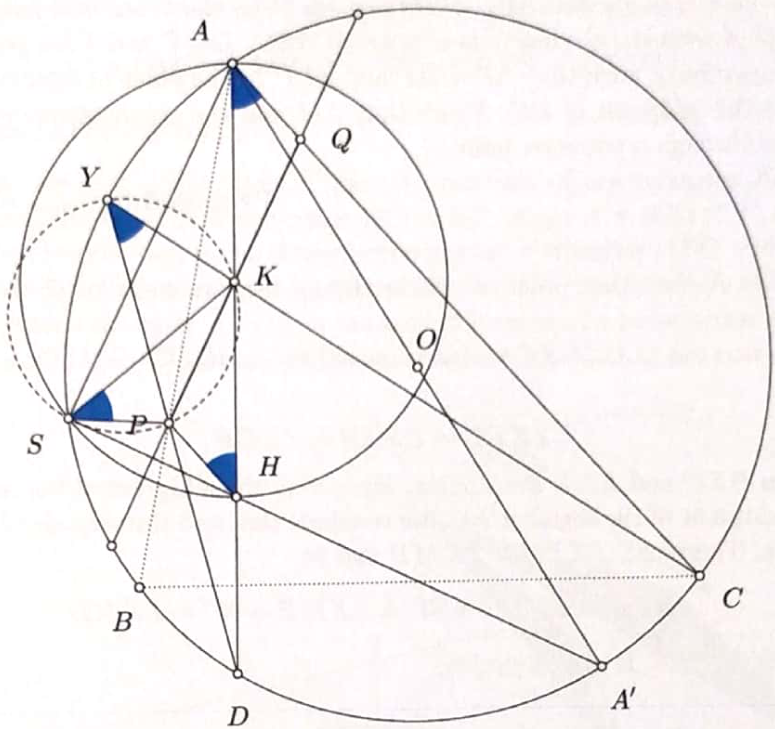
Now let be the other point of intersection of with and let be the other point of intersection of with .
Claim 3. is the perpendicular bisector of . Proof of Claim 3. We have so lies on the circle with diameter centered at . So . Since and are the circumcenters of and respectively, and is their common chord, then . But we also have and , thus . Since , then belongs on the perpendicular bisector of and the result follows.
From Claim 3 we have . From Claim 1 and the fact that we have that is a parallelogram and so (using Claim 2 as well)
Since we get that belongs on the circumcircle of triangle . Similarly it belongs to the circumcircle of triangle and therefore the result follows.
Claim 2. The intersection of and lies on . Proof of Claim 2. Let be the other point of intersection of with . Since , then is the midpoint of the chord of through . Since and intersect at , by the Butterfly theorem the points and are equidistant from . Thus and .
Now let be the other point of intersection of with and let be the other point of intersection of with .
Claim 3. is the perpendicular bisector of . Proof of Claim 3. We have so lies on the circle with diameter centered at . So . Since and are the circumcenters of and respectively, and is their common chord, then . But we also have and , thus . Since , then belongs on the perpendicular bisector of and the result follows.
From Claim 3 we have . From Claim 1 and the fact that we have that is a parallelogram and so (using Claim 2 as well)
Since we get that belongs on the circumcircle of triangle . Similarly it belongs to the circumcircle of triangle and therefore the result follows.
Techniques
Triangle centers: centroid, incenter, circumcenter, orthocenter, Euler line, nine-point circleCyclic quadrilateralsRadical axis theoremAngle chasing