Browse · MATH
Printjmc
geometry senior
Problem
In the diagram, , and are the centers of the three semi-circles. Also, and .
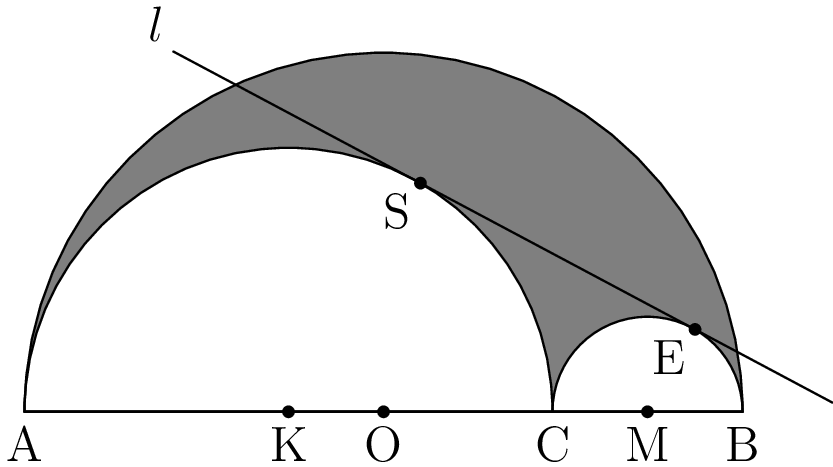 Line is drawn to touch the smaller semi-circles at points and so that and are both perpendicular to . Determine the area of quadrilateral .
Solution
We know that and are each radii of the semi-circle with center . Thus, . Therefore, .
The semi-circle with center has radius . The radius of the smaller unshaded circle is .
Construct line segments and perpendicular to line . Position point on so that is perpendicular to , as shown. In quadrilateral , . Hence, quadrilateral is a rectangle. The larger unshaded semi-circle has radius 50, so . The smaller unshaded semi-circle has radius 18, so . Thus, . The area of quadrilateral is the sum of the areas of rectangle and . Since , then . Using the Pythagorean Theorem in , or or (since ). The area of is . The area of rectangle is . Thus, the area of quadrilateral is .
The semi-circle with center has radius . The radius of the smaller unshaded circle is .
Construct line segments and perpendicular to line . Position point on so that is perpendicular to , as shown. In quadrilateral , . Hence, quadrilateral is a rectangle. The larger unshaded semi-circle has radius 50, so . The smaller unshaded semi-circle has radius 18, so . Thus, . The area of quadrilateral is the sum of the areas of rectangle and . Since , then . Using the Pythagorean Theorem in , or or (since ). The area of is . The area of rectangle is . Thus, the area of quadrilateral is .
Final answer
2040