Browse · MATH
Printjmc
geometry senior
Problem
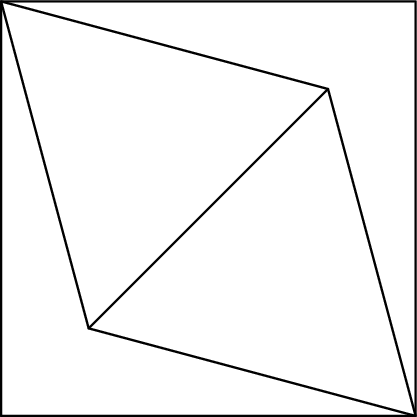
Inside a square with side length 10, two congruent equilateral triangles are drawn such that they share one side and each has one vertex on a vertex of the square. What is the side length of the largest square that can be inscribed in the space inside the square and outside of the triangles?
Solution
The largest possible square is the square with one vertex on the triangles' coincident vertices and with sides parallel to and coincident with those of the big square. There are two of them. We draw them in and label the diagram as shown: First, we find the side length of the equilateral triangle. is the midpoint of ; let , so and . is the diagonal of and thus has length . So we have It follows that the side length of the triangle is .
Now, look at diagonal and notice that it is made up of twice the diagonal of the small square plus the side length of the triangle. Let the side length of the small square be , so we have Solving yields so .
Now, look at diagonal and notice that it is made up of twice the diagonal of the small square plus the side length of the triangle. Let the side length of the small square be , so we have Solving yields so .
Final answer
5-\frac{5\sqrt{3}}{3}