Browse · MathNet
PrintCesko-Slovacko-Poljsko 2013
2013 geometry
Problem
Given triangle and its circumcircle. Point is midpoint of arc . Circle with diameter cuts angle bisector of at points (point lies closer to than ). Point is symmetric to with respect to line . Prove that circumcircle of triangle bisects segment .
Solution
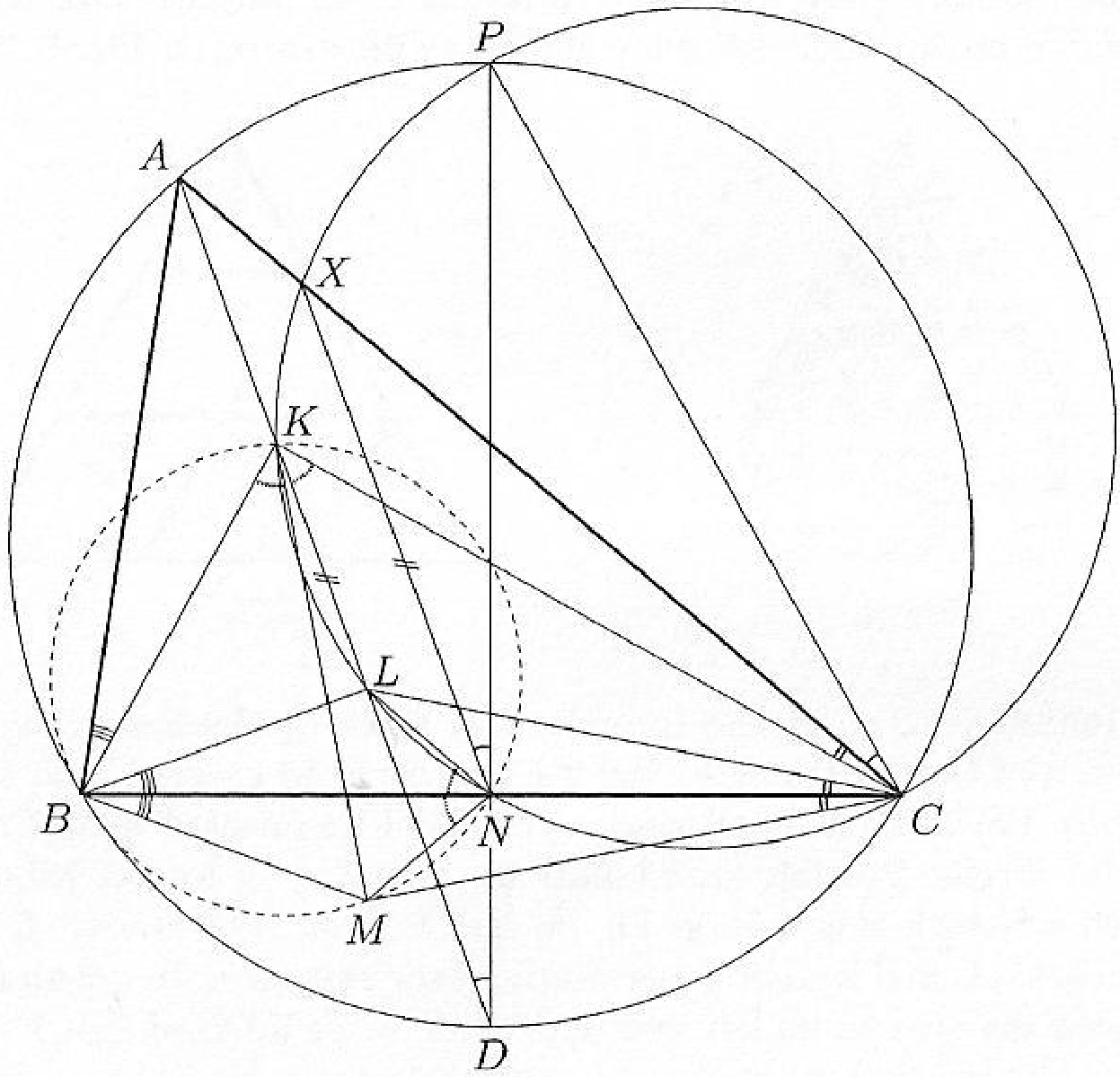
Let be the midpoint of arc , the midpoint of , the orthogonal projection of onto . Then points are concyclic (Fig. 7).
Fig. 7
We have therefore . It follows that , and . Obviously , so are isogonal conjugates with respect to triangle . Thus following equalities hold: and . This implies that are isogonal conjugates with respect to triangle . Using this we get therefore points are concyclic.
---
Alternative solution.
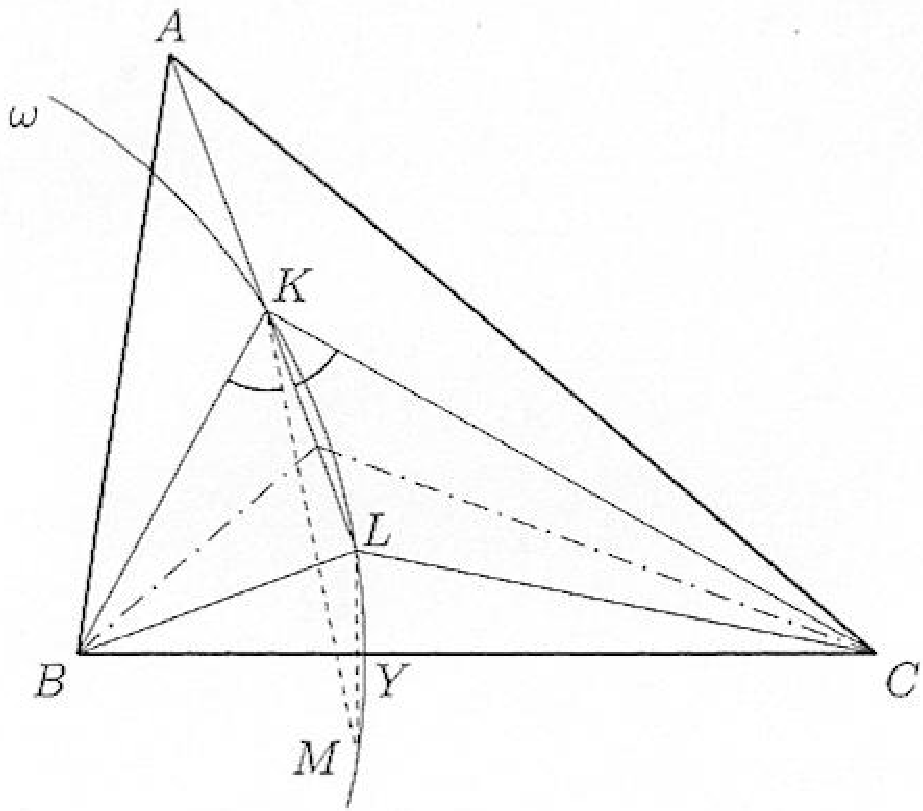
In the first solution, it is proven that points are isogonal conjugates with respect to . Thus angle bisectors of and are angle bisectors of and , respectively. From angle bisector theorem we deduce that . This means that points lie on Apollonian circle of points . Since is self-symmetric with respect to line , we get that lies on (Fig. 8).
Fig. 8
Let intersect segment at point . Then is angle bisector of both angles (because is the midpoint of arc ) and (because lies on Apollonian circle). Therefore . We end proof as we did in the first solution.
Fig. 7
We have therefore . It follows that , and . Obviously , so are isogonal conjugates with respect to triangle . Thus following equalities hold: and . This implies that are isogonal conjugates with respect to triangle . Using this we get therefore points are concyclic.
---
Alternative solution.
In the first solution, it is proven that points are isogonal conjugates with respect to . Thus angle bisectors of and are angle bisectors of and , respectively. From angle bisector theorem we deduce that . This means that points lie on Apollonian circle of points . Since is self-symmetric with respect to line , we get that lies on (Fig. 8).
Fig. 8
Let intersect segment at point . Then is angle bisector of both angles (because is the midpoint of arc ) and (because lies on Apollonian circle). Therefore . We end proof as we did in the first solution.
Techniques
Isogonal/isotomic conjugates, barycentric coordinatesCircle of ApolloniusAngle chasing