Browse · MathNet
PrintThe South African Mathematical Olympiad Third Round
South Africa counting and probability
Problem
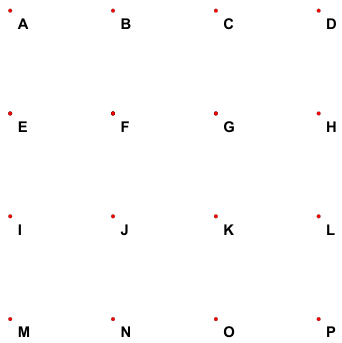
Consider points arranged as shown, with horizontal and vertical distances of between consecutive rows and columns. In how many ways can one choose four of these points such that the distance between every two of those four points is strictly greater than ?
Solution
Label the sixteen points , , , , , as shown below in Figure 1:
A selection of four points satisfying the condition that the distance between every two of the four points is greater than , will be called a valid selection.
Let us first consider a valid selection which includes one of the points of the inner square . Clearly, only one of these points (, , , ) can be used; say we select . The only points from the outer square at distance more than from , are , , , and . If we choose either or , then there are not enough points left among the remaining ones on the outer square to form a valid selection. We are therefore forced to select , and , together with , to obtain a valid selection. Similarly, by symmetry, there are three further valid selections that contain points from the inner square: , and .
All that remains, is to consider valid selections using only points from the outer square. We note that the only way to choose two points in a valid selection from the same side of the outer square, is to choose two corner points, such as and . But then the only option for the other two points in the valid selection would be to choose the other two corner points of the outer square, and , giving the valid selection . Moving away from corner points, leaves us with the two remaining valid selections (where only one point from each of the sides of the outer square is selected), namely and .
Hence, there are seven possible valid selections.
A selection of four points satisfying the condition that the distance between every two of the four points is greater than , will be called a valid selection.
Let us first consider a valid selection which includes one of the points of the inner square . Clearly, only one of these points (, , , ) can be used; say we select . The only points from the outer square at distance more than from , are , , , and . If we choose either or , then there are not enough points left among the remaining ones on the outer square to form a valid selection. We are therefore forced to select , and , together with , to obtain a valid selection. Similarly, by symmetry, there are three further valid selections that contain points from the inner square: , and .
All that remains, is to consider valid selections using only points from the outer square. We note that the only way to choose two points in a valid selection from the same side of the outer square, is to choose two corner points, such as and . But then the only option for the other two points in the valid selection would be to choose the other two corner points of the outer square, and , giving the valid selection . Moving away from corner points, leaves us with the two remaining valid selections (where only one point from each of the sides of the outer square is selected), namely and .
Hence, there are seven possible valid selections.
Final answer
7
Techniques
CombinatoricsDistance chasing