Browse · MathNet
PrintJapan Mathematical Olympiad
Japan geometry
Problem
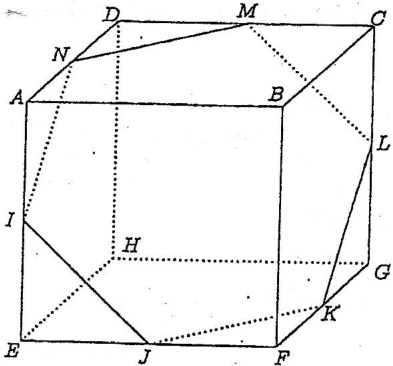
Suppose a cube - having a side length of and a plane are placed in space, and the intersection of the plane and the cube forms a hexagon , where the points , , , , , lie on the sides , , , , , , respectively, as shown in figure 3 below. If , , , determine the value obtained by subtracting the area of the hexagon from the sum of the areas of the triangles and . Here we denote for a line segment its length also by .
Solution
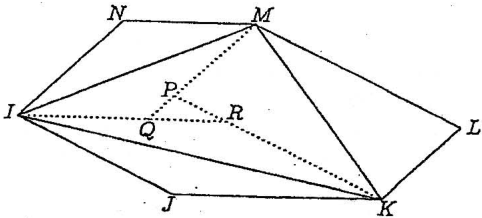
Take three points , , inside of the cube in such a way that the quadrilaterals , and are parallelograms. Since and are parallel, so are and , and we see that the points , , lie on a same straight line. Therefore, we conclude that the hexagon is partitioned into 3 parallelograms and a triangle as indicated in the figure below.
We then have
Here we are denoting and for the areas of the triangle and of the quadrilateral , respectively. We note also that since and lie on the same side from on the line , holds. Similarly, we have and .
Next, take three points , , inside of the cube so that the quadrilaterals , , are parallelograms. Then, in the same way as above, we obtain that . Furthermore, we get , and . Hence, the triangles and are congruent, and in particular, we have . Thus we obtain the fact that the answer we seek is , and thus it is enough to find the area of the triangle .
Let us now observe that the right triangles and are similar since the corresponding sides are parallel. Therefore, we have Since the triangle for which the ratios of the lengths of the three sides are is a right triangle whose hypotenuse is the side with length , we get . Thus, we get . Similarly, we obtain and .
Let be the foot of the perpendicular line drawn from to and let (assume that if lies on the opposite side from with respect to , then is negative). Then, from the Pythagorean theorem, we get Solving for we obtain , and then we get . Finally, we obtain which is the desired answer for the problem.
We then have
Here we are denoting and for the areas of the triangle and of the quadrilateral , respectively. We note also that since and lie on the same side from on the line , holds. Similarly, we have and .
Next, take three points , , inside of the cube so that the quadrilaterals , , are parallelograms. Then, in the same way as above, we obtain that . Furthermore, we get , and . Hence, the triangles and are congruent, and in particular, we have . Thus we obtain the fact that the answer we seek is , and thus it is enough to find the area of the triangle .
Let us now observe that the right triangles and are similar since the corresponding sides are parallel. Therefore, we have Since the triangle for which the ratios of the lengths of the three sides are is a right triangle whose hypotenuse is the side with length , we get . Thus, we get . Similarly, we obtain and .
Let be the foot of the perpendicular line drawn from to and let (assume that if lies on the opposite side from with respect to , then is negative). Then, from the Pythagorean theorem, we get Solving for we obtain , and then we get . Finally, we obtain which is the desired answer for the problem.
Final answer
4\sqrt{61}
Techniques
Other 3D problemsConstructions and lociDistance chasingTrigonometry