Browse · MathNet
PrintSELECTION EXAMINATION
Greece geometry
Problem
Let be a quadrilateral inscribed in the circle and let be the midpoints of the segments and , respectively. Prove that the centers of the circumcircles of the triangles and form a cyclic quadrilateral similar to .
Solution
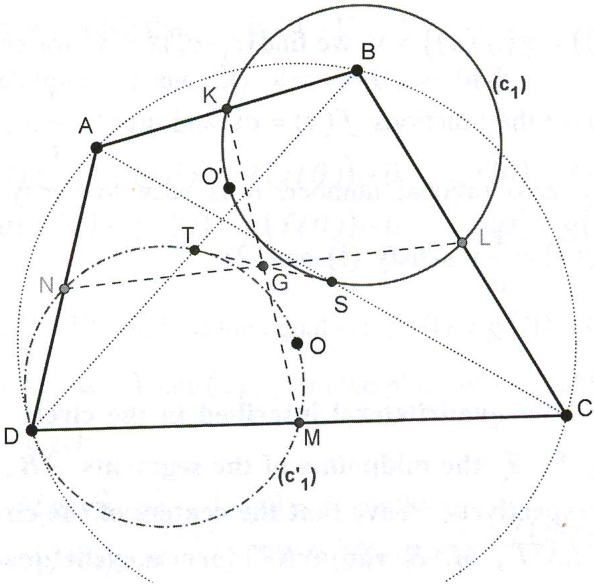
Let be the circumcircles of the triangles and , respectively. It is easy to prove that the quadrilaterals and are parallelograms and so will pass through the same point and therefore the points are symmetric of the points , respectively, with respect to a symmetry with center point . Let be the circumcircle of the triangle . Then passes through the center of the circle and it has diameter (since ). However the circles and are symmetric with respect to (since the triangles defined the two circles are point to point symmetric with respect to ). Hence the circle has radius and is passing through (the symmetric point of with respect to ).
Figure 6
Similarly we prove that the circles have radius and are passing through . Therefore the centers of the circles belong to the circle with center and radius . The centers of the circles and (which are the midpoints of the segments and , respectively) define a quadrilateral with sides parallel to the corresponding sides of . Hence the centers of the circles (symmetric of the centers of the circles ) define a quadrilateral similar to .
---
Alternative solution.
We will use the characteristic properties of the Euler circle of a triangle.
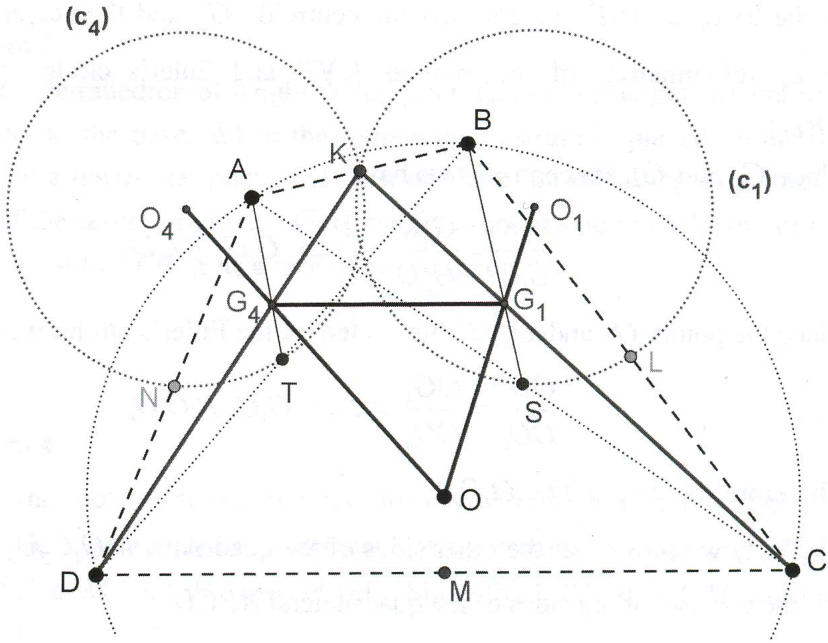
Figure 7
The center of the Euler circle of a triangle belongs to Euler's line of the triangle. It is the midpoint of the segment (where is the circumcentre and is the orthocenter of the triangle). The radius of the Euler's circle is the half of the radius of the circumcircle of the triangle. From the data of the problem we conclude that the circumcircles of the triangles , , and (, respectively), are the Euler's circles of the triangles , , and . The triangles , , and are inscribed in the same circle . Hence the circles are equal with radius . We consider the triangles and . In the triangle we consider the centroid (point of intersection of the medians and ) and the center of the circle (circumcircle of the triangle and Euler's circle of the triangle ). In the triangle we consider the centroid and the center of the circle (circumcircle of the triangle and Euler's circle of the triangle ). Since and are centroids we have: Since the points and are the centers of the Euler's circles we have: Therefore we have: . Similarly we prove that the other sides of the quadrilateral are parallel to the corresponding sides of the quadrilateral .
Figure 6
Similarly we prove that the circles have radius and are passing through . Therefore the centers of the circles belong to the circle with center and radius . The centers of the circles and (which are the midpoints of the segments and , respectively) define a quadrilateral with sides parallel to the corresponding sides of . Hence the centers of the circles (symmetric of the centers of the circles ) define a quadrilateral similar to .
---
Alternative solution.
We will use the characteristic properties of the Euler circle of a triangle.
Figure 7
The center of the Euler circle of a triangle belongs to Euler's line of the triangle. It is the midpoint of the segment (where is the circumcentre and is the orthocenter of the triangle). The radius of the Euler's circle is the half of the radius of the circumcircle of the triangle. From the data of the problem we conclude that the circumcircles of the triangles , , and (, respectively), are the Euler's circles of the triangles , , and . The triangles , , and are inscribed in the same circle . Hence the circles are equal with radius . We consider the triangles and . In the triangle we consider the centroid (point of intersection of the medians and ) and the center of the circle (circumcircle of the triangle and Euler's circle of the triangle ). In the triangle we consider the centroid and the center of the circle (circumcircle of the triangle and Euler's circle of the triangle ). Since and are centroids we have: Since the points and are the centers of the Euler's circles we have: Therefore we have: . Similarly we prove that the other sides of the quadrilateral are parallel to the corresponding sides of the quadrilateral .
Techniques
Cyclic quadrilateralsTriangle centers: centroid, incenter, circumcenter, orthocenter, Euler line, nine-point circleRotationHomothetyConstructions and loci