Browse · MathNet
PrintThe 65th IMO China National Team Selection Test
China counting and probability
Problem
Given a positive integer , a large equilateral triangle of side length is divided into small equilateral triangles of side length 1. Each small triangle is colored in one of three colors: red, yellow, or blue, such that there are triangles of each color. A trapezoid consisting of 3 small triangles is called a standard trapezoid. For example, in the case of shown below, the two shaded areas are standard trapezoids. A standard trapezoid is called a colorful trapezoid if the three small triangles it contains are all of different colors. Find the maximum possible number of colorful trapezoids. (These colorful trapezoids do not need to be non-overlapping.) 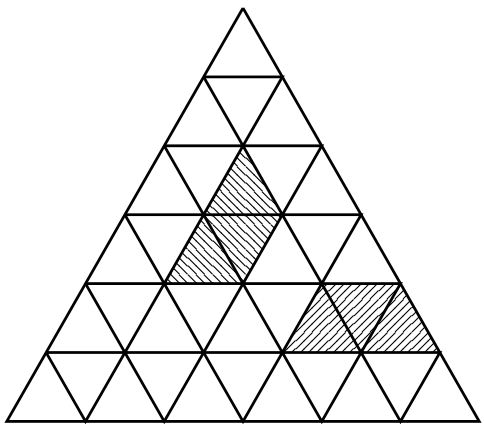
Solution
The maximum number of multicolored trapezoids is .
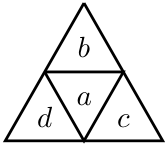
Use the numbers 1, 2, and 3 to represent the three colors. First, consider a small equilateral triangle of side length 2 formed by 4 small equilateral triangles. Let the middle small equilateral triangle be labeled , and the other three small equilateral triangles be labeled , , and . Then the three standard trapezoids within this triangle have the labels , , and .
(1) If , then at most 1 of these three standard trapezoids can be multicolored. The same applies if or . (2) If is different from , , and , then at least two of , , and must be equal, so at most 2 of these standard trapezoids can be multicolored. Equality holds if and only if is different from , , and , and , , and are not all equal.
It is easy to see that the number of small equilateral triangles of side length 2 is These equilateral triangles each contain distinct standard trapezoids, because the way to complete a standard trapezoid to a side length 2 equilateral triangle is unique.
Apart from these standard trapezoids, there are some standard trapezoids that require an additional small equilateral triangle outside the large triangle to form a side length 2 equilateral triangle.
---
The base of length 1 of these trapezoids must be on the boundary of the large triangle. It is easy to see that the number of such standard trapezoids is
Because the number of multicolored trapezoids within a side length 2 equilateral triangle does not exceed 2, the number of multicolored trapezoids does not exceed Equality holds if and only if the following two conditions are met simultaneously: (A) For any side length 2 equilateral triangle formed by 4 small equilateral triangles, the middle small equilateral triangle is different from the other three small equilateral triangles, and the other three small equilateral triangles are not all the same. (B) Each standard trapezoid with a base of length 1 on the boundary of the large triangle must be multicolored.
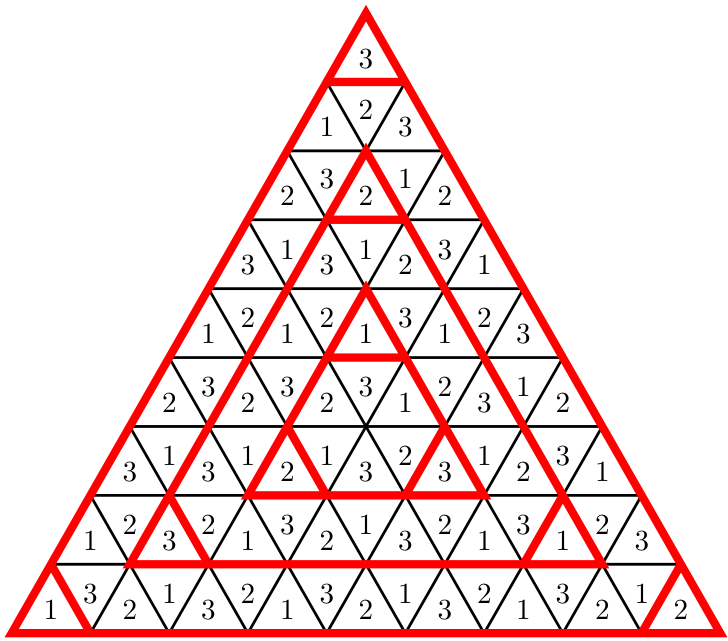
We now give a construction that meets these two conditions simultaneously. Center the large triangle at its center and draw concentric equilateral triangles with side lengths 3, 6, ..., 3(n - 1) in a counterclockwise manner, dividing all small triangles into "layers." As shown in the figure below.
In each layer of small equilateral triangles, remove the three corner small equilateral triangles (call these special triangles), so that the remaining small equilateral triangles form a loop (each adjacent pair shares a side). Starting from the innermost, the th loop has small equilateral triangles, so we can start from a certain triangle and label them 1, 2, 3, 1, 2, 3, ... in a clockwise manner until the loop is complete. This way, all standard trapezoids in the loop are multicolored.
Now condition (B) is met, and for condition (A), consider the side length 2 equilateral triangles. These triangles can be classified into three types: the first type consists of a standard trapezoid on a loop plus a special triangle; the second type consists of a standard trapezoid on a loop plus a small equilateral triangle from another loop; and the third type consists of an equilateral triangle with a special triangle at the center. Therefore, for the first and third types of side length 2 equilateral triangles, the three corner small equilateral triangles are not all the same color.
Therefore, we only need to simultaneously satisfy (a) Any two adjacent small equilateral triangles from different loops have different labels; (b) Each special triangle has a different label from its neighbors, and except for the three corner special triangles, the three neighbors of each special triangle are not all the same color.
First, we set the numbers in the innermost loop, and ensure that for any adjacent pair of small equilateral triangles from different loops, the number of the outer loop triangle is 1 more than the number of the inner loop triangle (mod 3). This can be achieved because moving 2 steps clockwise on the inner loop reaches the next contact position, while the outer loop moves 2 or 8 steps (skipping a special triangle), ensuring that the outer loop triangle is always 1 more than the inner loop triangle. This satisfies condition (a). For condition (b), we set the number of each special triangle to be 1 more than its neighbor from the inner loop (mod 3). Thus, if the number of the special triangle is , the numbers of its three neighbors should be , satisfying (b).
Finally, we count the occurrences of each color. Each color clearly appears equally in each loop. For the three small equilateral triangles in the loop that contact the outer special triangle, their labels are different since is not divisible by 3. Thus, the three symmetrically placed special triangles have different labels, ensuring that each color appears equally.
In summary, the maximum number of multicolored trapezoids is . □
Use the numbers 1, 2, and 3 to represent the three colors. First, consider a small equilateral triangle of side length 2 formed by 4 small equilateral triangles. Let the middle small equilateral triangle be labeled , and the other three small equilateral triangles be labeled , , and . Then the three standard trapezoids within this triangle have the labels , , and .
(1) If , then at most 1 of these three standard trapezoids can be multicolored. The same applies if or . (2) If is different from , , and , then at least two of , , and must be equal, so at most 2 of these standard trapezoids can be multicolored. Equality holds if and only if is different from , , and , and , , and are not all equal.
It is easy to see that the number of small equilateral triangles of side length 2 is These equilateral triangles each contain distinct standard trapezoids, because the way to complete a standard trapezoid to a side length 2 equilateral triangle is unique.
Apart from these standard trapezoids, there are some standard trapezoids that require an additional small equilateral triangle outside the large triangle to form a side length 2 equilateral triangle.
---
The base of length 1 of these trapezoids must be on the boundary of the large triangle. It is easy to see that the number of such standard trapezoids is
Because the number of multicolored trapezoids within a side length 2 equilateral triangle does not exceed 2, the number of multicolored trapezoids does not exceed Equality holds if and only if the following two conditions are met simultaneously: (A) For any side length 2 equilateral triangle formed by 4 small equilateral triangles, the middle small equilateral triangle is different from the other three small equilateral triangles, and the other three small equilateral triangles are not all the same. (B) Each standard trapezoid with a base of length 1 on the boundary of the large triangle must be multicolored.
We now give a construction that meets these two conditions simultaneously. Center the large triangle at its center and draw concentric equilateral triangles with side lengths 3, 6, ..., 3(n - 1) in a counterclockwise manner, dividing all small triangles into "layers." As shown in the figure below.
In each layer of small equilateral triangles, remove the three corner small equilateral triangles (call these special triangles), so that the remaining small equilateral triangles form a loop (each adjacent pair shares a side). Starting from the innermost, the th loop has small equilateral triangles, so we can start from a certain triangle and label them 1, 2, 3, 1, 2, 3, ... in a clockwise manner until the loop is complete. This way, all standard trapezoids in the loop are multicolored.
Now condition (B) is met, and for condition (A), consider the side length 2 equilateral triangles. These triangles can be classified into three types: the first type consists of a standard trapezoid on a loop plus a special triangle; the second type consists of a standard trapezoid on a loop plus a small equilateral triangle from another loop; and the third type consists of an equilateral triangle with a special triangle at the center. Therefore, for the first and third types of side length 2 equilateral triangles, the three corner small equilateral triangles are not all the same color.
Therefore, we only need to simultaneously satisfy (a) Any two adjacent small equilateral triangles from different loops have different labels; (b) Each special triangle has a different label from its neighbors, and except for the three corner special triangles, the three neighbors of each special triangle are not all the same color.
First, we set the numbers in the innermost loop, and ensure that for any adjacent pair of small equilateral triangles from different loops, the number of the outer loop triangle is 1 more than the number of the inner loop triangle (mod 3). This can be achieved because moving 2 steps clockwise on the inner loop reaches the next contact position, while the outer loop moves 2 or 8 steps (skipping a special triangle), ensuring that the outer loop triangle is always 1 more than the inner loop triangle. This satisfies condition (a). For condition (b), we set the number of each special triangle to be 1 more than its neighbor from the inner loop (mod 3). Thus, if the number of the special triangle is , the numbers of its three neighbors should be , satisfying (b).
Finally, we count the occurrences of each color. Each color clearly appears equally in each loop. For the three small equilateral triangles in the loop that contact the outer special triangle, their labels are different since is not divisible by 3. Thus, the three symmetrically placed special triangles have different labels, ensuring that each color appears equally.
In summary, the maximum number of multicolored trapezoids is . □
Final answer
18n^2 - 9n
Techniques
Coloring schemes, extremal argumentsConstructions and loci