Browse · MathNet
PrintIRL_ABooklet_2023
Ireland 2023 geometry
Problem
Suppose ABC is an isosceles triangle with . Show that . Give an example of a right-angled triangle with hypotenuse in which this inequality fails.
Solution
By the triangle inequality, , hence , using . Therefore , as required.
If , and , , , then and so , , are side lengths of a right-angled triangle with hypotenuse . Then Clearly, the polynomial is positive if is large enough, e.g., any will do. So, as long as we have a right-angled triangle in which .
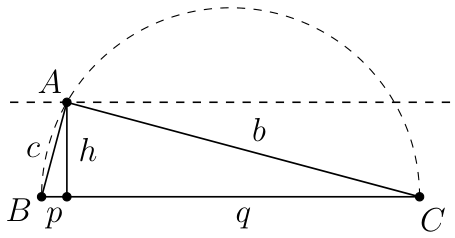
Alternatively, we may find such examples as follows. If is the length of the hypotenuse of the right-angled triangle , its area () is equal to . Hence, the desired inequality is equivalent to . If is the height of triangle on the hypotenuse , then () = and the desired inequality becomes . In the diagram below, this means that should be on the semicircle but not above the dashed line. To make this more explicit, let the foot of the altitude from divide the hypotenuse into segments of length and , and recall that . Thus, we want , i.e. . This is equivalent to As in our case, given we can choose any such that Because and , the value of determines and for any given . For example, with and , we obtain and . In this example, .
If , and , , , then and so , , are side lengths of a right-angled triangle with hypotenuse . Then Clearly, the polynomial is positive if is large enough, e.g., any will do. So, as long as we have a right-angled triangle in which .
Alternatively, we may find such examples as follows. If is the length of the hypotenuse of the right-angled triangle , its area () is equal to . Hence, the desired inequality is equivalent to . If is the height of triangle on the hypotenuse , then () = and the desired inequality becomes . In the diagram below, this means that should be on the semicircle but not above the dashed line. To make this more explicit, let the foot of the altitude from divide the hypotenuse into segments of length and , and recall that . Thus, we want , i.e. . This is equivalent to As in our case, given we can choose any such that Because and , the value of determines and for any given . For example, with and , we obtain and . In this example, .
Final answer
Example counterexample: a right triangle with sides a=41, b=40, c=9 (hypotenuse 41), for which 41^2 > 4·40·9.
Techniques
Triangle inequalitiesConstructions and lociPythagorean triples