Browse · MathNet
PrintProblems of Ukrainian Authors
Ukraine geometry
Problem
Let be an altitude in a tetrahedron and be inside the base . A point on is chosen so that , where are the dihedral angles corresponding to the edges respectively. Let be the points of intersection of the following lines and planes: , , . If the planes and are parallel to each other, prove that .
Solution
Let be a projection of the point onto the edge . Then , and so . This implies that . (fig. 43).
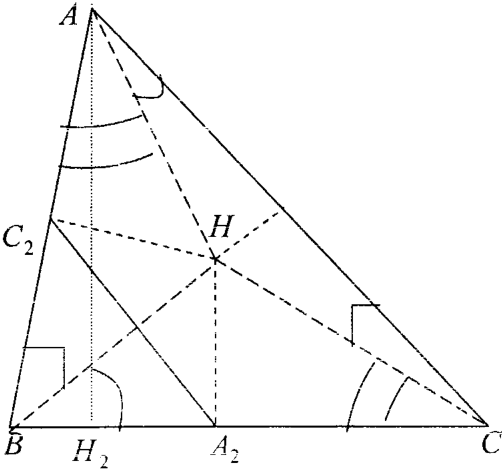
Analogously, . We will next prove that is the orthocenter of . Since we have that . In view of the fact that this implies that , from which . Similarly we obtain that and . From this it easily follows that , which implies that belongs to the altitude of starting at . Analogously, belongs to the other two altitudes of . So, we see that the projection of the point onto the base of the tetrahedron is the orthocenter of the base, and the line segments and are the altitudes of the base (fig. 44).
Consider the (see fig. 45). Since , we have that .
Fig. 44
So the lines and are both perpendicular to the line , which means that the whole plane is perpendicular to . This implies that . Similarly, in the plane we have two non-parallel lines and that are perpendicular to , and so . Analogously, .
Now, since , we have that , and so the triangles and are similar. It follows that . Also we have that and . This implies that . Analogously we can obtain that .
It follows that and finally that .
Analogously, . We will next prove that is the orthocenter of . Since we have that . In view of the fact that this implies that , from which . Similarly we obtain that and . From this it easily follows that , which implies that belongs to the altitude of starting at . Analogously, belongs to the other two altitudes of . So, we see that the projection of the point onto the base of the tetrahedron is the orthocenter of the base, and the line segments and are the altitudes of the base (fig. 44).
Consider the (see fig. 45). Since , we have that .
Fig. 44
So the lines and are both perpendicular to the line , which means that the whole plane is perpendicular to . This implies that . Similarly, in the plane we have two non-parallel lines and that are perpendicular to , and so . Analogously, .
Now, since , we have that , and so the triangles and are similar. It follows that . Also we have that and . This implies that . Analogously we can obtain that .
It follows that and finally that .
Techniques
3D ShapesOther 3D problemsTriangle centers: centroid, incenter, circumcenter, orthocenter, Euler line, nine-point circleAngle chasingDistance chasing