Browse · MathNet
PrintMacedonian Mathematical Olympiad
North Macedonia geometry
Problem
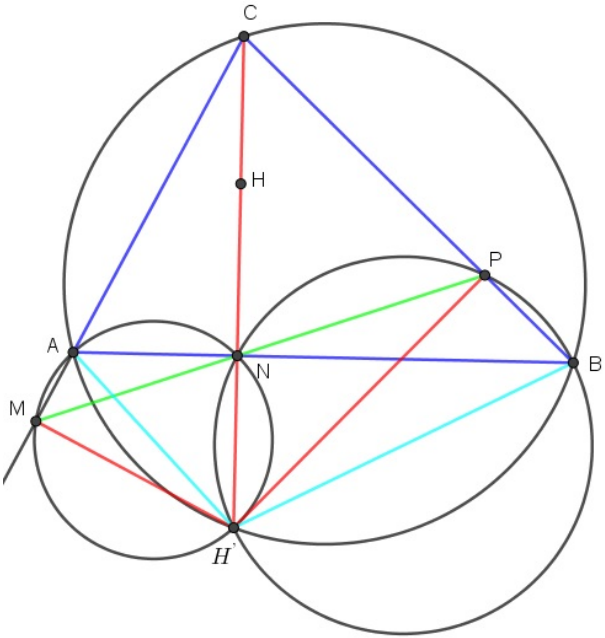
Let be an acute triangle with orthocenter . The point is symmetric with with respect to the line . Let be the intersection point of and . The circle passing through the points , and intersects again the line at , and the circle passing through the points , and intersects again the line at . Prove that the points , and are colinear.
Solution
First, we will show the following lemma.
Lemma. Let be an orthocenter in , and be the symmetric point of with respect to . Then lies on the circle around the triangle .
Proof.
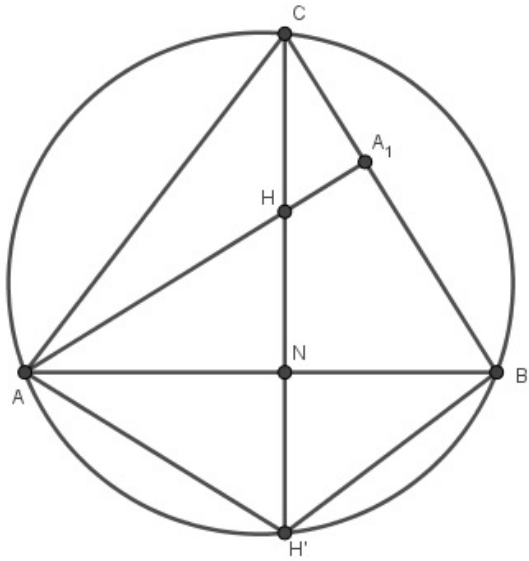
First proof of the lemma. Let be the intersection point of and , and be the foot of the height from towards . Then , since is a common side, and . From it follows that the quadrilateral is cyclic, i.e. lies on the circle around the triangle .
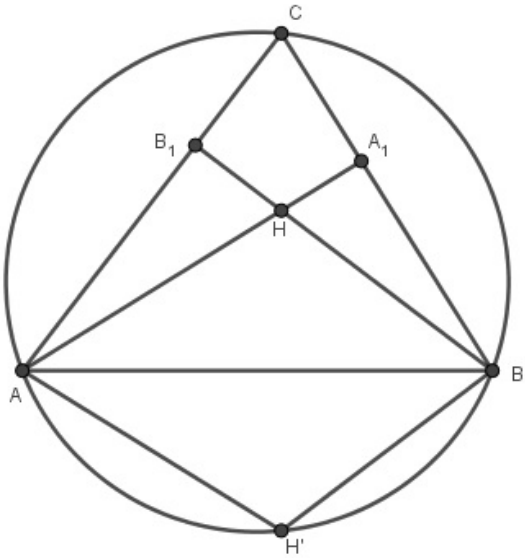
Second proof of the lemma. Let be the foot of the height from towards , and be the foot of the height from towards . From it follows that the quadrilateral is cyclic. Then , i.e. . From and it follows that . Then from It follows that the quadrilateral is cyclic, i.e. lies on the circle around the triangle .
From it follows that is a diameter of the circle around the triangle . Then , i.e.
.\quad (1) H'P \perp BC.\quad (2) H'N \perp AB.\quad (3) Using the lemma, we conclude that the quadrilateral $AH'BC$ is cyclic. From (1), (2), (3) and the theorem of Simpson for $\triangle ABC$ and having in mind that $H'$ lies on the circle around the triangle $\triangle ABC$, it follows the statement of the problem. --- **Alternative solution.** Using the power of point theorem, we have \overline{CA} \cdot \overline{CM} = \overline{CN} \cdot \overline{CH'} = \overline{CP} \cdot \overline{CB}, \text{ i.e. } \overline{CA} \cdot \overline{CM} = \overline{CP} \cdot \overline{CB} \frac{\overline{CM}}{\overline{CP}} = \frac{\overline{CB}}{\overline{CA}}.\quad (1) From the lemma it follows that the quadrilateral $AH'BC$ is cyclic. From $\angle NAC = \alpha$ and $\angle ANC = 90^\circ$ it follows $\angle ACN = 90^\circ - \alpha$. From $\angle ANH' = 90^\circ$ it follows that $AH'$ is a diameter of the circle around the quadrilateral $AMH'N$. Then $\angle AMH' = \angle ANH' = 90^\circ$. From the last and from $\angle MCH' = \angle ACN = 90^\circ - \alpha$, it follows that $\triangle ANC \sim \triangle H'MC$. Then $\frac{AN}{AC} = \frac{H'M}{H'C}$, i.e. \overline{AN} = \frac{\overline{H'M} \cdot \overline{AC}}{\overline{H'C}}.\quad () Similarly, we have that $\triangle BNC \sim \triangle H'PC$, i.e. \frac{BN}{BC} = \frac{H'P}{H'C}, \text{ so } \overline{BN} = \frac{\overline{H'P} \cdot \overline{BC}}{\overline{H'C}}.\quad (*) \frac{\overline{AN}}{BN} = \frac{\frac{\overline{H' M} \cdot \overline{AC}}{\overline{H' C}}}{\frac{\overline{H' P} \cdot \overline{BC}}{\overline{H' C}}} = \frac{\overline{H' M} \cdot \overline{AC}}{\overline{H' P} \cdot \overline{BC}}.\qquad (2) The quadrilateral $AH'BC$ is cyclic, so \angle AH'C = \angle ABC = \beta \quad \text{and} \quad \angle BH'C = \angle BAC = \alpha. Then $\angle H'BN = \angle H'BA = \angle H'CA = 90^\circ - \alpha$. Hence \angle H'BP = \angle H'BN + \angle NBP = 90^\circ - \alpha + \beta = 90^\circ - (\alpha - \beta) \quad \text{ i.e. } \angle PH'B = \alpha - \beta. From $\angle MH'C = \alpha$ it follows \angle MH'A = \angle MH'N - \angle AH'N = \angle MH'N - \angle AH'C = \alpha - \beta \quad \text{ i.e. } \angle MAH' = 90^\circ - (\alpha - \beta). It follows $\triangle H'MA \sim \triangle H'PB$, i.e. $\frac{\overline{H' M}}{MA} = \frac{\overline{H' P}}{PB}$ or \frac{PB}{MA} = \frac{H'P}{H'M}.\qquad (3) From (1), (2) and (3) and Menelaus' theorem for the points $M$, $N$ and $P$ and $\triangle ABC$ we have \frac{\overline{CM}}{MA} \cdot \frac{\overline{AN}}{NB} \cdot \frac{\overline{BP}}{PC} = \frac{\overline{CM}}{PC} \cdot \frac{\overline{AN}}{NB} \cdot \frac{\overline{BP}}{MA} = \frac{\overline{CB}}{CA} \cdot \frac{\overline{H' M} \cdot \overline{AC}}{\overline{H' P} \cdot \overline{BC}} \cdot \frac{\overline{H' P}}{H'M} = 1, $MNP$ are colinear.
Lemma. Let be an orthocenter in , and be the symmetric point of with respect to . Then lies on the circle around the triangle .
Proof.
First proof of the lemma. Let be the intersection point of and , and be the foot of the height from towards . Then , since is a common side, and . From it follows that the quadrilateral is cyclic, i.e. lies on the circle around the triangle .
Second proof of the lemma. Let be the foot of the height from towards , and be the foot of the height from towards . From it follows that the quadrilateral is cyclic. Then , i.e. . From and it follows that . Then from It follows that the quadrilateral is cyclic, i.e. lies on the circle around the triangle .
From it follows that is a diameter of the circle around the triangle . Then , i.e.
.\quad (1) H'P \perp BC.\quad (2) H'N \perp AB.\quad (3) Using the lemma, we conclude that the quadrilateral $AH'BC$ is cyclic. From (1), (2), (3) and the theorem of Simpson for $\triangle ABC$ and having in mind that $H'$ lies on the circle around the triangle $\triangle ABC$, it follows the statement of the problem. --- **Alternative solution.** Using the power of point theorem, we have \overline{CA} \cdot \overline{CM} = \overline{CN} \cdot \overline{CH'} = \overline{CP} \cdot \overline{CB}, \text{ i.e. } \overline{CA} \cdot \overline{CM} = \overline{CP} \cdot \overline{CB} \frac{\overline{CM}}{\overline{CP}} = \frac{\overline{CB}}{\overline{CA}}.\quad (1) From the lemma it follows that the quadrilateral $AH'BC$ is cyclic. From $\angle NAC = \alpha$ and $\angle ANC = 90^\circ$ it follows $\angle ACN = 90^\circ - \alpha$. From $\angle ANH' = 90^\circ$ it follows that $AH'$ is a diameter of the circle around the quadrilateral $AMH'N$. Then $\angle AMH' = \angle ANH' = 90^\circ$. From the last and from $\angle MCH' = \angle ACN = 90^\circ - \alpha$, it follows that $\triangle ANC \sim \triangle H'MC$. Then $\frac{AN}{AC} = \frac{H'M}{H'C}$, i.e. \overline{AN} = \frac{\overline{H'M} \cdot \overline{AC}}{\overline{H'C}}.\quad () Similarly, we have that $\triangle BNC \sim \triangle H'PC$, i.e. \frac{BN}{BC} = \frac{H'P}{H'C}, \text{ so } \overline{BN} = \frac{\overline{H'P} \cdot \overline{BC}}{\overline{H'C}}.\quad (*) \frac{\overline{AN}}{BN} = \frac{\frac{\overline{H' M} \cdot \overline{AC}}{\overline{H' C}}}{\frac{\overline{H' P} \cdot \overline{BC}}{\overline{H' C}}} = \frac{\overline{H' M} \cdot \overline{AC}}{\overline{H' P} \cdot \overline{BC}}.\qquad (2) The quadrilateral $AH'BC$ is cyclic, so \angle AH'C = \angle ABC = \beta \quad \text{and} \quad \angle BH'C = \angle BAC = \alpha. Then $\angle H'BN = \angle H'BA = \angle H'CA = 90^\circ - \alpha$. Hence \angle H'BP = \angle H'BN + \angle NBP = 90^\circ - \alpha + \beta = 90^\circ - (\alpha - \beta) \quad \text{ i.e. } \angle PH'B = \alpha - \beta. From $\angle MH'C = \alpha$ it follows \angle MH'A = \angle MH'N - \angle AH'N = \angle MH'N - \angle AH'C = \alpha - \beta \quad \text{ i.e. } \angle MAH' = 90^\circ - (\alpha - \beta). It follows $\triangle H'MA \sim \triangle H'PB$, i.e. $\frac{\overline{H' M}}{MA} = \frac{\overline{H' P}}{PB}$ or \frac{PB}{MA} = \frac{H'P}{H'M}.\qquad (3) From (1), (2) and (3) and Menelaus' theorem for the points $M$, $N$ and $P$ and $\triangle ABC$ we have \frac{\overline{CM}}{MA} \cdot \frac{\overline{AN}}{NB} \cdot \frac{\overline{BP}}{PC} = \frac{\overline{CM}}{PC} \cdot \frac{\overline{AN}}{NB} \cdot \frac{\overline{BP}}{MA} = \frac{\overline{CB}}{CA} \cdot \frac{\overline{H' M} \cdot \overline{AC}}{\overline{H' P} \cdot \overline{BC}} \cdot \frac{\overline{H' P}}{H'M} = 1, $MNP$ are colinear.
Techniques
Simson lineMenelaus' theoremCyclic quadrilateralsTriangle centers: centroid, incenter, circumcenter, orthocenter, Euler line, nine-point circleAngle chasing