Browse · MathNet
PrintAPMO
geometry
Problem
Let be the circumcentre and the orthocentre of an acute triangle . Prove that the area of one of the triangles , and is equal to the sum of the areas of the other two.
Solution
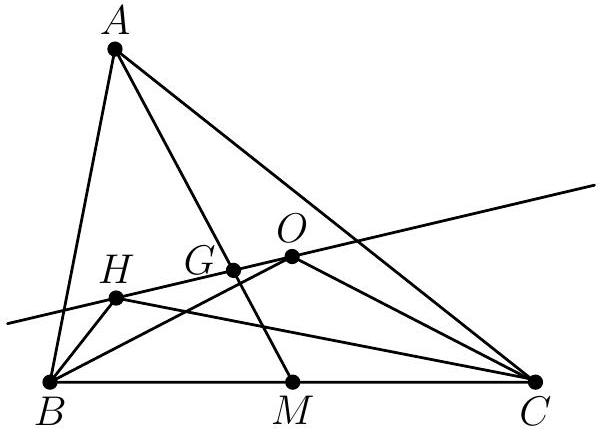
Suppose, without loss of generality, that and lie on the same side of line . Such line is the Euler line of , so the centroid lies on this line.
Let be the midpoint of . Then the distance between and the line is the average of the distances from and to , and the sum of the areas of triangles and is Since , . Hence and the result follows.
---
Alternative solution.
One can use barycentric coordinates: it is well known that Then the (signed) area of is proportional to Adding all three expressions we find that the sum of the signed areas is a constant times By multilinearity of the determinant, this sum equals which contains, in its rows, the coordinates of the centroid, the circumcenter, and the orthocenter. Since these three points lie on the Euler line of , the signed sum of the areas is , which means that one of the areas of , , is the sum of the other two areas.
Let be the midpoint of . Then the distance between and the line is the average of the distances from and to , and the sum of the areas of triangles and is Since , . Hence and the result follows.
---
Alternative solution.
One can use barycentric coordinates: it is well known that Then the (signed) area of is proportional to Adding all three expressions we find that the sum of the signed areas is a constant times By multilinearity of the determinant, this sum equals which contains, in its rows, the coordinates of the centroid, the circumcenter, and the orthocenter. Since these three points lie on the Euler line of , the signed sum of the areas is , which means that one of the areas of , , is the sum of the other two areas.
Techniques
Triangle centers: centroid, incenter, circumcenter, orthocenter, Euler line, nine-point circleIsogonal/isotomic conjugates, barycentric coordinatesDeterminants