Browse · MathNet
PrintAustria2019
Austria 2019 geometry
Problem
A (convex) trapezoid shall be called good if it is inscribed, has parallel sides and , and is shorter than . For a good trapezoid, we fix the following notations. The line parallel to through intersects the line in . The tangents through to the circumcircle of the trapezoid meet the circumcircle in and , respectively, where is on the same side of the line as . Characterize good trapezoids (in terms of the side lengths and/or angles of the trapezoid) for which the angles and are equal. The characterization should be as simple as possible.
Solution
Answer. The angles and are equal if and only if or .
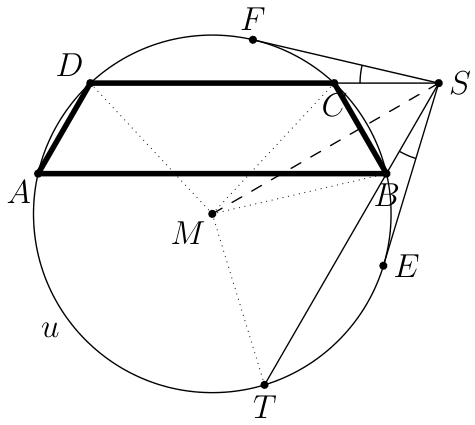
We denote the circumcircle of the trapezoid by , the second intersection point of the line with by and the centre of by , see Figure 4. As the trapezoid is inscribed, it is isosceles. As is a parallelogram by construction, we have and . Figure 4: Problem 14, Case 1: between and
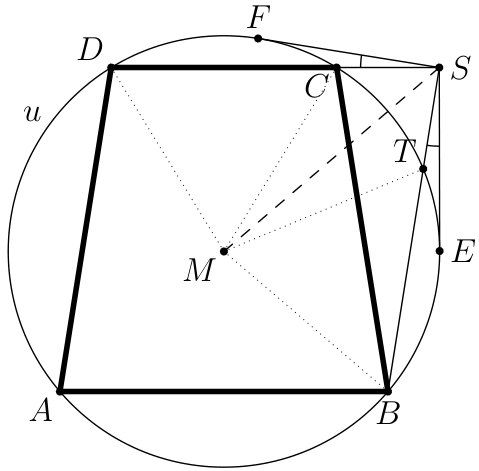
Consider the reflection across the line . It clearly maps and to each other and maps to itself. We say that the trapezoid meets the angle condition if . The trapezoid meets the angle condition if and only if the reflection maps the rays and to each other. Equivalently, the intersection points of these rays with are mapped to each other corresponding to the order of the points on the rays. We first consider the case that is between and , see Figure 4. Then the trapezoid meets the angle condition if and only if the reflection maps and to each other. Equivalently, the triangle is isosceles with axis of symmetry . As lies on the perpendicular bisector of in any case, this is equivalent to . As , this is in turn equivalent to the triangle being equilateral. Again by , this is equivalent to . As is a parallelogram, the trapezoid meets the angle condition in this case if and only if . We now consider the case that lies between and , see Figure 5. Then the above considerations show that the trapezoid meets the angle condition if and only if the reflection maps and to each other. Equivalently, the triangle is isosceles with axis of symmetry . By the same argument as in the first case, this is equivalent to . This is equivalent to .
Figure 5: Problem 14, Case 2: between and
We denote the circumcircle of the trapezoid by , the second intersection point of the line with by and the centre of by , see Figure 4. As the trapezoid is inscribed, it is isosceles. As is a parallelogram by construction, we have and . Figure 4: Problem 14, Case 1: between and
Consider the reflection across the line . It clearly maps and to each other and maps to itself. We say that the trapezoid meets the angle condition if . The trapezoid meets the angle condition if and only if the reflection maps the rays and to each other. Equivalently, the intersection points of these rays with are mapped to each other corresponding to the order of the points on the rays. We first consider the case that is between and , see Figure 4. Then the trapezoid meets the angle condition if and only if the reflection maps and to each other. Equivalently, the triangle is isosceles with axis of symmetry . As lies on the perpendicular bisector of in any case, this is equivalent to . As , this is in turn equivalent to the triangle being equilateral. Again by , this is equivalent to . As is a parallelogram, the trapezoid meets the angle condition in this case if and only if . We now consider the case that lies between and , see Figure 5. Then the above considerations show that the trapezoid meets the angle condition if and only if the reflection maps and to each other. Equivalently, the triangle is isosceles with axis of symmetry . By the same argument as in the first case, this is equivalent to . This is equivalent to .
Figure 5: Problem 14, Case 2: between and
Final answer
The angles ∠BSE and ∠FSC are equal if and only if ∠BAD = 60° or AB = AD.
Techniques
Cyclic quadrilateralsInscribed/circumscribed quadrilateralsTangentsTriangle centers: centroid, incenter, circumcenter, orthocenter, Euler line, nine-point circleAngle chasing