Browse · MathNet
PrintSELECTION EXAMINATION
Greece counting and probability
Problem
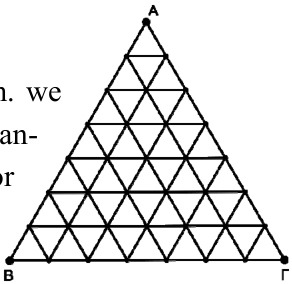
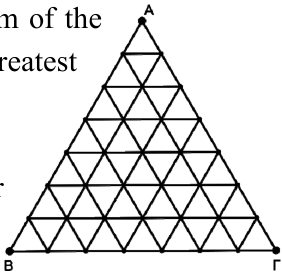
Let be an equilateral triangle of side cm. We divide with parallel lines into small equilateral triangles of side cm. In this way, we create a grid (see figure for ). Inside every small triangle we put exactly one positive integer from to , so that there are not two triangles with the same number. With vertices the points of the grid, we define regular hexagons of side cm. We call the value of a hexagon the sum of the numbers of its 6 small triangles. Find, as a function of , the greatest possible value of the sum of the values of all hexagons.
Solution
The small triangles are divided in four categories.
1st category: They have one vertex or or .
These are not members of any hexagon and so their numbers do not take part in the final sum of values of all hexagons.
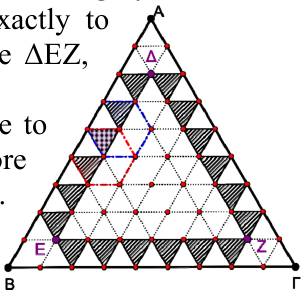
2nd category: Contains small triangles which belong only to one hexagon. On every side of there exist such triangles and so totally we have in this category.
3rd category: Contains small triangles which belong exactly to two hexagons. On every side of there are such triangles and so there are totally triangles in this category.
Note that for the computation of the final sums we must take into account that we will sum two times the numbers of the triangles of the second category.
4th category: Contains small triangles which belong exactly to three hexagons. These triangles are inside the triangle , see figure. These triangles are totally .
In order to obtain the greatest possible sum, we have to put as many as possible big numbers into triangles of higher category (then they will be counted more times). According to this reasoning we must put:
(1) The numbers of the set into the triangles of the first category.
(2) The numbers of the set into triangles of the second category, with partial sum
(3) The numbers of the set into triangles of the third category, with partial sum:
(4) The numbers of the set into triangles of the fourth category, with partial sum:
Hence the greatest possible sum of values is:
Let now be a member of the set and a member of the set . Then in the final sum there exists the summand . In the case of interchange of the position of the members of the sets and , then in the final sum we will have the summand . Since and , it follows that . Hence the sum we have found is the maximal.
1st category: They have one vertex or or .
These are not members of any hexagon and so their numbers do not take part in the final sum of values of all hexagons.
2nd category: Contains small triangles which belong only to one hexagon. On every side of there exist such triangles and so totally we have in this category.
3rd category: Contains small triangles which belong exactly to two hexagons. On every side of there are such triangles and so there are totally triangles in this category.
Note that for the computation of the final sums we must take into account that we will sum two times the numbers of the triangles of the second category.
4th category: Contains small triangles which belong exactly to three hexagons. These triangles are inside the triangle , see figure. These triangles are totally .
In order to obtain the greatest possible sum, we have to put as many as possible big numbers into triangles of higher category (then they will be counted more times). According to this reasoning we must put:
(1) The numbers of the set into the triangles of the first category.
(2) The numbers of the set into triangles of the second category, with partial sum
(3) The numbers of the set into triangles of the third category, with partial sum:
(4) The numbers of the set into triangles of the fourth category, with partial sum:
Hence the greatest possible sum of values is:
Let now be a member of the set and a member of the set . Then in the final sum there exists the summand . In the case of interchange of the position of the members of the sets and , then in the final sum we will have the summand . Since and , it follows that . Hence the sum we have found is the maximal.
Final answer
3(k^4 - 14k^2 + 33k - 24)/2
Techniques
Coloring schemes, extremal argumentsGames / greedy algorithmsCounting two ways