Browse · MathNet
PrintFinal Round
Netherlands geometry
Problem
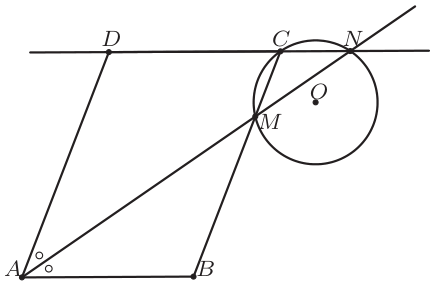
Given is a parallelogram with and . The angular bisector of angle intersects side in and intersects the extension of in . Point is the centre of the circle through , , and . Prove that .
Solution
As an intermediate step, we first show that triangles OCM and OCN are congruent. Since and are parallel, we have (F angles): . Since and are parallel, we have (Z angles): . It follows that , so triangle is isosceles with apex . We obtain . Line segments , , and are radii of the same circle, and therefore of equal length. Triangles and are therefore congruent (three pairs of equal sides).
To show that , we will show that triangles and are congruent. We will do this using the ZHZ-criterion. We will show that , and , and .
The equality follows since and are radii of the same circle. In part (a), we saw triangles and are congruent. Furthermore, these two triangles are isosceles ( and ). Hence, the four base angles , , , and are equal. We see that . The only thing we still need to show is that .
Observe that (Z angles) and (as is the angular bisector of ). We find that . Triangle is therefore isosceles and we have . We previously saw that , and we also have as is a parallelogram. We therefore obtain which concludes the proof.
To show that , we will show that triangles and are congruent. We will do this using the ZHZ-criterion. We will show that , and , and .
The equality follows since and are radii of the same circle. In part (a), we saw triangles and are congruent. Furthermore, these two triangles are isosceles ( and ). Hence, the four base angles , , , and are equal. We see that . The only thing we still need to show is that .
Observe that (Z angles) and (as is the angular bisector of ). We find that . Triangle is therefore isosceles and we have . We previously saw that , and we also have as is a parallelogram. We therefore obtain which concludes the proof.
Techniques
QuadrilateralsCirclesAngle chasing