Browse · MathNet
PrintInternational Mathematical Olympiad Shortlisted Problems
counting and probability
Problem
Let be a positive integer, and consider a sequence of positive integers. Extend it periodically to an infinite sequence by defining for all . If and prove that
Solution
First, we claim that Assume contrariwise that is the smallest counterexample. From and , taking into account the periodicity of our sequence, it follows that Thus our assumption that implies the stronger statement that , which by gives . The minimality of then yields , and (4) becomes contradictory. This establishes our first claim.
In particular we now know that . If , then and the desired inequality holds trivially. Otherwise, consider the number with such that Since and by (2), we have and hence . Therefore if for each positive integer we let be the number of indices satisfying , we have Next we claim that for . Indeed, by and , each with (thus ) belongs to , and for this reason .
It follows from the definition of the \,s and (5) that Adding to both sides and using that for , we get as we wished to prove.
---
Alternative solution.
In the first quadrant of an infinite grid, consider the increasing "staircase" obtained by shading in dark the bottom cells of the th column for . We will prove that there are at most dark cells.
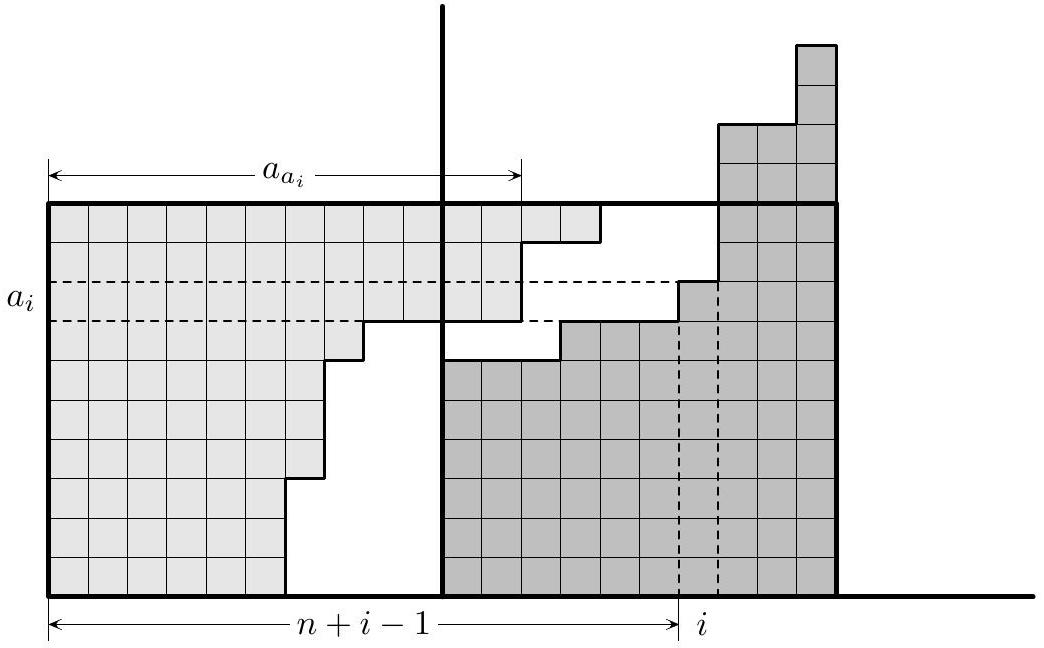
To do it, consider the square in the first quadrant with a vertex at the origin. Also consider the square directly to the left of . Starting from its lower left corner, shade in light the leftmost cells of the th row for . Equivalently, the light shading is obtained by reflecting the dark shading across the line and translating it units to the left. The figure below illustrates this construction for the sequence .
We claim that there is no cell in which is both dark and light. Assume, contrariwise, that there is such a cell in column . Consider the highest dark cell in column which is inside . Since it is above a light cell and inside , it must be light as well. There are two cases:
Case 1.
If then this dark and light cell is , as highlighted in the figure. However, this is the -th cell in row , and we only shaded light cells in that row, a contradiction.
Case 2.
If , this dark and light cell is . This is the -th cell in row and we shaded light cells in this row, so we must have . But by (1) and (2), so implies , contradicting our assumption.
We conclude that there are no cells in which are both dark and light. It follows that the number of shaded cells in is at most .
Finally, observe that if we had a light cell to the right of , then by symmetry we would have a dark cell above , and then the cell would be dark and light. It follows that the number of light cells in equals the number of dark cells outside of , and therefore the number of shaded cells in equals . The desired result follows.
---
Alternative solution.
As in Solution 1, we first establish that for . Now define for and extend the sequence periodically modulo . We claim that this sequence also satisfies the conditions of the problem.
For we have and , so . Also and imply . Finally, the definitions imply that so by (2) and (3). This establishes (1) and (2) for .
Our new sequence has the additional property that which allows us to construct the following visualization: Consider equally spaced points on a circle, sequentially labelled , so point is also labelled . We draw arrows from vertex to vertices for , keeping in mind that by (6). Since by (3), no arrow will be drawn twice, and there is no arrow from a vertex to itself. The total number of arrows is Now we show that we never draw both arrows and for . Assume contrariwise. This means, respectively, that We have by (1), so . Since by (3), this implies that using (1) and (3). But then, using (1) again, implies , which combined with gives us that . This contradicts (2).
This means that the number of arrows is at most , which implies that Recalling that for , the desired inequality follows.
In particular we now know that . If , then and the desired inequality holds trivially. Otherwise, consider the number with such that Since and by (2), we have and hence . Therefore if for each positive integer we let be the number of indices satisfying , we have Next we claim that for . Indeed, by and , each with (thus ) belongs to , and for this reason .
It follows from the definition of the \,s and (5) that Adding to both sides and using that for , we get as we wished to prove.
---
Alternative solution.
In the first quadrant of an infinite grid, consider the increasing "staircase" obtained by shading in dark the bottom cells of the th column for . We will prove that there are at most dark cells.
To do it, consider the square in the first quadrant with a vertex at the origin. Also consider the square directly to the left of . Starting from its lower left corner, shade in light the leftmost cells of the th row for . Equivalently, the light shading is obtained by reflecting the dark shading across the line and translating it units to the left. The figure below illustrates this construction for the sequence .
We claim that there is no cell in which is both dark and light. Assume, contrariwise, that there is such a cell in column . Consider the highest dark cell in column which is inside . Since it is above a light cell and inside , it must be light as well. There are two cases:
Case 1.
If then this dark and light cell is , as highlighted in the figure. However, this is the -th cell in row , and we only shaded light cells in that row, a contradiction.
Case 2.
If , this dark and light cell is . This is the -th cell in row and we shaded light cells in this row, so we must have . But by (1) and (2), so implies , contradicting our assumption.
We conclude that there are no cells in which are both dark and light. It follows that the number of shaded cells in is at most .
Finally, observe that if we had a light cell to the right of , then by symmetry we would have a dark cell above , and then the cell would be dark and light. It follows that the number of light cells in equals the number of dark cells outside of , and therefore the number of shaded cells in equals . The desired result follows.
---
Alternative solution.
As in Solution 1, we first establish that for . Now define for and extend the sequence periodically modulo . We claim that this sequence also satisfies the conditions of the problem.
For we have and , so . Also and imply . Finally, the definitions imply that so by (2) and (3). This establishes (1) and (2) for .
Our new sequence has the additional property that which allows us to construct the following visualization: Consider equally spaced points on a circle, sequentially labelled , so point is also labelled . We draw arrows from vertex to vertices for , keeping in mind that by (6). Since by (3), no arrow will be drawn twice, and there is no arrow from a vertex to itself. The total number of arrows is Now we show that we never draw both arrows and for . Assume contrariwise. This means, respectively, that We have by (1), so . Since by (3), this implies that using (1) and (3). But then, using (1) again, implies , which combined with gives us that . This contradicts (2).
This means that the number of arrows is at most , which implies that Recalling that for , the desired inequality follows.
Techniques
Counting two waysRecursion, bijectionColoring schemes, extremal arguments