Browse · MATH
Printjmc
counting and probability intermediate
Problem
Each square of the three by three grid is painted so that the whole picture has at least the two lines of symmetry indicated. Each grid square is painted one solid color. What is the maximum number of colors that could have been used? 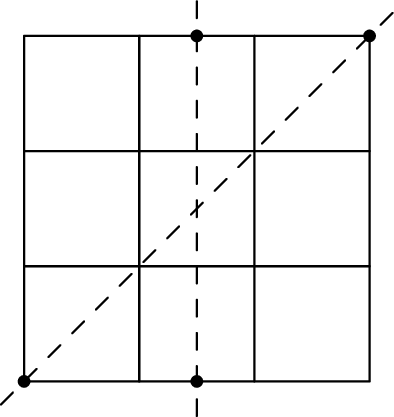
Solution
The color of the center square is unrestricted, so we can call that color 1.
If, without loss of generality, we assign color 2 to the top left corner, the vertical line of symmetry forces the top right square to also be color 2, and the diagonal line of symmetry forces the bottom right square to be color 2, which then, by the vertical line of symmetry, forces the bottom left square to be color 2.
Finally, if, without loss of generality, we assign color 3 to the top middle square, the diagonal line of symmetry forces the right middle square to be color 3, which then, by the vertical line of symmetry, forces the left middle square to be color 3, and this then forces the bottom middle square to also be color 3, by the diagonal line of symmetry. Thus, at most colors may be used.
If, without loss of generality, we assign color 2 to the top left corner, the vertical line of symmetry forces the top right square to also be color 2, and the diagonal line of symmetry forces the bottom right square to be color 2, which then, by the vertical line of symmetry, forces the bottom left square to be color 2.
Finally, if, without loss of generality, we assign color 3 to the top middle square, the diagonal line of symmetry forces the right middle square to be color 3, which then, by the vertical line of symmetry, forces the left middle square to be color 3, and this then forces the bottom middle square to also be color 3, by the diagonal line of symmetry. Thus, at most colors may be used.
Final answer
3