Browse · MathNet
PrintChina Girls' Mathematical Olympiad
China algebra
Problem
(1) Prove that there exist five nonnegative real numbers , , , and with their sum equal to such that for any arrangement of these numbers around a circle, there are always two neighboring numbers with their product not less than .
(2) Prove that for any five nonnegative real numbers with their sum equal to , it is always possible to arrange them around a circle such that there are two neighboring numbers with their product not greater than .
(posed by Qian Zhanwang)
(2) Prove that for any five nonnegative real numbers with their sum equal to , it is always possible to arrange them around a circle such that there are two neighboring numbers with their product not greater than .
(posed by Qian Zhanwang)
Solution
(1) Let , , it is easy to see that, when arranging them around a circle, we can always get two neighboring numbers of , and their product is .
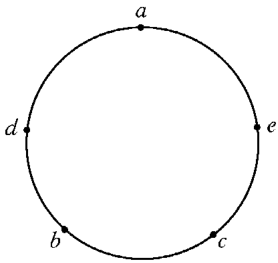
(2) For any five nonnegative real numbers , , , and with their sum equal to , without loss of generality, we assume that . Arrange these numbers around a circle in such a way as seen in the figure:
Since , we have , and then .
Furthermore, , then , i.e. . So Since and , then any neighboring numbers in this arrangement have their product less than .
(2) For any five nonnegative real numbers , , , and with their sum equal to , without loss of generality, we assume that . Arrange these numbers around a circle in such a way as seen in the figure:
Since , we have , and then .
Furthermore, , then , i.e. . So Since and , then any neighboring numbers in this arrangement have their product less than .
Techniques
QM-AM-GM-HM / Power MeanLinear and quadratic inequalitiesCombinatorial optimizationPigeonhole principle