Browse · MathNet
PrintTeam selection tests for GMO 2018
Saudi Arabia 2018 counting and probability
Problem
In a graph with 8 vertices that contains no cycle of length 4, at most how many edges can there be?
Solution
Let denote the set of all vertices. Let be the greatest degree of a vertex in the graph and be a vertex with degree and let be the set of vertices connected to .
In the full subgraph consisting of vertices in , no vertex can have degree 2 or more, because this would make a cycle of length 4. Therefore, there are at most edges in this full subgraph.
Similarly, none of the vertices in can have 2 or more connections to because this would also make a cycle of length 4. Therefore, there are at most edges between and . Finally, the number of edges in is at most , hence - If , . - If , . - If , .
Let us now prove that is not possible by ruling out the two cases with and .
1. If and , then there are exactly 2 edges in the full subgraph consisting of vertices in (each vertex in is connected to exactly one other vertex in ), there are exactly 3 edges between and (each vertex in is connected to exactly 1 vertex in ) and there are exactly 3 edges in (all 3 of the vertices in are connected).
Let us denote the vertices in by . and cannot be connected to the same vertex in , otherwise this would make a cycle of length 4 (for example cyclically connected).
Therefore, exactly 3 of the 4 vertices in are connected to . Since each vertex in is connected to exactly one other vertex in , two of these 3 vertices are connected. Let us call them and let us assume without loss of generality that they are connected to and . Now, we have a cycle of length 4 as are cyclically connected. Therefore, and is not possible.
2. If and , then all vertices in the graph must have degree 3. Let be any vertex and be defined as above. Similarly as above, no vertex in can have 2 or more connections to as this would make a cycle of length 4.
Hence, each vertex in is connected to at most 1 vertex in and thus connected to at least 2 vertices in . If we consider the full subgraph consisting of the 4 vertices in , each vertex has degree at least 2. In a graph with 4 vertices such that each vertex has degree at least 2, there must be a cycle of length 4. Therefore, and is also not possible.
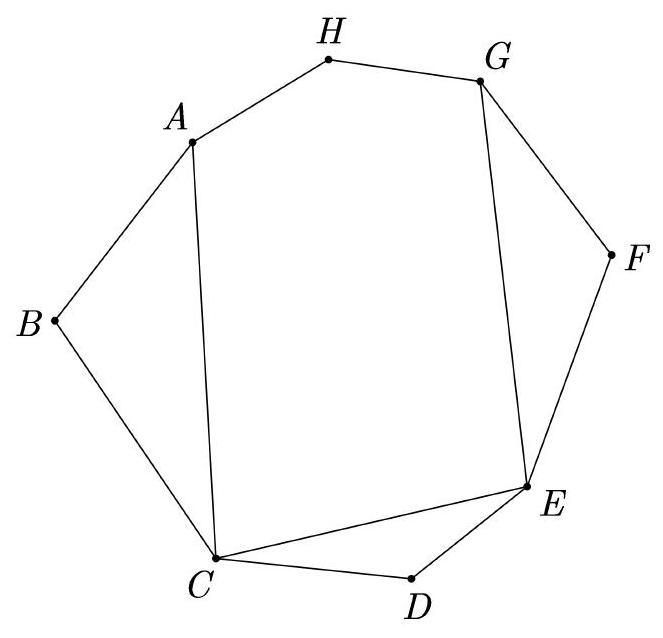
Let us now give an example of a graph with . Consider an octagon . Now, draw the additional three edges . This is a graph with 8 vertices, 11 edges and no cycles of length 4.
In the full subgraph consisting of vertices in , no vertex can have degree 2 or more, because this would make a cycle of length 4. Therefore, there are at most edges in this full subgraph.
Similarly, none of the vertices in can have 2 or more connections to because this would also make a cycle of length 4. Therefore, there are at most edges between and . Finally, the number of edges in is at most , hence - If , . - If , . - If , .
Let us now prove that is not possible by ruling out the two cases with and .
1. If and , then there are exactly 2 edges in the full subgraph consisting of vertices in (each vertex in is connected to exactly one other vertex in ), there are exactly 3 edges between and (each vertex in is connected to exactly 1 vertex in ) and there are exactly 3 edges in (all 3 of the vertices in are connected).
Let us denote the vertices in by . and cannot be connected to the same vertex in , otherwise this would make a cycle of length 4 (for example cyclically connected).
Therefore, exactly 3 of the 4 vertices in are connected to . Since each vertex in is connected to exactly one other vertex in , two of these 3 vertices are connected. Let us call them and let us assume without loss of generality that they are connected to and . Now, we have a cycle of length 4 as are cyclically connected. Therefore, and is not possible.
2. If and , then all vertices in the graph must have degree 3. Let be any vertex and be defined as above. Similarly as above, no vertex in can have 2 or more connections to as this would make a cycle of length 4.
Hence, each vertex in is connected to at most 1 vertex in and thus connected to at least 2 vertices in . If we consider the full subgraph consisting of the 4 vertices in , each vertex has degree at least 2. In a graph with 4 vertices such that each vertex has degree at least 2, there must be a cycle of length 4. Therefore, and is also not possible.
Let us now give an example of a graph with . Consider an octagon . Now, draw the additional three edges . This is a graph with 8 vertices, 11 edges and no cycles of length 4.
Final answer
11
Techniques
Turán's theoremCounting two waysColoring schemes, extremal arguments