Browse · MathNet
PrintTHE 68th NMO SELECTION TESTS FOR THE BALKAN AND INTERNATIONAL MATHEMATICAL OLYMPIADS
Romania geometry
Problem
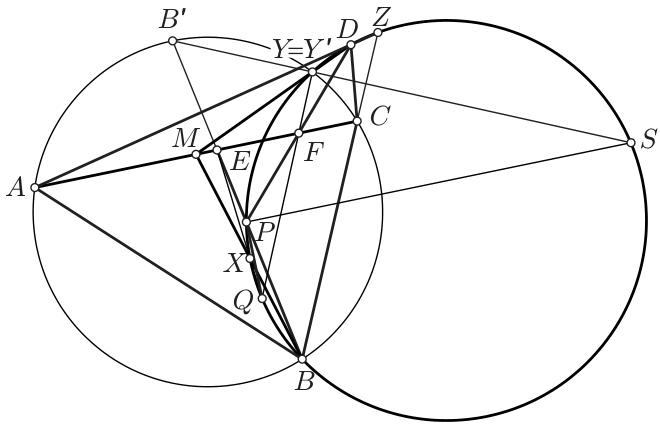
Let be a convex quadrangle such that . The internal bisectrices of the angles and cross the diagonal at and , respectively, and meet at . Let be the midpoint of the diagonal . The segments and cross the circle again at and , respectively, and the lines and meet at . Prove that the lines and are perpendicular.
IMO 2016 Shortlist
IMO 2016 Shortlist
Solution
We first show that lies on the circle . To this end, let be the point on the ray , emanating from , such that . The triangles and are therefore similar and have opposite orientations. Since , so are the triangles and . Hence, using directed angles, , so lies on the circle .
Let the lines and meet at . The equality of directed angles shows that lies on the circle ; and the equality of directed angles shows that so does . Since the angle is acute, , so , and is therefore the point where crosses the circle again. Consequently, , so the latter lies on the circle , by the preceding paragraph.
Next, we show that is the internal bisectrix of the angle . To this end, simply refer to the internal angle bisectrix theorem and the similar triangles above, to write Let now , the internal bisectrix of the angle , cross the circle again at , so the latter is the midpoint of the arc not containing . The line is therefore the external bisectrix of the angle , so it is perpendicular to , by the preceding paragraph.
Let the line through and parallel to meet the line at . To prove the required perpendicularity, we show and perpendicular.
Use directed angles to write , and infer that lies on the circle . Restated, the line through and perpendicular to passes through the point where crosses the circle again, which is . Similarly, the line through and perpendicular to passes through the point where crosses the circle again, which is . Consequently, and are perpendicular to and , respectively, so lies on the circle of which is a diameter. The conclusion follows.
---
Alternative solution.
Begin by noticing that, since , the circles and are reflections of one another across .
We first show that lies on the circle . To this end, let the ray , emanating from , cross the circle at , and let be the reflection of across . By the preceding, lies on the circle and is a parallelogram, so, using directed angles, . The equality of directed angles therefore implies that , so lies on the circle . It follows that and coincide, so lies on the circle . Similarly, lies on the circle .
Next, we show that lies on the circle . To this end, let the perpendicular bisectrix of the segment cross the circle at and , and the circle at and , so that and all lie in the same half-plane relative to the line . Notice that and lie on the bisectrices and , respectively, of the angles and , respectively. Further, notice that and refer to the fact that bisects the angle , to write and infer that bisects the angle , so lies on the line through .
Similarly, lies on the line through . Use directed angles to write , and infer that lies on the circle .
Finally, since and are reflections of one another across , the quadrangle is a parallelogram, so, using directed angles, . This shows that and are parallel; since the latter is perpendicular to , so is the former.
---
Alternative solution.
If one of the vertices , lies on the perpendicular bisectrix of the diagonal , so do both and , and the conclusion follows.
Assuming now that neither nor lie on the perpendicular bisectrix of the diagonal , we show that and project orthogonally to the same point on the line . To this end, project and on the line to and , respectively, and notice that the two coincide if and only if, in terms of directed segments, . Notice that where angles are all directed, so it is sufficient to show that To this end, let the line through and perpendicular to meet the line at . We will prove that are concyclic, so, in terms of directed angles, . Similarly, , so it is sufficient to show that With reference to the sine law, straightforward calculations show that the left-hand member is , the right-hand member is , and the conclusion follows by equality of the two angles.
We still have to prove that are concyclic. Since and are the two bisectrices of the angle , the cross-ratio is harmonic, so .
It is therefore sufficient to show that . To this end, let the lines and meet at , and let the lines and meet at . Use directed angles to write and infer that lies on the circle ; similarly, so does , and the quadrangle is therefore cyclic.
Reflect in the circle , centered at , to obtain . Since lies on the polar of with respect to this circle, the lines and are perpendicular, so lies on the circle on diameter . It follows that reflection in the circle sends to itself, so the two circles are orthogonal. Consequently, the power of with respect to the circle is the square of the radius of ; that is, . This completes the proof.
Let the lines and meet at . The equality of directed angles shows that lies on the circle ; and the equality of directed angles shows that so does . Since the angle is acute, , so , and is therefore the point where crosses the circle again. Consequently, , so the latter lies on the circle , by the preceding paragraph.
Next, we show that is the internal bisectrix of the angle . To this end, simply refer to the internal angle bisectrix theorem and the similar triangles above, to write Let now , the internal bisectrix of the angle , cross the circle again at , so the latter is the midpoint of the arc not containing . The line is therefore the external bisectrix of the angle , so it is perpendicular to , by the preceding paragraph.
Let the line through and parallel to meet the line at . To prove the required perpendicularity, we show and perpendicular.
Use directed angles to write , and infer that lies on the circle . Restated, the line through and perpendicular to passes through the point where crosses the circle again, which is . Similarly, the line through and perpendicular to passes through the point where crosses the circle again, which is . Consequently, and are perpendicular to and , respectively, so lies on the circle of which is a diameter. The conclusion follows.
---
Alternative solution.
Begin by noticing that, since , the circles and are reflections of one another across .
We first show that lies on the circle . To this end, let the ray , emanating from , cross the circle at , and let be the reflection of across . By the preceding, lies on the circle and is a parallelogram, so, using directed angles, . The equality of directed angles therefore implies that , so lies on the circle . It follows that and coincide, so lies on the circle . Similarly, lies on the circle .
Next, we show that lies on the circle . To this end, let the perpendicular bisectrix of the segment cross the circle at and , and the circle at and , so that and all lie in the same half-plane relative to the line . Notice that and lie on the bisectrices and , respectively, of the angles and , respectively. Further, notice that and refer to the fact that bisects the angle , to write and infer that bisects the angle , so lies on the line through .
Similarly, lies on the line through . Use directed angles to write , and infer that lies on the circle .
Finally, since and are reflections of one another across , the quadrangle is a parallelogram, so, using directed angles, . This shows that and are parallel; since the latter is perpendicular to , so is the former.
---
Alternative solution.
If one of the vertices , lies on the perpendicular bisectrix of the diagonal , so do both and , and the conclusion follows.
Assuming now that neither nor lie on the perpendicular bisectrix of the diagonal , we show that and project orthogonally to the same point on the line . To this end, project and on the line to and , respectively, and notice that the two coincide if and only if, in terms of directed segments, . Notice that where angles are all directed, so it is sufficient to show that To this end, let the line through and perpendicular to meet the line at . We will prove that are concyclic, so, in terms of directed angles, . Similarly, , so it is sufficient to show that With reference to the sine law, straightforward calculations show that the left-hand member is , the right-hand member is , and the conclusion follows by equality of the two angles.
We still have to prove that are concyclic. Since and are the two bisectrices of the angle , the cross-ratio is harmonic, so .
It is therefore sufficient to show that . To this end, let the lines and meet at , and let the lines and meet at . Use directed angles to write and infer that lies on the circle ; similarly, so does , and the quadrangle is therefore cyclic.
Reflect in the circle , centered at , to obtain . Since lies on the polar of with respect to this circle, the lines and are perpendicular, so lies on the circle on diameter . It follows that reflection in the circle sends to itself, so the two circles are orthogonal. Consequently, the power of with respect to the circle is the square of the radius of ; that is, . This completes the proof.
Techniques
Cyclic quadrilateralsInversionPolar triangles, harmonic conjugatesAngle chasingTriangle trigonometry