Browse · MathNet
PrintHrvatska 2011
Croatia 2011 counting and probability
Problem
Each side and each diagonal of a convex -gon is colored in one of colors. It is known that there doesn't exist a closed monochrome broken line whose vertices are also the vertices of the given -gon. Determine the largest possible value of . (Russia 1990)
Solution
It is known that a graph with vertices that contains no cycles has at most edges. That fact is easily proven by induction by the number of vertices . Hence, at most edges (i.e. sides and diagonals) can be colored with the same color.
Since the number of colors is and the total number of edges (sides and diagonals) is , we conclude that Let be an arbitrary positive integer. We will show that we can color the sides and diagonals of a regular -gon with colors so that there doesn't exist a closed monochrome broken line (without loss of generality we can assume that the polygon is regular because we only care how the edges are colored). Moreover, we will show that with each of the colors we can color exactly sides and diagonals in the required way.
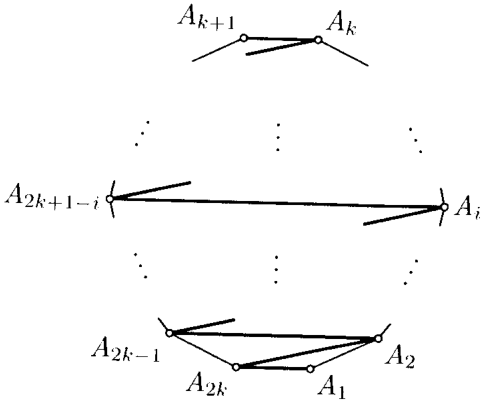
Let us denote the vertices of the regular -gon with . With one color we color the broken line , , as shown on the picture below.
With each following color , we color the broken line obtained by rotating the mentioned one by angle around the center of the polygon.
The broken lines obtained in such a way are disjoint because otherwise one of the diagonals would be left unpainted, and that is not possible.
Therefore, the largest possible value of is .
Since the number of colors is and the total number of edges (sides and diagonals) is , we conclude that Let be an arbitrary positive integer. We will show that we can color the sides and diagonals of a regular -gon with colors so that there doesn't exist a closed monochrome broken line (without loss of generality we can assume that the polygon is regular because we only care how the edges are colored). Moreover, we will show that with each of the colors we can color exactly sides and diagonals in the required way.
Let us denote the vertices of the regular -gon with . With one color we color the broken line , , as shown on the picture below.
With each following color , we color the broken line obtained by rotating the mentioned one by angle around the center of the polygon.
The broken lines obtained in such a way are disjoint because otherwise one of the diagonals would be left unpainted, and that is not possible.
Therefore, the largest possible value of is .
Final answer
2k
Techniques
Graph TheoryColoring schemes, extremal arguments