Browse · MathNet
PrintStars of Mathematics Competition
Romania geometry
Problem
Let and be two points on a circle such that is not a diameter, and let be a point of the line segment , other than its midpoint. Circles and are interiorly tangent to the circle at and , respectively. They both pass through and intersect again at . The line intersects circle at and . Circle intersects line segments and at and , respectively, while circle intersects line segments and at and , respectively. Prove that:
a) the quadrilateral is an isosceles trapezoid;
b) is the midpoint of the line segment .
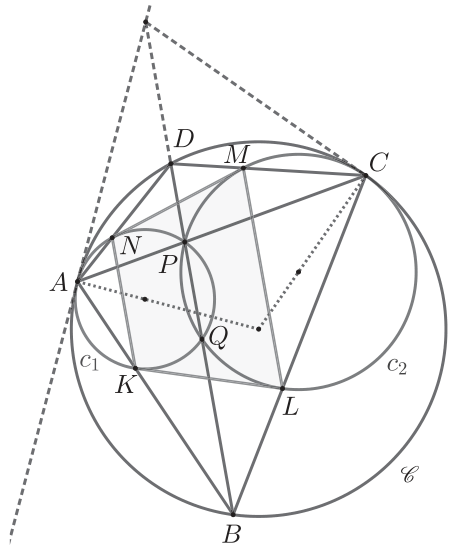
a) the quadrilateral is an isosceles trapezoid;
b) is the midpoint of the line segment .
Solution
a) Point lies on the radical axis, , of circles and , therefore , which indicates that the quadrilateral is cyclic. So is . It follows that . The angle between the tangent at to the circle (which is also tangent to ) with line subtends arcs of circle and of circle , and therefore . We obtain that and, similarly, . (This fact also follows from the homotheties that transform circles , and , respectively, into .) Finally, . Similarly, , which leads to the conclusion. Alternatively, one could have noticed that line segments , and share the same perpendicular bisector.
b) The radical axes of circles , , (one for each pair of circles), i.e., the tangent line to at , the tangent line to at and the line are not all parallel, therefore they are concurrent in the radical center. Diagonal is then a symmedian of triangle , which means that quadrilateral is harmonic. (One can also use this fact to give a different proof to a).)
As is an isosceles trapezoid, it follows that , which means that rays and are isogonal with respect to angle ). But being harmonic, is a symmedian of triangle , therefore , which is its isogonal, is the median.
---
Alternative solution.
Alternative Solution. One could use a property of harmonic quadrilaterals that was put into evidence by the Danube Mathematical Competition from the same year: If is the midpoint of diagonal of a harmonic quadrilateral , then .
One proves that is the only point on the line segment that has the property from above. Next, one proves that point does have the property, which makes it the midpoint of .
b) The radical axes of circles , , (one for each pair of circles), i.e., the tangent line to at , the tangent line to at and the line are not all parallel, therefore they are concurrent in the radical center. Diagonal is then a symmedian of triangle , which means that quadrilateral is harmonic. (One can also use this fact to give a different proof to a).)
As is an isosceles trapezoid, it follows that , which means that rays and are isogonal with respect to angle ). But being harmonic, is a symmedian of triangle , therefore , which is its isogonal, is the median.
---
Alternative solution.
Alternative Solution. One could use a property of harmonic quadrilaterals that was put into evidence by the Danube Mathematical Competition from the same year: If is the midpoint of diagonal of a harmonic quadrilateral , then .
One proves that is the only point on the line segment that has the property from above. Next, one proves that point does have the property, which makes it the midpoint of .
Techniques
Radical axis theoremTangentsHomothetyCyclic quadrilateralsBrocard point, symmediansIsogonal/isotomic conjugates, barycentric coordinatesPolar triangles, harmonic conjugatesAngle chasing