Browse · MathNet
Print22nd Chinese Girls' Mathematical Olympiad
China counting and probability
Problem
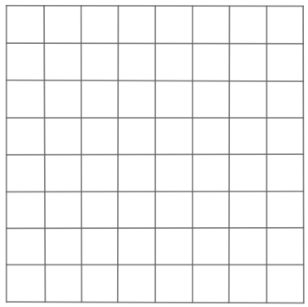
As shown below, a square grid of side length is constructed by sticks of length . Find the least number of sticks to be removed so that the resulting figure contains no rectangle.
Solution
The answer is .
First, we prove that at least sticks must be removed. Suppose the figure does not contain any rectangles, then each bounded connected area must consist of at least three unit squares, i.e., the area is at least . Therefore, there can be at most bounded connected areas. Removing one stick can at most reduce the number of bounded connected areas by (either by merging two bounded areas into one, or by merging a bounded area with an unbounded area). Initially, there are bounded connected areas, so at least sticks must be removed.
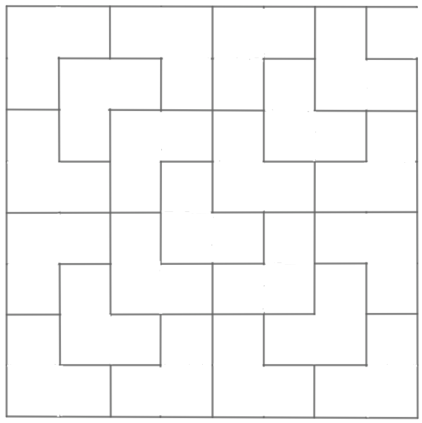
The figure below shows an example of removing sticks, where each bounded connected area has an area of , and the figure does not contain any rectangles.
First, we prove that at least sticks must be removed. Suppose the figure does not contain any rectangles, then each bounded connected area must consist of at least three unit squares, i.e., the area is at least . Therefore, there can be at most bounded connected areas. Removing one stick can at most reduce the number of bounded connected areas by (either by merging two bounded areas into one, or by merging a bounded area with an unbounded area). Initially, there are bounded connected areas, so at least sticks must be removed.
The figure below shows an example of removing sticks, where each bounded connected area has an area of , and the figure does not contain any rectangles.
Final answer
43
Techniques
Invariants / monovariantsColoring schemes, extremal arguments