Browse · MathNet
PrintThe 16th Japanese Mathematical Olympiad - The Final Round
Japan counting and probability
Problem
and are positive integers with , , and . There is a rectangular town like a chessboard with avenues and streets. represents the intersection of the -th avenue from the west and the -th street from the north. For which there exists a path from to passing all the intersections exactly once?


Solution
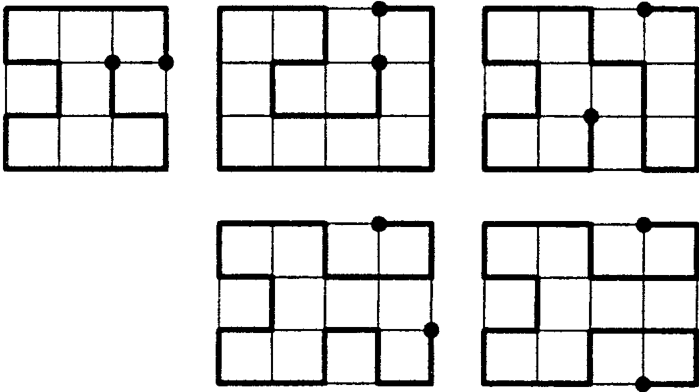
By walking one block from one intersection to another, the sum of the coordinates changes its parity. Since there are totally blocks in the way, must satisfy one of the followings: (1) is odd, and both and are even, or (2) is even, and one of and is odd and the other is even. However, even if (1) or (2) holds, there are no such paths if one of the followings are satisfied (see Fig. 1): (3) and , or (4) is even, ( or ) and • is odd and , or • is even and . Figure 1: These examples satisfy (3) or (4), so there is no such paths.
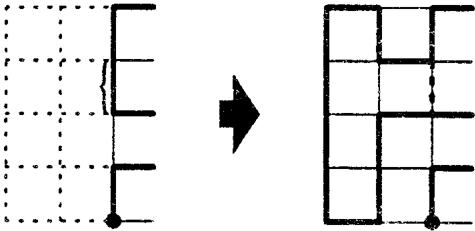
Now we take arbitrary satisfying and prove, by induction, the existence of a path with the required conditions. (1) or (2) satisfied, and neither (3) nor (4) satisfied. For , see Fig. 2. Let and assume, as presumption of the induction, that such paths exist for and any and satisfying . Figure 2: When or , the positions of and are the same as one of those in the figure, allowing rotation and reversing. In any cases in the figure, there exists a path satisfying the required conditions. When both and are greater than 2, excluding the cases mentioned in Fig. 3, there is a path which passes all the intersections on third to -th avenue exactly once, because of the presumption of the induction. Since such paths always contain some part of the third avenue, one can expand that part as Fig. 4 and get a path which satisfies the required conditions. One can prove similarly the case both and are less than . Reversing the direction if necessary, we may assume and . Reversing the whole town if necessary, we may assume is even. Start from and go to via all the intersections on the first and second avenue. Walk one block to the east. From that intersection, because of the presumption of the induction, there is a path to via all the rest intersections.
Figure 3: The positions of and which don't meet if the two avenues are removed from the west are the case in the figure, and the upside-down version of it. In both cases in the figure, there are a way satisfying the conditions in the problem. Figure 4: Expand a block of the third avenue.
Now we take arbitrary satisfying and prove, by induction, the existence of a path with the required conditions. (1) or (2) satisfied, and neither (3) nor (4) satisfied. For , see Fig. 2. Let and assume, as presumption of the induction, that such paths exist for and any and satisfying . Figure 2: When or , the positions of and are the same as one of those in the figure, allowing rotation and reversing. In any cases in the figure, there exists a path satisfying the required conditions. When both and are greater than 2, excluding the cases mentioned in Fig. 3, there is a path which passes all the intersections on third to -th avenue exactly once, because of the presumption of the induction. Since such paths always contain some part of the third avenue, one can expand that part as Fig. 4 and get a path which satisfies the required conditions. One can prove similarly the case both and are less than . Reversing the direction if necessary, we may assume and . Reversing the whole town if necessary, we may assume is even. Start from and go to via all the intersections on the first and second avenue. Walk one block to the east. From that intersection, because of the presumption of the induction, there is a path to via all the rest intersections.
Figure 3: The positions of and which don't meet if the two avenues are removed from the west are the case in the figure, and the upside-down version of it. In both cases in the figure, there are a way satisfying the conditions in the problem. Figure 4: Expand a block of the third avenue.
Final answer
There exists such a path if and only if the parity condition holds and none of the small obstructions occur. Precisely: (i) If the total number of intersections mn is odd, then both a+b and a'+b' are even; or (ii) if mn is even, then exactly one of a+b and a'+b' is odd. In addition, the following exceptional cases admit no such path: (iii) m = 2 and b = b' with b not equal to 1 or n; (iv) m = 3, n even, and either b' − b > 1 or a = a' = 2, together with the orientation constraint that if a+b is odd then b < b', and if a+b is even then b > b'.
Techniques
Graph TheoryColoring schemes, extremal argumentsInduction / smoothing