Browse · MathNet
PrintRioplatense Mathematical Olympiad
Argentina geometry
Problem
Initially we have a paper triangle such that . In the first step, we draw the angle bisectors of the three angles of the triangle, which intersect in , and then using a pair of scissors we cut along segments , and , obtaining 3 triangles: , and . In the second step we repeat the same procedure with the three triangles, that is: each one of those is cut into three smaller triangles cutting along the angle bisectors. At the end of the second step we have 9 triangles in total. This procedure continues in the same way until we complete 10 steps. How many of the triangles at the end of the process have an angle of ?
Solution
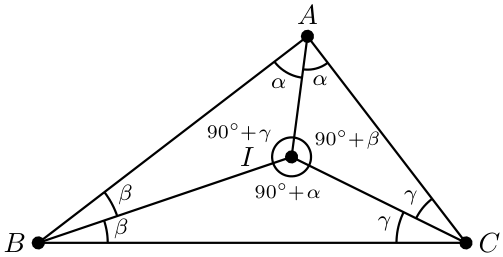
Let , and . Notice that , and if is the incenter of we can compute , , in terms of these variables.
Fact 1: The number of angles in any step of the process is equal to the number of angles in the next step. Proof: It suffices to prove that each angle generates a angle, and that every angle is generated by a angle. The first statement is clear: if, say, , then . For the second statement, observe that the only way we can obtain a angle is if one of the angles at I measures , because those are the only obtuse angles generated. For this to be true, one of our variables must be equal to , which in turn means one of the angles of ABC must be . Fact 2: The number of angles in any step of the process is half the number of angles in the next step. Proof: When performing a step, every angle gets divided into two angles. Moreover, this is the only way of obtaining a angle. Using these two facts we can readily complete the following table, which shows the answer is .
Fact 1: The number of angles in any step of the process is equal to the number of angles in the next step. Proof: It suffices to prove that each angle generates a angle, and that every angle is generated by a angle. The first statement is clear: if, say, , then . For the second statement, observe that the only way we can obtain a angle is if one of the angles at I measures , because those are the only obtuse angles generated. For this to be true, one of our variables must be equal to , which in turn means one of the angles of ABC must be . Fact 2: The number of angles in any step of the process is half the number of angles in the next step. Proof: When performing a step, every angle gets divided into two angles. Moreover, this is the only way of obtaining a angle. Using these two facts we can readily complete the following table, which shows the answer is .
| Step | 1 | 2 | 3 | 4 | 5 | 6 | 7 | 8 | 9 | 10 |
|---|---|---|---|---|---|---|---|---|---|---|
| Measure | 60° | 120° | 60° | 120° | 60° | 120° | 60° | 120° | 60° | 120° |
| Angles | 2 | 2 | 4 | 4 | 8 | 8 | 16 | 16 | 32 | 32 |
Final answer
32
Techniques
Triangle centers: centroid, incenter, circumcenter, orthocenter, Euler line, nine-point circleAngle chasingRecursion, bijection