Browse · MathNet
PrintVMO
Vietnam geometry
Problem
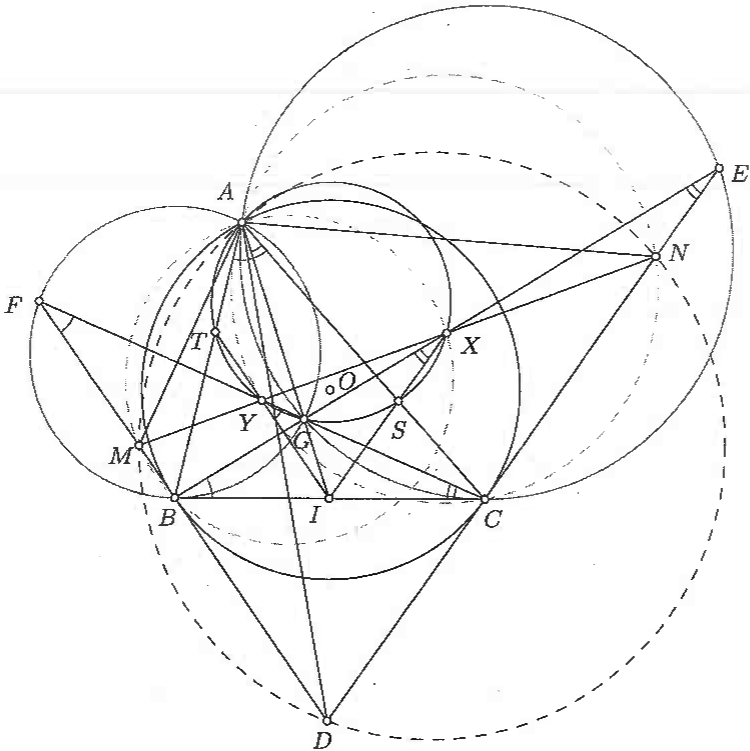
Let be the intersection of the two tangent lines of at and . The circle passing through and tangent to at intersects the median passing of the triangle at . Lines , intersect , at respectively.
a) The line passing through the midpoints of and cuts , at respectively. Prove that the points and lie on a same circle.
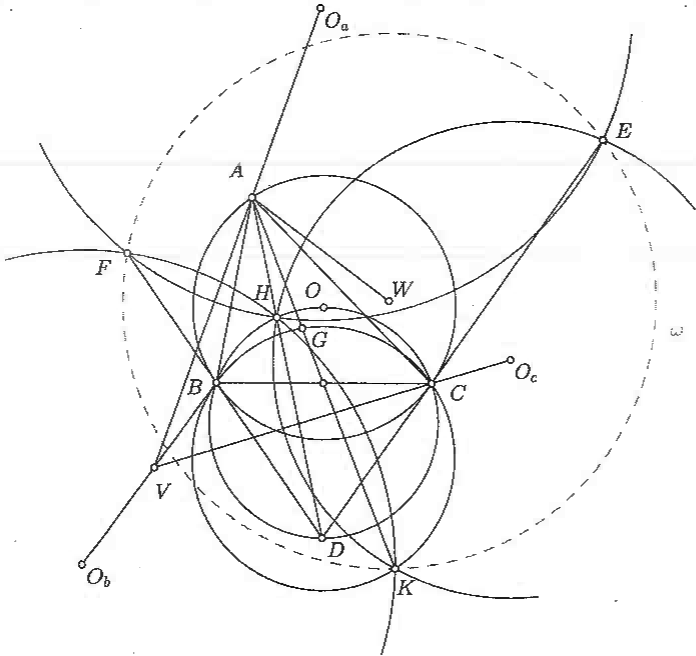
b) Lines intersect the circumcircle of at respectively. The perpendicular bisectors of , and cut and at and respectively. Prove that the points and are collinear.
a) The line passing through the midpoints of and cuts , at respectively. Prove that the points and lie on a same circle.
b) Lines intersect the circumcircle of at respectively. The perpendicular bisectors of , and cut and at and respectively. Prove that the points and are collinear.
Solution
a) Let , and be the midpoints of , and , respectively. Let , intersect , at , respectively. Since is tangent to , we have so is tangent to as well. Since , are midpoints of , , we have is parallel to , then , and thus and are concyclic, so .
Similarly, implying that and lie on the same circle.
Hence, . Therefore, and lie on the same circle. Similarly, and lie on the same circle. Thus, we have , and . So we have implying that and lie on the same circle.
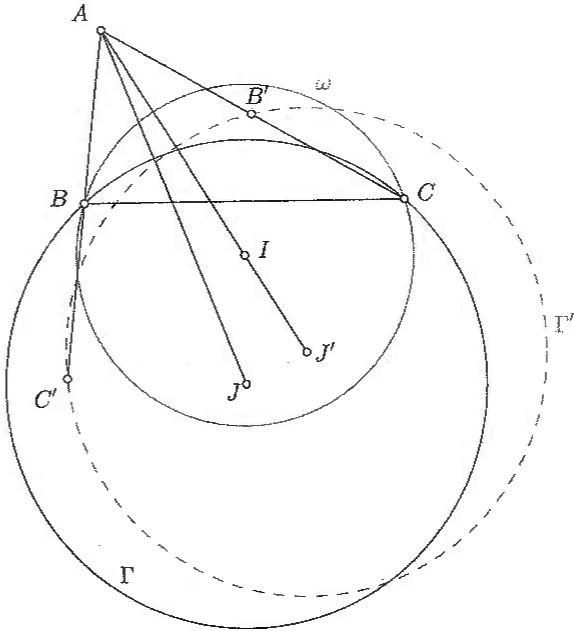
b) For a triangle , define the transformation namely , which is the union of the inversion of center , power , and the reflection through the angle bisector of . First, let prove the following lemma
Lemma. Let be a triangle and be a circle through . Assume that transforms into , then are isogonal with respect to .
Proof. We have the inversion with center and power transforms into , and are collinear due to the property of the inversion. Then after the reflection through the bisector of , transforms to . This implies that are isogonal with respect to angle .
Back to our main problem, let and be the centers of , and . Note that are the mutual intersections of the perpendicular bisectors of , so the perpendicular bisectors of and are precisely the lines and . By Desargue's theorem, and are collinear if and only if and are concurrent. So we will show that indeed and concur.
Let be the center of the circle . Now let's consider the transformation . Since and , we have , and thus and are isogonal with respect to . So turns to and vice versa, and hence it transforms to and vice versa. Since , and are isogonal with respect to , the transformation will transform to and vice versa. Now, we have and similarly , then , thus Also, since , , are isogonal with respect to . Hence turns to each other and hence it turns and to each other. By the lemma, we have and are isogonal with respect to angle .
Using this similar argument, we can show that turns to each other, by noting that so , and . It also turns to each other since and , so . Thus, this transformation turns and to each other, and by the lemma, are isogonal with respect to . Similarly, we can show that are isogonal with respect to . Hence, and will concur on the isogonal conjugate of with respect to triangle . The proof is completed.
Similarly, implying that and lie on the same circle.
Hence, . Therefore, and lie on the same circle. Similarly, and lie on the same circle. Thus, we have , and . So we have implying that and lie on the same circle.
b) For a triangle , define the transformation namely , which is the union of the inversion of center , power , and the reflection through the angle bisector of . First, let prove the following lemma
Lemma. Let be a triangle and be a circle through . Assume that transforms into , then are isogonal with respect to .
Proof. We have the inversion with center and power transforms into , and are collinear due to the property of the inversion. Then after the reflection through the bisector of , transforms to . This implies that are isogonal with respect to angle .
Back to our main problem, let and be the centers of , and . Note that are the mutual intersections of the perpendicular bisectors of , so the perpendicular bisectors of and are precisely the lines and . By Desargue's theorem, and are collinear if and only if and are concurrent. So we will show that indeed and concur.
Let be the center of the circle . Now let's consider the transformation . Since and , we have , and thus and are isogonal with respect to . So turns to and vice versa, and hence it transforms to and vice versa. Since , and are isogonal with respect to , the transformation will transform to and vice versa. Now, we have and similarly , then , thus Also, since , , are isogonal with respect to . Hence turns to each other and hence it turns and to each other. By the lemma, we have and are isogonal with respect to angle .
Using this similar argument, we can show that turns to each other, by noting that so , and . It also turns to each other since and , so . Thus, this transformation turns and to each other, and by the lemma, are isogonal with respect to . Similarly, we can show that are isogonal with respect to . Hence, and will concur on the isogonal conjugate of with respect to triangle . The proof is completed.
Techniques
TangentsDesargues theoremInversionIsogonal/isotomic conjugates, barycentric coordinatesAngle chasingCyclic quadrilaterals