Browse · MATH
Printjmc
geometry intermediate
Problem
In the diagram, the four points have coordinates , , , and . What is the area of quadrilateral ? 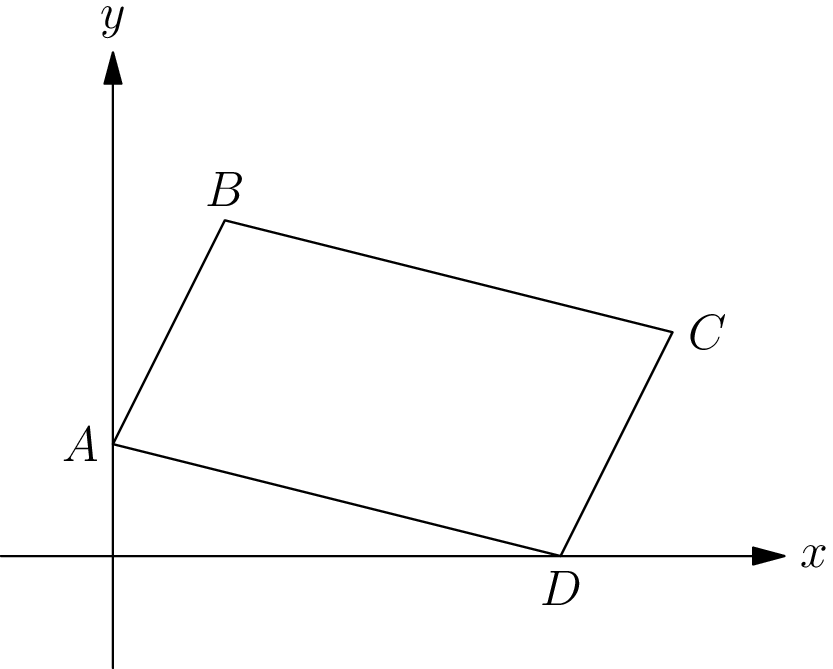
Solution
We draw a horizontal line through (meeting the -axis at ) and a vertical line through (meeting the -axis at ). Suppose the point of intersection of these two lines is . We know that has coordinates (since has -coordinate 3) and has coordinates (since has -coordinate 5), so has coordinates .
Using the given coordinates, , , , , , , , and .
The area of equals the area of minus the areas of triangles , , , and .
is a rectangle, so it has area .
Triangles and have bases and of length 1 and heights and of length 2, so each has area Triangles and have bases and of length 4 and heights and of length 1, so each has area Thus, the area of is (Alternatively, we could notice that is a parallelogram. Therefore, if we draw the diagonal , the area is split into two equal pieces. Dropping a perpendicular from to on the -axis produces a trapezoid from which only two triangles need to be removed to determine half of the area of .)
Using the given coordinates, , , , , , , , and .
The area of equals the area of minus the areas of triangles , , , and .
is a rectangle, so it has area .
Triangles and have bases and of length 1 and heights and of length 2, so each has area Triangles and have bases and of length 4 and heights and of length 1, so each has area Thus, the area of is (Alternatively, we could notice that is a parallelogram. Therefore, if we draw the diagonal , the area is split into two equal pieces. Dropping a perpendicular from to on the -axis produces a trapezoid from which only two triangles need to be removed to determine half of the area of .)
Final answer
9