Browse · MathNet
PrintUSA TSTST
United States counting and probability
Problem
Let denote the set of ordered pairs of positive integers. A finite subset of is stable if whenever is in , then so are all points of with both and . Prove that if is a stable set, then among all stable subsets of (including the empty set and itself), at least half of them have an even number of elements.
Solution
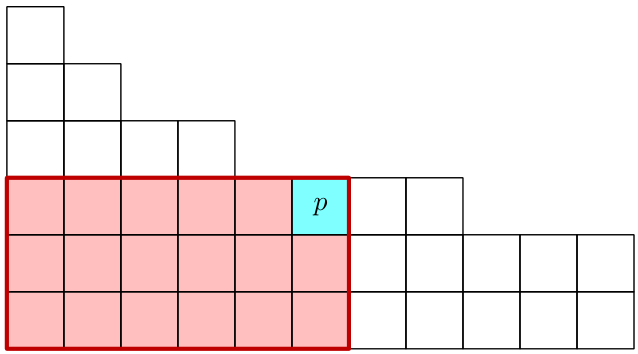
Suppose . For any , let denote the stable rectangle with upper-right corner . We say such is pivotal if and is even.
Claim — If , then a pivotal always exists. Proof. Consider the top row of . If it has length at least 2, one of the two rightmost points in it is pivotal. Otherwise, the top row has length 1. Now either the top point or the point below it (which exists as ) is pivotal. We describe how to complete the induction, given some pivotal . There is a partition where and are the sets of points in above and to the right of (possibly empty). Claim — The desired inequality holds for stable subsets containing . Proof. Let denote the number of even stable subsets of ; denote , , analogously. The stable subsets containing are exactly , where and are stable. Since is even, exactly stable subsets containing are even, and exactly are odd. As and by inductive hypothesis, we obtain as desired. By the inductive hypothesis, the desired inequality also holds for stable subsets not containing , so we are done.
Claim — If , then a pivotal always exists. Proof. Consider the top row of . If it has length at least 2, one of the two rightmost points in it is pivotal. Otherwise, the top row has length 1. Now either the top point or the point below it (which exists as ) is pivotal. We describe how to complete the induction, given some pivotal . There is a partition where and are the sets of points in above and to the right of (possibly empty). Claim — The desired inequality holds for stable subsets containing . Proof. Let denote the number of even stable subsets of ; denote , , analogously. The stable subsets containing are exactly , where and are stable. Since is even, exactly stable subsets containing are even, and exactly are odd. As and by inductive hypothesis, we obtain as desired. By the inductive hypothesis, the desired inequality also holds for stable subsets not containing , so we are done.
Techniques
Induction / smoothingInvariants / monovariantsColoring schemes, extremal arguments