Browse · MathNet
PrintXXXI Brazilian Math Olympiad
Brazil counting and probability
Problem
Carlitos has several pieces formed by four unit squares, shaped as an L: 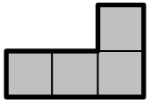 He assembles bigger figures with these pieces, making them share one or more sides of the little squares. In the following example, the figure in the left was assembled by two pieces sharing a unit side. The figures are not allowed to have holes.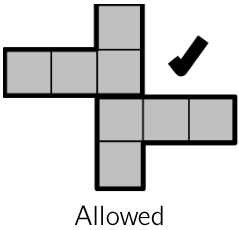

a) Draw a figure with perimeter .
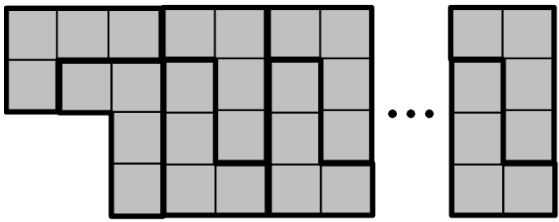
b) Describe how is it possible to obtain a figure with perimeter .
c) Is it possible to obtain a figure with odd perimeter? Justify your answer.
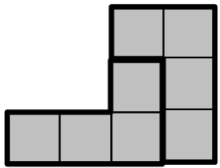
a) Draw a figure with perimeter .
b) Describe how is it possible to obtain a figure with perimeter .
c) Is it possible to obtain a figure with odd perimeter? Justify your answer.
Solution
a) For example, (of course, there are other possibilities)
b) For example, which consists of a rectangle with dimensions minus a square of side .
c) No, it's not possible, because is odd. Each piece has perimeter , which is even, and each junction between a piece and a figure adds to the perimeter minus twice the number of the common sides of the piece and the figure. Hence the perimeter of every figure is always even.
b) For example, which consists of a rectangle with dimensions minus a square of side .
c) No, it's not possible, because is odd. Each piece has perimeter , which is even, and each junction between a piece and a figure adds to the perimeter minus twice the number of the common sides of the piece and the figure. Hence the perimeter of every figure is always even.
Final answer
a) One can arrange the pieces to obtain a figure with perimeter fourteen (for example, as in the provided sample drawing). b) Construct a rectangle of four by one thousand one using the pieces and remove a two by two corner notch; this yields perimeter two thousand ten. c) No; an odd perimeter is impossible because every such figure has even perimeter.
Techniques
Invariants / monovariantsConstructions and loci