Browse · MathNet
PrintTHE 68th NMO SELECTION TESTS FOR THE JUNIOR BALKAN MATHEMATICAL OLYMPIAD
Romania geometry
Problem
The incircle of triangle touches the sides , , and at , , and respectively. On the line segments , , and , consider the points , , and respectively such that the sums , , and are minimum.
a) Prove that the lines , , and are concurrent.
b) Prove that , and are the altitudes of triangle .
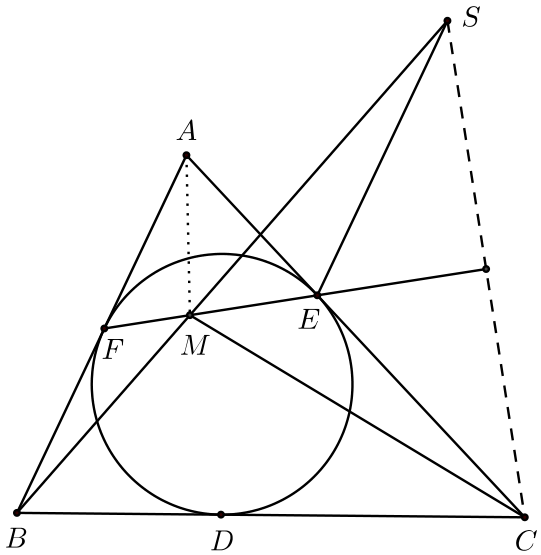
a) Prove that the lines , , and are concurrent.
b) Prove that , and are the altitudes of triangle .
Solution
a) Let be the reflection of across the line . As , it follows that , hence , therefore and are parallel. is a trapezoid (or a parallelogram); let be the intersection point of its diagonals. According to the billiards problem, is the point of the line for which the sum is minimum. Triangles and are similar, therefore . It follows that . Multiplying this with the two analogous relations we get By the converse of the trigonometric form of Ceva's theorem, it follows that the lines , , and are concurrent.
b) We have , hence, from a well-known problem ("The gliding bisector Theorem") it follows that is parallel to the bisector of angle . The bisector is perpendicular to , therefore is also perpendicular to .
b) We have , hence, from a well-known problem ("The gliding bisector Theorem") it follows that is parallel to the bisector of angle . The bisector is perpendicular to , therefore is also perpendicular to .
Techniques
Ceva's theoremTangentsTriangle trigonometryOptimization in geometryAngle chasingTriangle centers: centroid, incenter, circumcenter, orthocenter, Euler line, nine-point circle