Browse · harp
Printjmc
geometry junior
Problem
A large square region is paved with gray square tiles, each measuring inches on a side. A border inches wide surrounds each tile. The figure below shows the case for . When , the gray tiles cover of the area of the large square region. What is the ratio for this larger value of 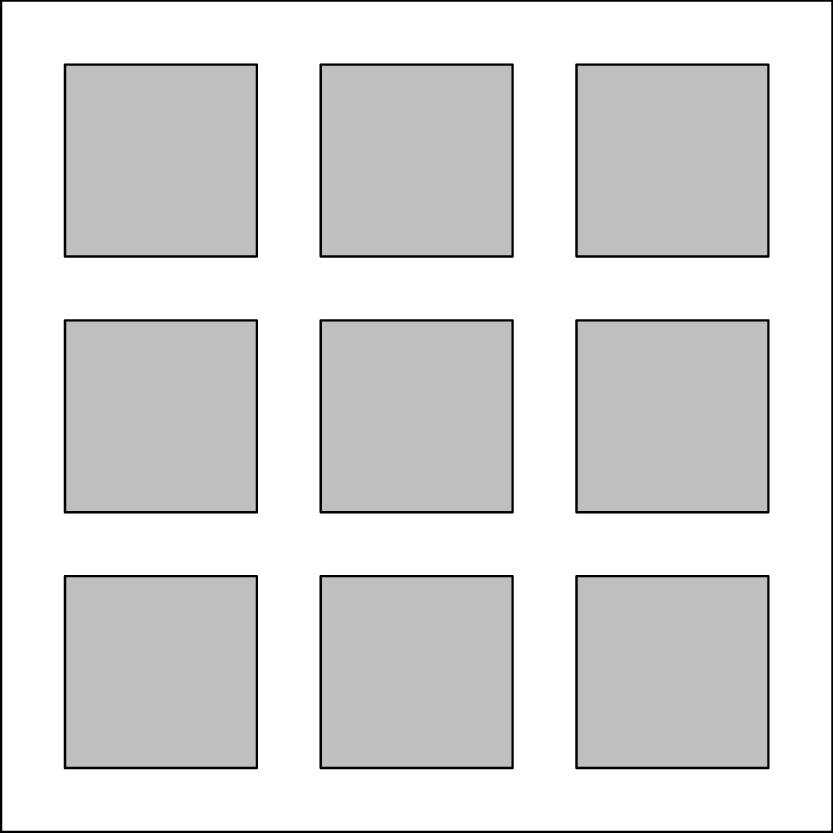
(A)
(B)
(C)
(D)
Solution
The area of the shaded region is . To find the area of the large square, we note that there is a -inch border between each of the pairs of consecutive squares, as well as from between first/last squares and the large square, for a total of times the length of the border, i.e. . Adding this to the total length of the consecutive squares, which is , the side length of the large square is , yielding the equation . Taking the square root of both sides (and using the fact that lengths are non-negative) gives , and cross-multiplying now gives . Note: Once we obtain to ease computation, we may take the reciprocal of both sides to yield so Multiplying both sides by yields the same answer as before.
Final answer
A