Browse · MathNet
Print59th Ukrainian National Mathematical Olympiad
Ukraine counting and probability
Problem
A table has positive integers in its cells so that the sum of numbers in any two cells that share common side is a factorial of a positive integer. Show that there are at least equal numbers in the table. The factorial of a positive integer is a product .
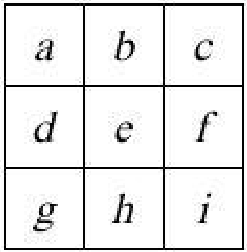 Fig. 5
Solution
We will start with the following lemma. Lemma 1. There exists a diagonal that has two equal numbers for any square. Proof. Let be the greatest number in square. Let his neighbors in this square be and . Clearly, they are located on a diagonal, so if , the lemma is proven. Suppose . Then , thus . It is also clear that . But then that leads to a contradiction. This finishes the proof of Lemma 1.
By contradiction, suppose are in the table (Fig. 5). By Lemma 1 for the square that consists of either or . In the first case, we will use Lemma 1 for the square with , and then for . Thus, either , or , or .
In the second case, we will use Lemma 1 for , and then for . Thus, either or , or . In all cases we obtain three equal numbers.
By contradiction, suppose are in the table (Fig. 5). By Lemma 1 for the square that consists of either or . In the first case, we will use Lemma 1 for the square with , and then for . Thus, either , or , or .
In the second case, we will use Lemma 1 for , and then for . Thus, either or , or . In all cases we obtain three equal numbers.
Techniques
Coloring schemes, extremal argumentsIntegersOther