Browse · MathNet
Print58th Ukrainian National Mathematical Olympiad
Ukraine counting and probability
Problem
For which positive integers , square can be completely covered (without overlaps) by rectangles and one square , where: a) ; b) ?
Solution
For both a) and b) it is obvious that has to be odd and greater than .
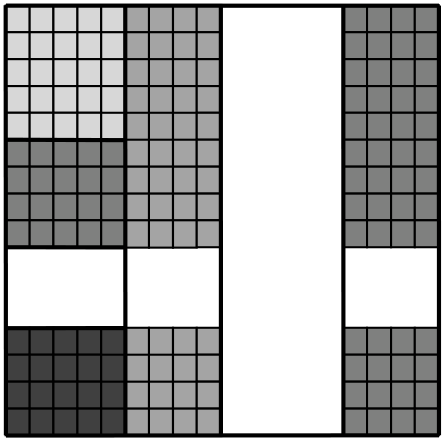
a) Hence, is odd and greater than . Let us show that any such odd satisfies the condition. It is clear that any stripe can be covered by rectangles . For and the required coverage is shown on Fig. 7–8. For any odd and it is sufficient to cut the square into a square or and several stripes (Fig. 9).
Fig. 9
b) Let us show that by a similar scheme we can cover squares and . For this, it is sufficient to cover and . Then, each of the above size can be cut into a square or and several stripes (Fig. 10–11).
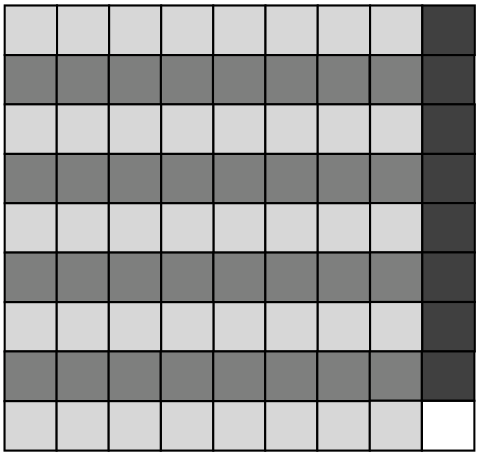
Now, let us show that squares and cannot be covered according to the condition. For the square , consider this coloring in black and white squares, as shown in Fig. 12. Out of squares, are black and are white, which means there are more black cells than white ones. Each rectangle inside of this square covers the same number of black and white cells. Therefore, if there existed such coverage, the number of black and white cells would differ only by . For the general case square when , analogous coloring yields more black cells than white cells.
Fig. 10
Analogously, for square , we show the coloring (Fig. 13) with black and white cells, which again means there is no such coverage. And for the case when , the same holds.
a) Hence, is odd and greater than . Let us show that any such odd satisfies the condition. It is clear that any stripe can be covered by rectangles . For and the required coverage is shown on Fig. 7–8. For any odd and it is sufficient to cut the square into a square or and several stripes (Fig. 9).
Fig. 9
b) Let us show that by a similar scheme we can cover squares and . For this, it is sufficient to cover and . Then, each of the above size can be cut into a square or and several stripes (Fig. 10–11).
Now, let us show that squares and cannot be covered according to the condition. For the square , consider this coloring in black and white squares, as shown in Fig. 12. Out of squares, are black and are white, which means there are more black cells than white ones. Each rectangle inside of this square covers the same number of black and white cells. Therefore, if there existed such coverage, the number of black and white cells would differ only by . For the general case square when , analogous coloring yields more black cells than white cells.
Fig. 10
Analogously, for square , we show the coloring (Fig. 13) with black and white cells, which again means there is no such coverage. And for the case when , the same holds.
Final answer
a) Exactly the odd n with n ≥ 5. b) Exactly the odd n with n > 8 and n ≡ 1 or 7 (mod 8), equivalently n = 8m + 9 or n = 8m + 15 for integers m ≥ 0.
Techniques
Coloring schemes, extremal argumentsInvariants / monovariants