Browse · MathNet
Print31st Turkish Mathematical Olympiad
Turkey geometry
Problem
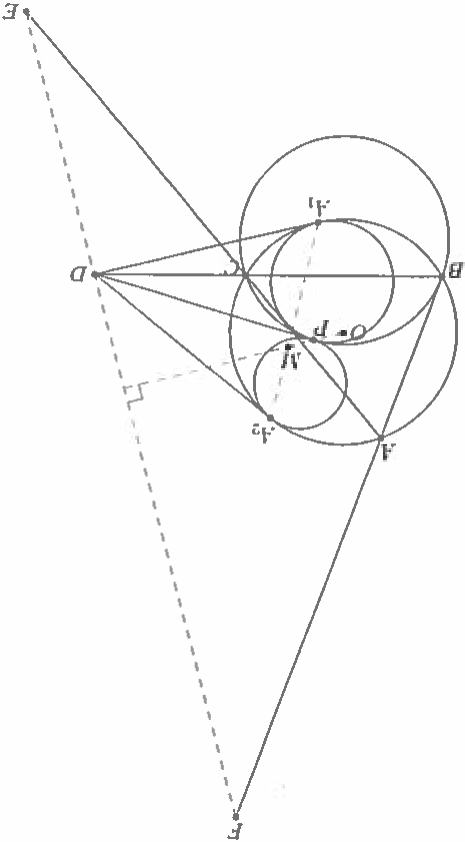
Let be a triangle and let be a point in the interior of this triangle. Let be the circle that is tangent to the circumcircle of at internally and tangent to the circumcircle of at internally. Let be the circle that is tangent to the circumcircle of at externally and tangent to the circumcircle of at internally. Define similarly. Let be the circumcentre of . Prove that the lines and are concurrent.
Solution
From the radical axis theorem on the circles , and , the tangent lines to passing through and intersect on the line , let us say at point . From the radical axis theorem on the circles , and , we see that the line passing through and tangent to the circle passes through as well. Therefore, is the pole of the line . Define the points analogously. Looking at the similarity we have
Therefore, by Menelaus' Theorem we get that the points are collinear. Thus, from La Hire Theorem we can deduce that the lines , and are concurrent. Let the common point of these lines be . Since is the pole of the line we get . Therefore, in order to complete the solution we should prove that are collinear. Hence it suffices to show that is perpendicular to . Let be the circumradius of the triangle . From the power of the point with respect to the circle we have . Similarly, from the power of the point with respect to the circle we get . Hence and we get . We are done.
Therefore, by Menelaus' Theorem we get that the points are collinear. Thus, from La Hire Theorem we can deduce that the lines , and are concurrent. Let the common point of these lines be . Since is the pole of the line we get . Therefore, in order to complete the solution we should prove that are collinear. Hence it suffices to show that is perpendicular to . Let be the circumradius of the triangle . From the power of the point with respect to the circle we have . Similarly, from the power of the point with respect to the circle we get . Hence and we get . We are done.
Techniques
Radical axis theoremPolar triangles, harmonic conjugatesMenelaus' theoremTangents