Browse · MathNet
Print51st Ukrainian National Mathematical Olympiad, 4th Round
Ukraine geometry
Problem
Through a point outside a circle , a tangent and a secant are drawn. intersects at the points and ( is between and ). The tangent to the circle at the point intersects the line segment at the point . is a bisector of the triangle . If the points and are collinear, prove that the product of two side lengths of the triangle equals to the square of the third side length. 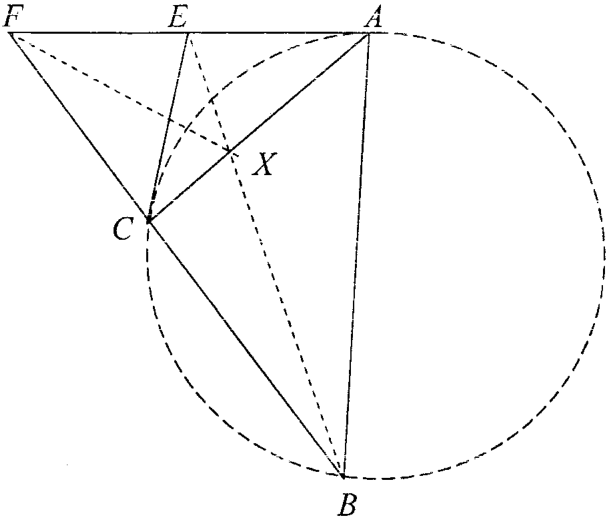 Fig. 31
Solution
We will prove that is a "simedian" of (a cevian symmetric to the median with respect to the bisector, all drawn from the vertex ). By a known property of the "simedian" (which we will also prove) . By the angle bisector theorem for (fig. 31).
is similar to since they have a common angle , and . So, . which provides the required
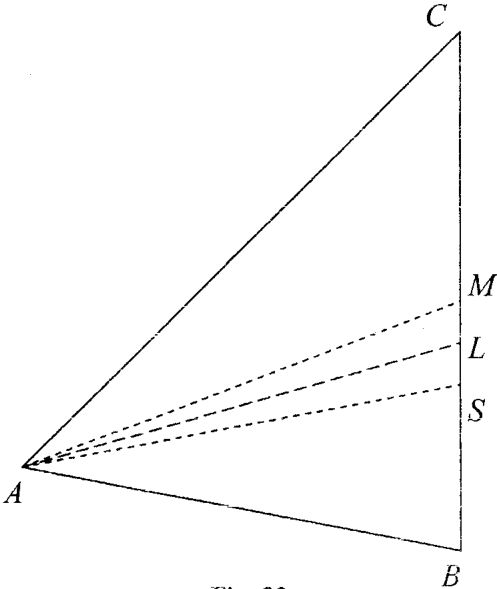
Now we will prove the necessary properties of the “simedian”. 1) Let be the “simedian”, as on fig. 32., be the bisector, — the median of , then . Consider the quotient of the areas of the triangles and : because the angles and are equal (fig. 32). Similarly, consider the areas of the triangles and to obtain that Since is a median, we have that , and so dividing the equalities we get: as required.
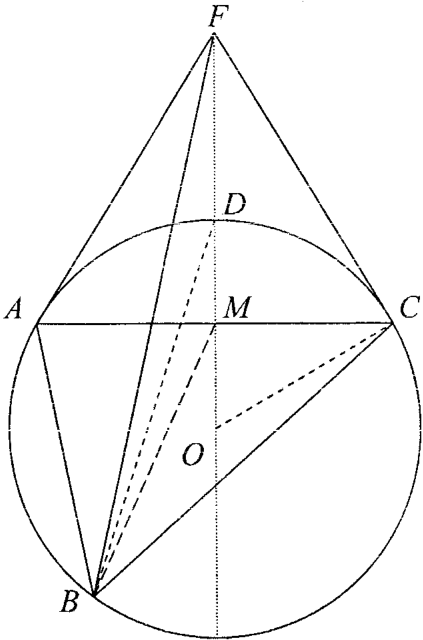
Let be the center of the circle. Then in the right triangle we have , and so Now consider the triangles and . They have a common angle and proportional adjacent sides, hence, they are similar. Let Fig. 32 Fig. 33
then , . This implies (see fig. 33) and by the angle bisector theorem, is the bisector of . This means that the angle between and the bisector equals to the angle between the bisector and the median , and so is indeed a "simedian" of the triangle .
---
Alternative solution.
Alternative solution. Consider the triangle . The points , and are collinear, so, by the Menelaus' theorem, we have Since is the bisector of the angle , we get . , as they are tangents to the same circle from the same point, and from the secant-tangent theorem. So we can rewrite (1) in the form Since , we have . So by the sine theorem for the triangle we get and, on the other hand, by the sine theorem for the triangle Using (2), (3), and (4) together with the sine theorem for the triangle , we obtain which implies the necessary identity.
is similar to since they have a common angle , and . So, . which provides the required
Now we will prove the necessary properties of the “simedian”. 1) Let be the “simedian”, as on fig. 32., be the bisector, — the median of , then . Consider the quotient of the areas of the triangles and : because the angles and are equal (fig. 32). Similarly, consider the areas of the triangles and to obtain that Since is a median, we have that , and so dividing the equalities we get: as required.
Let be the center of the circle. Then in the right triangle we have , and so Now consider the triangles and . They have a common angle and proportional adjacent sides, hence, they are similar. Let Fig. 32 Fig. 33
then , . This implies (see fig. 33) and by the angle bisector theorem, is the bisector of . This means that the angle between and the bisector equals to the angle between the bisector and the median , and so is indeed a "simedian" of the triangle .
---
Alternative solution.
Alternative solution. Consider the triangle . The points , and are collinear, so, by the Menelaus' theorem, we have Since is the bisector of the angle , we get . , as they are tangents to the same circle from the same point, and from the secant-tangent theorem. So we can rewrite (1) in the form Since , we have . So by the sine theorem for the triangle we get and, on the other hand, by the sine theorem for the triangle Using (2), (3), and (4) together with the sine theorem for the triangle , we obtain which implies the necessary identity.
Techniques
Brocard point, symmediansTangentsMenelaus' theoremTriangle trigonometryAngle chasing