Browse · MathNet
PrintEstonian Math Competitions
Estonia counting and probability
Problem
There are sticks of length with a number , or written on each of them. There is an unlimited supply of sticks with every number. Two triangles consisting of three sticks are considered different if neither of the triangles can be composed from sticks of the other triangle.
a. How many different triangles consisting of three sticks are possible?
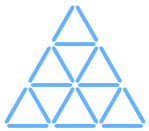
b. From sticks, one makes an equilateral triangle of side length , divided into pairwise different equilateral triangles of side length . Find the largest possible sum of the numbers written on the sticks on the boundary of the big triangle.
a. How many different triangles consisting of three sticks are possible?
b. From sticks, one makes an equilateral triangle of side length , divided into pairwise different equilateral triangles of side length . Find the largest possible sum of the numbers written on the sticks on the boundary of the big triangle.
Solution
a. There are triangles having the same number on each side (, , ). There are triangles having one number on two sides and another number on the third side (, , , , , ). Only triangle has a different number on every side (). Thus there are different triangles consisting of three sticks in total.
b. The largest sum of numbers written on sticks is . Suppose that the sum of the numbers on the sticks on the boundary of the big triangle is . This means that all sticks on the boundary have on it. There are different triangles consisting of three sticks having on some side. As the number of small triangles having a side on the boundary of the big triangle is also , all different triangles consisting of three sticks and having on some side must occur at the corners or in the middle of a side of the big triangle. As one of these triangles has on every side, but not all sides of a small triangle can lie on the boundary of the big triangle, at least one stick with number lies in the interior of the big triangle. The other small triangle with this stick as a side lies entirely in the interior of the big triangle. This contradicts the previously proved claim that all triangles consisting of three sticks and having on one side lie on the boundary of the big triangle. The contradiction shows that the sum is impossible.
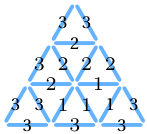
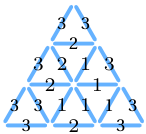
Figure 24 shows that the sum can be .
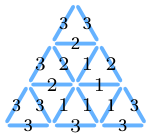
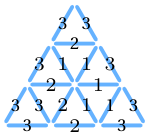
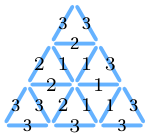
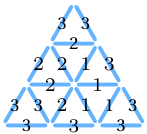
Any of Figures 25, 26, 27, 28 and 29 shows that the sum can be .
Remark: Figures 24–29 contain all possibilities, modulo rotations and reflections, for obtaining the sum .
---
Alternative solution.
a. The question of the problem is equivalent to the question how many three-digit numbers whose each digit is , or and digits are in non-decreasing order do there exist. There are such numbers (, , , , , , , , , ).
b. The largest sum of numbers written on sticks is . Suppose that the sum of the numbers on the sticks on the boundary of the big triangle is . This means that all sticks on the boundary have on it. In all triangles consisting of three sticks, the number occurs times in total. To have occurrences on the boundary, the triangle with on every side must definitely be used. As not all sides of a small triangle can lie on the boundary of the big triangle, at least one stick with number lies in the interior of the big triangle. Thus all occurrences must be used. But the stick in the interior of the big triangle and having on it is a side of another triangle entirely in the interior of the big triangle, whence we have occurrences of when counted by triangles. The contradiction shows that the sum is impossible.
Any of Figures 25, 26, 27, 28 and 29 shows that the sum can be .
Remark: Figures 24–29 contain all possibilities, modulo rotations and reflections, for obtaining the sum .
b. The largest sum of numbers written on sticks is . Suppose that the sum of the numbers on the sticks on the boundary of the big triangle is . This means that all sticks on the boundary have on it. There are different triangles consisting of three sticks having on some side. As the number of small triangles having a side on the boundary of the big triangle is also , all different triangles consisting of three sticks and having on some side must occur at the corners or in the middle of a side of the big triangle. As one of these triangles has on every side, but not all sides of a small triangle can lie on the boundary of the big triangle, at least one stick with number lies in the interior of the big triangle. The other small triangle with this stick as a side lies entirely in the interior of the big triangle. This contradicts the previously proved claim that all triangles consisting of three sticks and having on one side lie on the boundary of the big triangle. The contradiction shows that the sum is impossible.
Figure 24 shows that the sum can be .
Any of Figures 25, 26, 27, 28 and 29 shows that the sum can be .
Remark: Figures 24–29 contain all possibilities, modulo rotations and reflections, for obtaining the sum .
---
Alternative solution.
a. The question of the problem is equivalent to the question how many three-digit numbers whose each digit is , or and digits are in non-decreasing order do there exist. There are such numbers (, , , , , , , , , ).
b. The largest sum of numbers written on sticks is . Suppose that the sum of the numbers on the sticks on the boundary of the big triangle is . This means that all sticks on the boundary have on it. In all triangles consisting of three sticks, the number occurs times in total. To have occurrences on the boundary, the triangle with on every side must definitely be used. As not all sides of a small triangle can lie on the boundary of the big triangle, at least one stick with number lies in the interior of the big triangle. Thus all occurrences must be used. But the stick in the interior of the big triangle and having on it is a side of another triangle entirely in the interior of the big triangle, whence we have occurrences of when counted by triangles. The contradiction shows that the sum is impossible.
Any of Figures 25, 26, 27, 28 and 29 shows that the sum can be .
Remark: Figures 24–29 contain all possibilities, modulo rotations and reflections, for obtaining the sum .
Final answer
a: 10, b: 26
Techniques
Recursion, bijectionCounting two ways