Browse · MathNet
Print66th Belarusian Mathematical Olympiad
Belarus geometry
Problem
We say that a diagonal of a convex hexagon is good if it divides the hexagon into two circumscribed quadrilaterals. Find the greatest number of good diagonals in a convex hexagon.
Solution
Answer: 1.
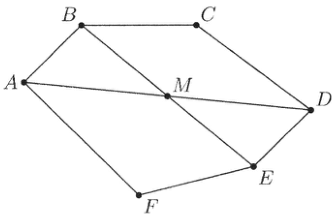
Show that among any two intersecting main diagonals of the hexagon at most one diagonal can be good. Suppose, contrary to our claim, that there are two good intersecting main diagonals. Without loss of generality, we assume that and are good diagonals of the hexagon (see Fig. 1). Then and are circumscribed quadrilaterals, therefore the sums of their opposite sides are equal. Hence, , . Summing both the equalities we obtain Let be the intersection point of and . Then by the triangle inequality we have contrary to (1).
Fig. 1 Fig. 2
If the diagonal of the hexagon divides it into two quadrilaterals, then this diagonal connects two opposite vertices of the hexagon ("main" diagonal). But any two such diagonals intersect each other, hence the hexagon has at most one good diagonal.
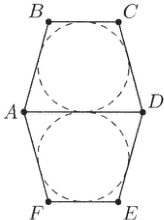
There are many ways to construct the hexagon with one good diagonal. For example, we draw the circle and circumscribe the trapezoid , , (see Fig. 2). Let and be symmetric to and , respectively, with respect to the line . It is evident that is a good diagonal of the hexagon .
Show that among any two intersecting main diagonals of the hexagon at most one diagonal can be good. Suppose, contrary to our claim, that there are two good intersecting main diagonals. Without loss of generality, we assume that and are good diagonals of the hexagon (see Fig. 1). Then and are circumscribed quadrilaterals, therefore the sums of their opposite sides are equal. Hence, , . Summing both the equalities we obtain Let be the intersection point of and . Then by the triangle inequality we have contrary to (1).
Fig. 1 Fig. 2
If the diagonal of the hexagon divides it into two quadrilaterals, then this diagonal connects two opposite vertices of the hexagon ("main" diagonal). But any two such diagonals intersect each other, hence the hexagon has at most one good diagonal.
There are many ways to construct the hexagon with one good diagonal. For example, we draw the circle and circumscribe the trapezoid , , (see Fig. 2). Let and be symmetric to and , respectively, with respect to the line . It is evident that is a good diagonal of the hexagon .
Final answer
1
Techniques
Inscribed/circumscribed quadrilateralsTriangle inequalitiesConstructions and loci