Browse · MathNet
PrintBalkan Mathematical Olympiad
geometry
Problem
Let be a quadrilateral, let be the intersection point of diagonals and , and let be the intersection point of sides and . Consider the parallelograms and . Prove that , and are collinear.
Solution
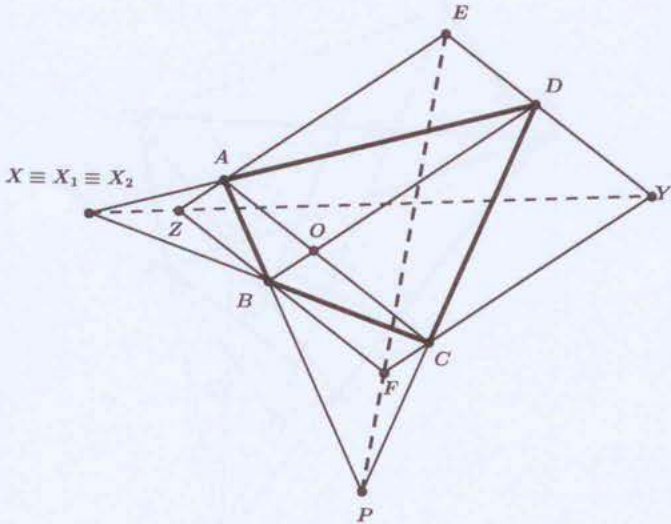
Figure 1 Clearly, is a parallelogram. Let and .
From Menelaos Theorem in triangle and the line it follows hence In similar way, from Menelaos Theorem in triangle and the line we get From (1) and (2) it follows that lines and intersect line in the same point, hence we have . This implies the collinearity of the points , , , and we are done.
---
Alternative solution.
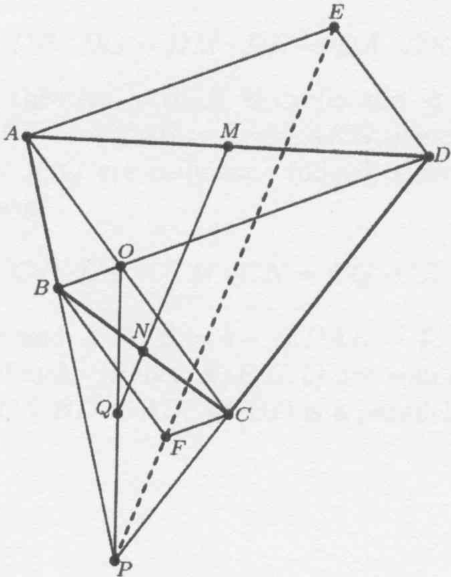
Let and be the midpoints of the sides and , respectively, and let be the midpoint of the segment (Figure 2). Considering the homothecy , it is clear that the points , , are collinear if and only if points , , are collinear. Figure 2
Now, we know that we have the Newton-Gauss line of a complete quadrilateral for any permutation of the vertices of the quadrilaterals. In our situation we are looking for the Newton-Gauss line of the quadrilateral defined by the following points: 1. the midpoint of "diagonal" , 2. the midpoint of "diagonal" , 3. the midpoint of the segment determined by the intersections of the "opposite sides" (, ) and (, )
From Menelaos Theorem in triangle and the line it follows hence In similar way, from Menelaos Theorem in triangle and the line we get From (1) and (2) it follows that lines and intersect line in the same point, hence we have . This implies the collinearity of the points , , , and we are done.
---
Alternative solution.
Let and be the midpoints of the sides and , respectively, and let be the midpoint of the segment (Figure 2). Considering the homothecy , it is clear that the points , , are collinear if and only if points , , are collinear. Figure 2
Now, we know that we have the Newton-Gauss line of a complete quadrilateral for any permutation of the vertices of the quadrilaterals. In our situation we are looking for the Newton-Gauss line of the quadrilateral defined by the following points: 1. the midpoint of "diagonal" , 2. the midpoint of "diagonal" , 3. the midpoint of the segment determined by the intersections of the "opposite sides" (, ) and (, )
Techniques
Menelaus' theoremHomothety