Browse · MathNet
PrintSingapore Mathematical Olympiad (SMO)
Singapore geometry
Problem
Determine all real numbers between and such that it is possible to partition an equilateral triangle into finitely many triangles, each of which has an angle of .
Solution
Consider the sum of the angles of the triangles at each type of the vertices. At type 0, the sum is . At type 1, the sum is . At type 2, the sum is . Therefore Now each Type 1 vertex has at most 1 angle of and each Type 2 vertex has at most 2 which each Type 0 vertex has, none. So the number of angles of is , a contradiction.
Now we construct for each . It is trivial for . Take the centre of the triangle and join it to the vertices to obtain a partition into 3 congruent triangles. Now assume .
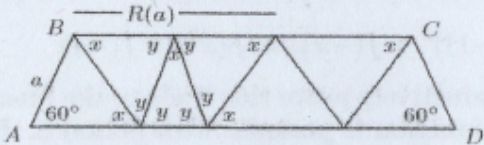
Define an -trapezium to be the trapezium with , , . Then it follows that . We call a polygon -good if it can be partitioned into triangles each with one angle.
Lemma 1: There exists such that an -trapezium is -good when . Proof: The proof is clear from Fig. A. The second, third and fourth triangles are isosceles. The fifth and sixth triangles form a parallelogram with arbitrarily long horizontal side.
Fig.A
Fig.B
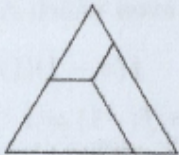
Lemma 2: An -trapezium is -good. Proof: It follows from the fact that the trapezium can be sliced into arbitrarily thin -trapezium so that . (See Fig. B.) Since an equilateral triangle can be partitioned in -trapeziums, the proof is complete.
Now we construct for each . It is trivial for . Take the centre of the triangle and join it to the vertices to obtain a partition into 3 congruent triangles. Now assume .
Define an -trapezium to be the trapezium with , , . Then it follows that . We call a polygon -good if it can be partitioned into triangles each with one angle.
Lemma 1: There exists such that an -trapezium is -good when . Proof: The proof is clear from Fig. A. The second, third and fourth triangles are isosceles. The fifth and sixth triangles form a parallelogram with arbitrarily long horizontal side.
Fig.A
Fig.B
Lemma 2: An -trapezium is -good. Proof: It follows from the fact that the trapezium can be sliced into arbitrarily thin -trapezium so that . (See Fig. B.) Since an equilateral triangle can be partitioned in -trapeziums, the proof is complete.
Final answer
0 < x ≤ 120
Techniques
Angle chasingConstructions and loci