Browse · MathNet
PrintEstonian Mathematical Olympiad
Estonia geometry
Problem
Inside a regular hexagon , equal rectangles , , and are drawn. How much of the area of the hexagon do these rectangles cover? 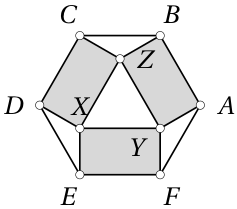
Solution
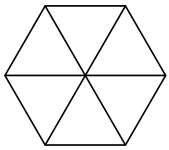
Each interior angle of a regular hexagon has a size of . Thus, a regular hexagon can be divided into equilateral triangles with side lengths equal to the hexagon itself (Fig. 23). Denoting the area of such a triangle as , the area of the hexagon is therefore .
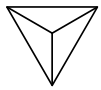
The opposite sides of a rectangle are of equal length. Hence , and , so is also an equilateral triangle with the same side length. Since the rectangles , and are equal, the triangles , and are isosceles. Their bases are the sides of the hexagon, the base angle is and the vertex angle is . Thus, it is possible to form one equilateral triangle from these three triangles, whose side length is equal to the side length of the hexagon (Fig. 24).
In total, the area not covered by the rectangles is . Therefore, the total area of the rectangles is , which is of the area of the hexagon.
Fig. 23 Fig. 24
The opposite sides of a rectangle are of equal length. Hence , and , so is also an equilateral triangle with the same side length. Since the rectangles , and are equal, the triangles , and are isosceles. Their bases are the sides of the hexagon, the base angle is and the vertex angle is . Thus, it is possible to form one equilateral triangle from these three triangles, whose side length is equal to the side length of the hexagon (Fig. 24).
In total, the area not covered by the rectangles is . Therefore, the total area of the rectangles is , which is of the area of the hexagon.
Fig. 23 Fig. 24
Final answer
2/3
Techniques
Triangle trigonometryAngle chasingConstructions and loci