Browse · MathNet
PrintIMO 2016 Shortlisted Problems
2016 geometry
Problem
Let be the incentre of a non-equilateral triangle , be the -excentre, be the reflection of in , and be the reflection of line in . Define points and line analogously. Let be the intersection point of and .
a. Prove that lies on line where is the circumcentre of triangle .
b. Let one of the tangents from to the incircle of triangle meet the circumcircle at points and . Show that .
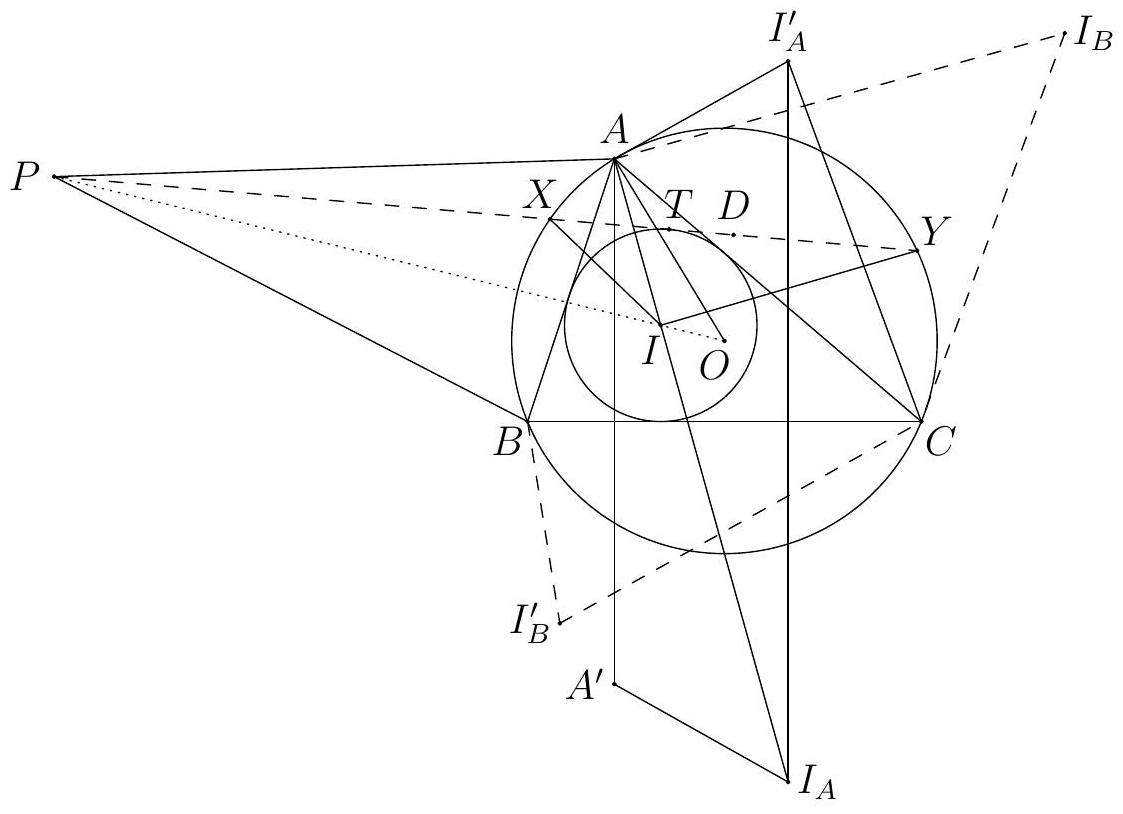
a. Prove that lies on line where is the circumcentre of triangle .
b. Let one of the tangents from to the incircle of triangle meet the circumcircle at points and . Show that .
Solution
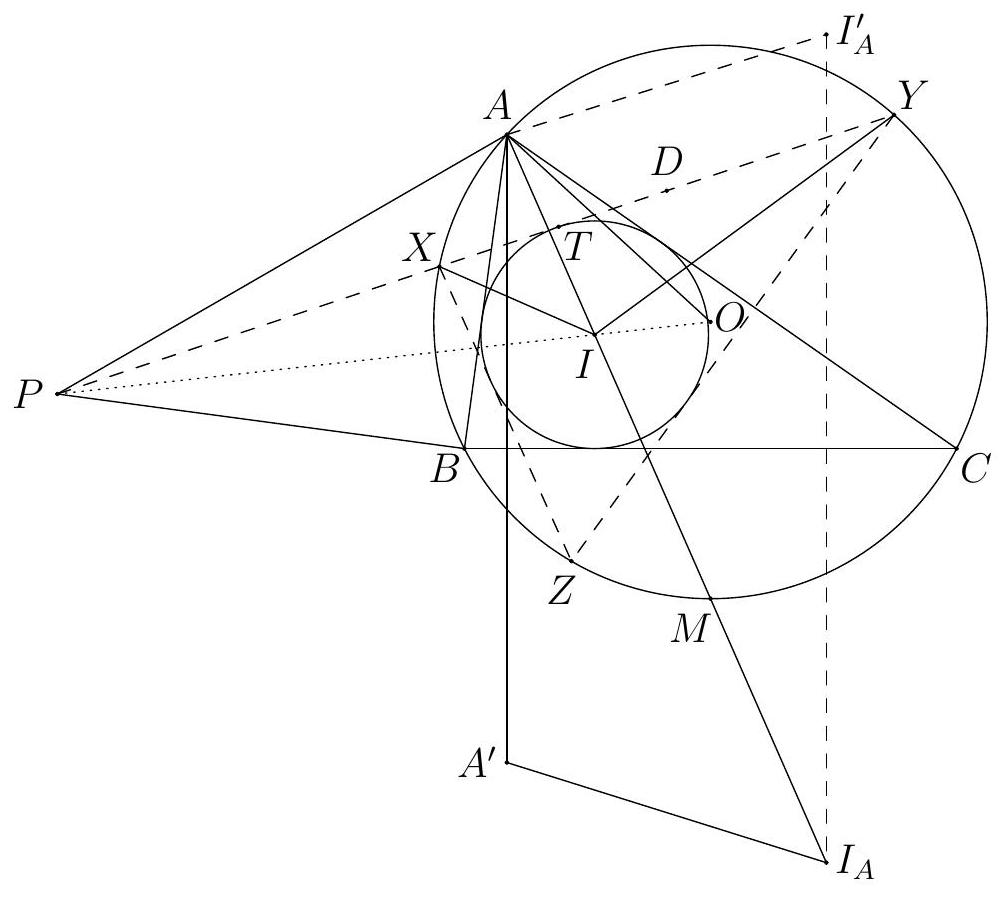
a. Let be the reflection of in and let be the second intersection of line and the circumcircle of triangle . As triangles and are isosceles with , they are similar to each other. Also, triangles and are similar. Therefore we have Together with , we find that triangles and are similar. Denote by the intersection of line and line . Using directed angles, we have This shows are concyclic. Denote by and the circumradius and inradius of triangle . Then is independent of . Hence, also meets line at the same point so that , and lies on .
b. By Poncelet's Porism, the other tangents to the incircle of triangle from and meet at a point on . Let be the touching point of the incircle to , and let be the midpoint of . We have This shows and hence .
---
Alternative solution.
a. Note that triangles and are similar since their corresponding interior angles are equal. Therefore, the four triangles , , and are all similar. From , we get . From and , the triangles and are directly similar. Consider the inversion with centre and radius followed by the reflection in . Then and are mapped to each other, and and are mapped to each other. From the similar triangles obtained, we have so that is mapped to under the transformation. In addition, line is mapped to the altitude from , and hence is mapped to the reflection of in , which we call point . Note that is an isosceles trapezoid, which shows it is inscribed in a circle. The preimage of this circle is a straight line, meaning that are collinear.
b. Denote by and the circumradius and inradius of triangle . Note that by the above transformation, we have and . Therefore, we find that This shows , and it follows that and are mapped to each other under the inversion with respect to the circumcircle of triangle . Then , which is the power of with respect to , equals . This yields are concyclic. Let be the touching point of the incircle to , and let be the midpoint of . Then This shows and hence .
b. By Poncelet's Porism, the other tangents to the incircle of triangle from and meet at a point on . Let be the touching point of the incircle to , and let be the midpoint of . We have This shows and hence .
---
Alternative solution.
a. Note that triangles and are similar since their corresponding interior angles are equal. Therefore, the four triangles , , and are all similar. From , we get . From and , the triangles and are directly similar. Consider the inversion with centre and radius followed by the reflection in . Then and are mapped to each other, and and are mapped to each other. From the similar triangles obtained, we have so that is mapped to under the transformation. In addition, line is mapped to the altitude from , and hence is mapped to the reflection of in , which we call point . Note that is an isosceles trapezoid, which shows it is inscribed in a circle. The preimage of this circle is a straight line, meaning that are collinear.
b. Denote by and the circumradius and inradius of triangle . Note that by the above transformation, we have and . Therefore, we find that This shows , and it follows that and are mapped to each other under the inversion with respect to the circumcircle of triangle . Then , which is the power of with respect to , equals . This yields are concyclic. Let be the touching point of the incircle to , and let be the midpoint of . Then This shows and hence .
Techniques
Triangle centers: centroid, incenter, circumcenter, orthocenter, Euler line, nine-point circleInversionTangentsCyclic quadrilateralsAngle chasingIsogonal/isotomic conjugates, barycentric coordinates