Browse · MathNet
PrintSELECTION EXAMINATION
Greece geometry
Problem
Let an equilateral triangle of side . Let , and the midpoints of the sides , and , respectively. Let the symmetric point of with respect to the line . We color the points , , , , , , using one of the two colors = red and = blue.
a. Find how many equilateral triangles are defined with vertices from the seven points , , , , , , .
b. Prove that, if the points and will be colored with the same color, then for every coloring of the remaining points there exists an equilateral triangle with vertices from the points , , , , , , whose all vertices have the same color.
c. Can we have the same conclusion, if the points and will be colored by different colors?
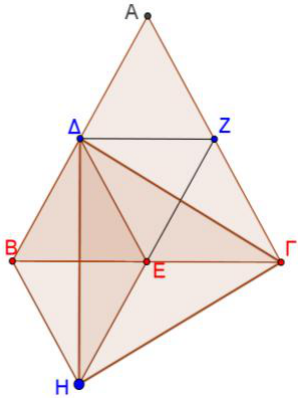
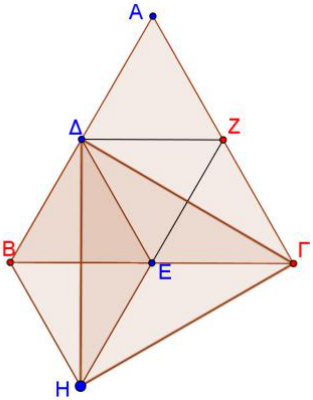
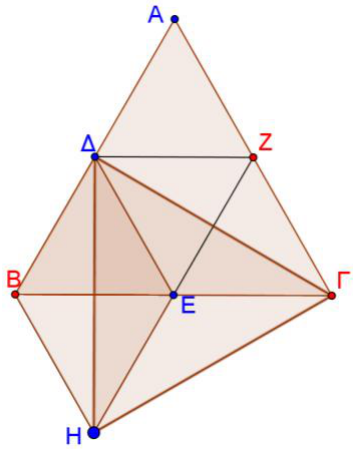
a. Find how many equilateral triangles are defined with vertices from the seven points , , , , , , .
b. Prove that, if the points and will be colored with the same color, then for every coloring of the remaining points there exists an equilateral triangle with vertices from the points , , , , , , whose all vertices have the same color.
c. Can we have the same conclusion, if the points and will be colored by different colors?
Solution
a. There are defined totally seven equilateral triangles from the given points. Since the seven equilateral triangles are Figure 7 Figure 8 , , , , , (symmetric of with respect to the line ), (it has = altitude of equilateral triangle, ).
b. Let and are colored red. If the points or are also red, then we have the wanted triangle. Suppose that and are colored blue. If the point is blue then we are done. Let the point is colored red. If the point is colored red, then the triangle has its vertices red. Let point is colored blue. In that case for any coloring of one of the triangles , will have its vertices of the same color. Figure 9
c. In that case we have not the same conclusion. In figure 9 we give a coloring with all equilateral triangles having their vertices with different colors. The points , , have been colored red and the remaining points blue.
b. Let and are colored red. If the points or are also red, then we have the wanted triangle. Suppose that and are colored blue. If the point is blue then we are done. Let the point is colored red. If the point is colored red, then the triangle has its vertices red. Let point is colored blue. In that case for any coloring of one of the triangles , will have its vertices of the same color. Figure 9
c. In that case we have not the same conclusion. In figure 9 we give a coloring with all equilateral triangles having their vertices with different colors. The points , , have been colored red and the remaining points blue.
Final answer
a) 7; b) Yes; c) No
Techniques
HomothetyAngle chasingDistance chasingColoring schemes, extremal arguments