Browse · MathNet
PrintAPMO
geometry
Problem
Let be a positive integer. Consider distinct lines on the plane, no two of which are parallel. Of the lines, are colored blue, the other are colored red. Let be the set of all points on the plane that lie on at least one blue line, and the set of all points on the plane that lie on at least one red line. Prove that there exists a circle that intersects in exactly points, and also intersects in exactly points.
Solution
Consider a line on the plane and a point on it such that is not parallel to any of the lines. Rotate about counterclockwise until it is parallel to one of the lines. Take note of that line and keep rotating until all the lines are met. The lines are now ordered according to which line is met before or after. Say the lines are in order . Clearly there must be such that and are of different colors.
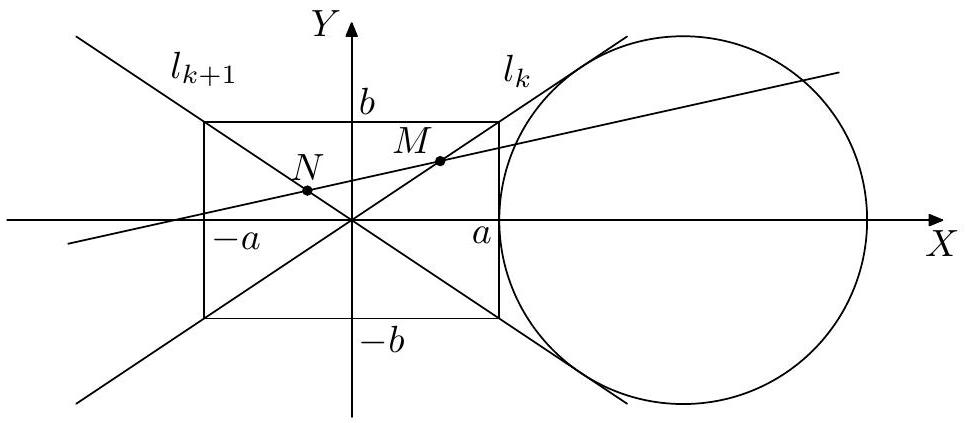
Now we set up a system of - and -axes on the plane. Consider the two angular bisectors of and . If we rotate counterclockwise, the line will be parallel to one of the bisectors before the other. Let the bisector that is parallel to the rotation of first be the -axis, and the other the -axis. From now on, we will be using the directed angle notation: for lines and , we define to be a real number in denoting the angle in radians such that when is rotated counterclockwise by radians, it becomes parallel to . Using this notation, we notice that there is no such that is between and .
Because the lines are distinct, the set of all the intersections between and () is a finite set of points. Consider a rectangle with two opposite vertices lying on and the other two lying on . With respect to the origin (the intersection of and ), we can enlarge the rectangle as much as we want, while all the vertices remain on the lines. Thus, there is one of these rectangles which contains all the points in in its interior. Since each side of is parallel to either - or -axis, is a part of the four lines , where .
Consider the circle tangent to the right of the side of the rectangle, and to both and . We claim that this circle intersects in exactly points, and also intersects in exactly points. Since is tangent to both and and the two lines have different colors, it is enough to show that intersects with each of the other lines in exactly 2 points. Note that no two lines intersect on the circle because all the intersections between lines are in which is in the interior of .
Consider any line among these lines. Let intersect with and at the points and , respectively ( and are not necessarily distinct). Notice that both and must be inside . There are two cases:
(i) intersects on the side once and another time on side; (ii) intersects and sides.
However, if (ii) happens, and would be both positive, and then would be between and , a contradiction. Thus, only (i) can happen. Then intersects in exactly two points, and we are done.
Alternative solution:
By rotating the diagram we can ensure that no line is vertical. Let be the lines listed in order of increasing gradient. Then there is a such that lines and are oppositely coloured. By rotating our coordinate system and cyclically relabelling our lines we can ensure that are listed in order of increasing gradient, and are oppositely coloured, and no line is vertical.
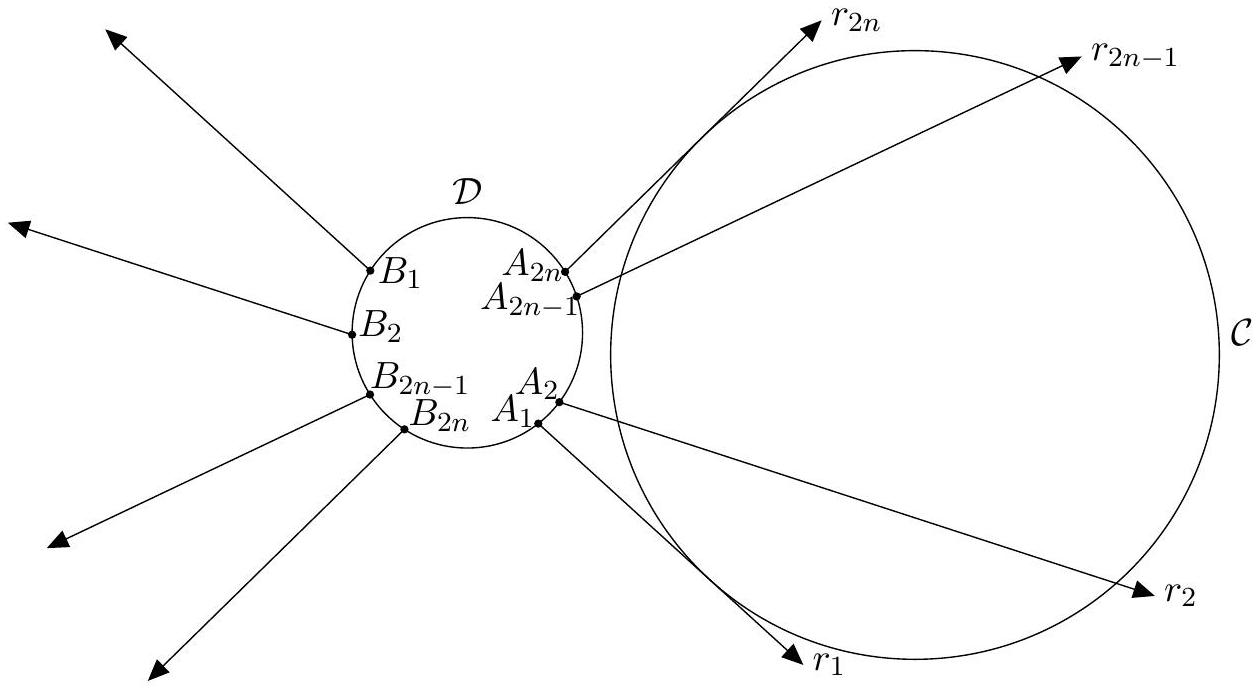
Let be a circle centred at the origin and of sufficiently large radius so that - All intersection points of all pairs of lines lie strictly inside ; and - Each line intersects in two points and , say, such that is on the right semicircle (the part of the circle in the positive half-plane) and is on the left semicircle.
Note that the anticlockwise order of the points around is . (If occurred before then rays and (as defined below) would intersect outside .)
For each , let be the ray that is the part of the line starting from point and that extends to the right. Let be any circle tangent to and , that lies entirely to the right of . Then intersects each of twice and is tangent to and . Thus has the required properties.
Now we set up a system of - and -axes on the plane. Consider the two angular bisectors of and . If we rotate counterclockwise, the line will be parallel to one of the bisectors before the other. Let the bisector that is parallel to the rotation of first be the -axis, and the other the -axis. From now on, we will be using the directed angle notation: for lines and , we define to be a real number in denoting the angle in radians such that when is rotated counterclockwise by radians, it becomes parallel to . Using this notation, we notice that there is no such that is between and .
Because the lines are distinct, the set of all the intersections between and () is a finite set of points. Consider a rectangle with two opposite vertices lying on and the other two lying on . With respect to the origin (the intersection of and ), we can enlarge the rectangle as much as we want, while all the vertices remain on the lines. Thus, there is one of these rectangles which contains all the points in in its interior. Since each side of is parallel to either - or -axis, is a part of the four lines , where .
Consider the circle tangent to the right of the side of the rectangle, and to both and . We claim that this circle intersects in exactly points, and also intersects in exactly points. Since is tangent to both and and the two lines have different colors, it is enough to show that intersects with each of the other lines in exactly 2 points. Note that no two lines intersect on the circle because all the intersections between lines are in which is in the interior of .
Consider any line among these lines. Let intersect with and at the points and , respectively ( and are not necessarily distinct). Notice that both and must be inside . There are two cases:
(i) intersects on the side once and another time on side; (ii) intersects and sides.
However, if (ii) happens, and would be both positive, and then would be between and , a contradiction. Thus, only (i) can happen. Then intersects in exactly two points, and we are done.
Alternative solution:
By rotating the diagram we can ensure that no line is vertical. Let be the lines listed in order of increasing gradient. Then there is a such that lines and are oppositely coloured. By rotating our coordinate system and cyclically relabelling our lines we can ensure that are listed in order of increasing gradient, and are oppositely coloured, and no line is vertical.
Let be a circle centred at the origin and of sufficiently large radius so that - All intersection points of all pairs of lines lie strictly inside ; and - Each line intersects in two points and , say, such that is on the right semicircle (the part of the circle in the positive half-plane) and is on the left semicircle.
Note that the anticlockwise order of the points around is . (If occurred before then rays and (as defined below) would intersect outside .)
For each , let be the ray that is the part of the line starting from point and that extends to the right. Let be any circle tangent to and , that lies entirely to the right of . Then intersects each of twice and is tangent to and . Thus has the required properties.
Techniques
TangentsRotationCartesian coordinatesConstructions and lociAngle chasing